
In this article
When a Lakewood Ranch driver gets rear-ended on University Parkway, they don't open the Yellow Pages — they open Google. That moment, repeated thousands of times a month across Sarasota and Manatee County, is exactly why SEO for law firms Sarasota has become the highest-leverage marketing channel in the legal industry. The firms showing up in the Map Pack and the top three organic results are capturing the lion's share of qualified case inquiries, while everyone else fights over scraps in paid ads. This guide breaks down exactly how to build that visibility — and how to measure whether it's translating into signed cases.
Most Sarasota firms believe paying more for ads equals more cases. But the firms winning the phone calls are the ones quietly compounding organic visibility — and they're paying less per signed case every quarter.
Questions This Guide Answers
- Why do Sarasota law firms with strong organic visibility consistently outperform those relying on ads alone?
- Which on-page and off-page signals actually move the needle in the Sarasota legal market?
- How do you measure SEO ROI in a way that connects rankings to signed retainers?
Key Findings
- Law firms investing in SEO see an average 526% ROI over three years — a return that compounds long after the initial work is done.
- Google Business Profile optimization is the single highest-leverage tactic for Sarasota firms, driving the majority of high-intent "lawyer near me" clicks.
- Hyper-local practice area pages (e.g., "Personal Injury Lawyer Bradenton") outperform generic "Sarasota lawyer" pages on both ranking and conversion.
How We Built This Guide
This guide synthesizes published legal marketing benchmarks, Google's local search documentation, and patterns we've seen working with professional service firms across Sarasota and Manatee County. Where we cite a specific number, we link it to its source. Where we share a tactic, we explain the mechanism — not just the buzzword — so you can evaluate whether it fits your firm's practice areas and competitive position.
1. Why SEO for Law Firms Sarasota Is a Different Game
Legal is one of the most expensive verticals on Google. In personal injury and family law, single keyword clicks routinely cross $100 in paid auctions, and a single mis-targeted campaign can burn a month's marketing budget before lunch on a Friday. That economic pressure is why organic visibility matters so much: every signed case from organic isn't a one-time win, it's a click you don't have to keep buying.
Layered on top of that is the Florida Bar. Rules around advertising, "specialist" language, testimonials, and case results are stricter than what dentists, realtors, or contractors deal with. A page that converts beautifully in another industry can trigger a complaint if it runs in a Sarasota firm's domain without the right disclaimers. Good SEO copy for law firms is written with compliance baked in, not bolted on after the fact.
The Sarasota market itself adds nuance. Established firms downtown have decades of brand authority, but the corridor running through Lakewood Ranch, Bradenton, and Venice is growing fast — and Google's local algorithm rewards firms that build relevance for those specific submarkets before the incumbents do. That's the window most firms are missing. Start with the local SEO fundamentals for Sarasota and Manatee County before chasing broad statewide terms.
- Compliance-first SEO copy avoids costly Bar complaints while still converting.
- Niche down by practice area and neighborhood before trying to rank for broad terms.
2. Local Intent: Why 46% of Searches Decide Your Caseload
| Factor | Broad Statewide SEO | Local Sarasota/Manatee SEO |
|---|---|---|
| Search intent match | Low | High |
| Competition level | Very high | Moderate |
| Conversion to consultations | Weak | Strong |
| Bar compliance risk | Higher | Manageable |
| Best for / When to choose | Multi-office statewide firms | Solo & small firms targeting local clients |
When someone types "divorce attorney Sarasota" or "car accident lawyer near me," they aren't researching — they're hiring. The window between that query and a signed retainer is often measured in hours. Google knows it, which is why local-intent searches surface the Map Pack first, pushing the traditional ten blue links below the fold on most phones.
That layout has consequences. If your firm isn't in the top three local results, you're effectively invisible to the segment of the market most likely to convert today. Paid ads sit above the Map Pack, but the click-through patterns on legal queries skew strongly toward the organic local results because users learned long ago that "Ad" labels mean someone is buying their attention.
Google ranks the Map Pack on three pillars: proximity (how close is the searcher to your office), relevance (does your profile and website actually match the query), and prominence (reviews, citations, links, brand mentions). All three are controllable. None of them happen by accident.
- Optimize for "near me" and city + practice area queries first.
- Local intent rewards proximity, relevance, and prominence — all three are controllable.
3. Google Business Profile: The Highest-ROI SEO Services for Law Firms

If you do nothing else this quarter, fix your Google Business Profile. Claim it, verify it, and complete every field — categories that match your actual practice areas, hours including after-hours intake lines, service areas that explicitly list Sarasota, Bradenton, Lakewood Ranch, and Venice, and clean, high-resolution photos of your office, your team, and the courthouses you actually walk into. Sterile stock photography signals nothing; an attorney standing in front of the Sarasota County Courthouse signals everything.
Publish a GBP post every week. Community sponsorships, bar association involvement, a legal update on a recent Florida statute, a compliant note about a verdict — these aren't just content, they're freshness signals telling Google you're active. Dormant profiles drift down the Map Pack quietly, and most firms don't notice until the phone stops ringing.
Reviews are the single biggest lever in the prominence pillar. Build a systematic ask into your client closeout process — a short text message with a direct link works better than business cards left on a desk. Volume matters, but so do recency and your response rate. A profile with 180 reviews and an attorney replying personally within 48 hours beats a profile with 400 reviews and silence. Use the Q&A feature proactively too: seed the questions every caller already asks ("Do you offer free consultations?" "Do you handle cases on contingency?") with answers that comply with Bar rules.
- A well-maintained GBP often outranks a firm's own website for branded and near-me searches.
- Photos with geotagged metadata reinforce your physical presence in Sarasota.
For the deeper mechanics, see our complete Google Business Profile playbook.
4. Local Citations Drive 45% Higher CTR — Here's How to Build Them
Citations are mentions of your firm's Name, Address, and Phone number (NAP) across legal and general directories — Avvo, Justia, FindLaw, Martindale-Hubbell, Super Lawyers, Yelp, the Better Business Bureau, and a long tail of niche legal aggregators. Each one is a small vote of confidence that your firm is real, located where you say it is, and reachable at the number you publish.
The problem is drift. A missing suite number on Avvo, an old phone number on the BBB from before you switched intake systems, an abbreviated street name on Yelp — Google sees inconsistency and quietly downgrades trust. The fix is unglamorous: audit your top 25 citations every quarter, fix mismatches manually where the tools can't, and standardize one canonical NAP format you use everywhere, including your website footer and your LegalService schema markup.
Prioritize legal directories over generic ones. Avvo, Martindale-Hubbell, Super Lawyers, Justia, and FindLaw carry more topical authority for legal queries than a random business directory, and they often surface directly in branded searches for your firm. Tools like BrightLocal or Moz Local can automate detection, but expect to spend a few hours manually cleaning up the legal-specific listings — they often require attorney verification before they'll accept edits.
- Standardize one canonical NAP format and use it everywhere — including your website footer and schema markup.
- New office location? Update citations within 30 days to avoid ranking dips.
5. Practice Area Pages: Where SEO Services for Law Firms Pay Off Hardest
The single biggest mistake Sarasota firms make is dumping every practice area onto one "Areas We Serve" page. Google has nothing specific to rank, and prospects find nothing specific to their situation. The fix is the opposite extreme: a dedicated, in-depth page for every practice area and city combination you actually serve. "Personal Injury Lawyer Sarasota." "Family Law Attorney Bradenton." "Estate Planning Lawyer Venice." "Motorcycle Accident Lawyer Lakewood Ranch."
Each page should answer the questions a real prospect asks at 11pm the night of an incident: what do I do right now, how long does this process take, what does it cost, what makes your firm different. Generic boilerplate fails on both counts — it doesn't rank because Google sees it everywhere, and it doesn't convert because the reader doesn't feel understood.
Layer in local trust signals that no out-of-market competitor can copy. Name the courthouses you practice in — Sarasota County Courthouse, Manatee County Judicial Center, the Twelfth Judicial Circuit. Reference the local context: hurricane-season property claims, snowbird estate planning, the specific intersections where rear-end collisions cluster. Add team bios with Florida Bar credentials and admission years. Wrap the whole page in proper schema markup (LegalService, Attorney, FAQPage) so Google can parse and surface it in rich results.
- Generic "Sarasota lawyer" pages convert poorly. Specific "Bradenton motorcycle accident lawyer" pages convert because they match the searcher's exact problem.
- Aim for 1,200–2,000 words per practice area page, with original photography and clear CTAs.
For context on how practice area SEO fits into a wider plan, our broader Sarasota digital marketing strategy walks through the channel mix.
6. What a High-Converting Sarasota Law Firm Website Looks Like
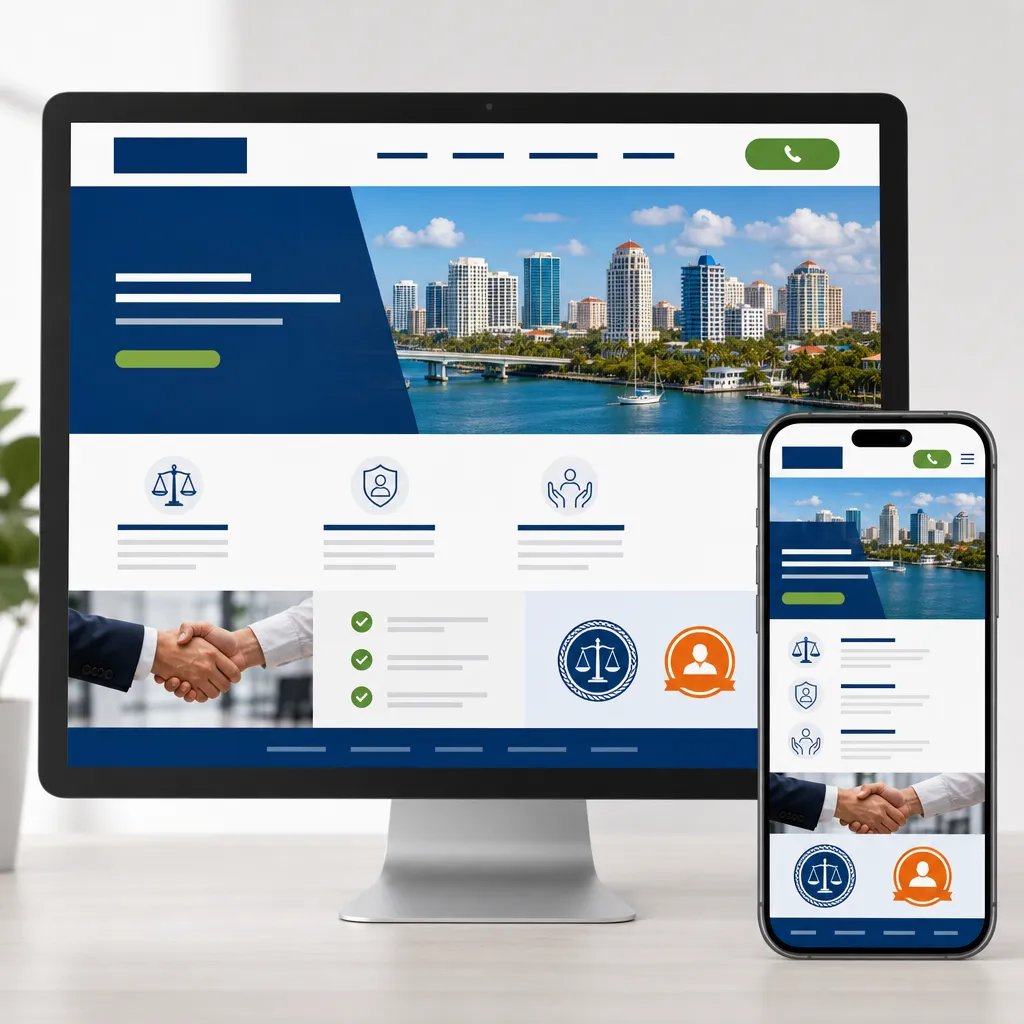
Mobile-first isn't a design preference for legal — it's the reality of the medium. The majority of legal searches happen on phones, often within minutes of an accident, an arrest, or a family crisis. If your site doesn't load fast, render cleanly on a 5-inch screen, and put a tap-to-call button above the fold on every page, you're leaking cases regardless of how high you rank.
Trust signals do the silent work of conversion. Florida Bar certifications, peer-review awards like Super Lawyers and Martindale's AV rating, verified Google reviews pulled in via widget — these aren't decoration. They're the cues a stressed prospect uses to decide whether to dial or keep scrolling. Display them prominently near the top of the page, not buried in a sidebar.
Page speed is a confirmed Google ranking factor through Core Web Vitals, but the bigger story is the conversion impact. Aim for a Largest Contentful Paint under 2.5 seconds. Compress hero images. Lazy-load anything below the fold. And give every practice area page its own form — not a generic contact form that pipes every lead into the same inbox with no context about what they came in searching for. The intake team works faster, and your attribution data actually means something.
- Every practice area page needs its own form — not a generic "Contact Us" that funnels all leads to the same inbox.
- A/B test headlines and CTAs continuously; small changes can lift conversion 20%+.
7. Measuring ROI: From Rankings to Signed Cases (and Notes on Medical SEO Sarasota)
| Métrica | Valor |
|---|
Here's the analogy that reframes the whole conversation for most managing partners: PPC is renting a billboard on I-75 — the moment you stop paying, the billboard goes blank. SEO is buying the land underneath it. The upfront work is heavier, but a year in, you own the visibility, and every click that comes through is essentially free. That's why the cost-per-signed-case curve looks so different between the two channels by month nine or twelve.
To prove it, you need attribution. Install call tracking through a platform like CallRail or WhatConverts and assign dynamic numbers to every channel — organic, GBP, Google Ads, Facebook, referrals. Tag form submissions with the practice area and the source page. Now when you sit down at the end of a quarter, you can answer the only question that matters: how many signed cases came from organic, and what did each one cost.
Over three years, well-executed SEO typically delivers around 526% ROI for law firms. That's the benchmark to hold your agency or internal team accountable to. If your monthly report only shows keyword rankings, ask for case attribution next quarter — and if they can't deliver it, that's a signal in itself. The same playbook, incidentally, applies to adjacent verticals. Medical SEO Sarasota practices — orthopedic groups, plastic surgeons, urgent care chains — use identical Map Pack tactics, hyper-local landing pages, and citation hygiene to capture local patient demand. The mechanics don't change much across regulated, high-intent service categories.
Picture a mid-sized Sarasota personal injury firm ranking #2 in the Map Pack for "car accident lawyer Sarasota." Their GBP carries 180 reviews averaging 4.9 stars, they run eight practice area pages targeting specific injury types and neighborhoods, and their citations are consistent across 40 directories. They pull in 60+ qualified case inquiries per month organically — at a fraction of what a competing firm spends on Google Ads to generate the same volume. That gap is the asset SEO builds.
- Review attribution monthly, optimize quarterly, expect compounding returns by month 9–12.
- If your agency only reports rankings, ask them for case attribution next quarter.
For a side-by-side on timing and return, see how SEO and PPC compare on speed and ROI.
What This Means for Sarasota Law Firm Partners and Marketing Leads
- Treat your Google Business Profile like a high-traffic landing page — it likely is the first impression more than half your prospects ever see of your firm.
- Stop measuring SEO by keyword rankings. Start measuring it by signed cases and cost per acquisition, then hold your agency or in-house team to that standard.
- Build hyper-local content around specific neighborhoods (Lakewood Ranch, Venice, Bradenton, Siesta Key) and practice areas. The firms doing this are quietly winning the next decade of legal search.
Keep Learning
- Local SEO Services for Sarasota & Manatee County Growth — Deeper dive into Map Pack ranking factors, GBP optimization, and the local signals Google uses to rank professional service firms across Sarasota and Bradenton.
- Sarasota PPC Agency: Get Faster ROI on Google & Facebook Ads — When SEO is the long game, PPC fills the gap. Learn how to balance both channels for predictable case flow while your organic visibility compounds.
- Top Digital Marketing Agency in Sarasota & Manatee County — How SEO fits into a broader Sarasota marketing strategy spanning paid ads, social, and conversion optimization for service-based businesses.
- Sarasota Home Service: Turn Website Visitors into Booked Calls — A conversion-focused breakdown that translates well to law firm intake: how to turn local search traffic into actual booked consultations.
Frequently Asked Questions
How long does SEO take to generate signed cases for a Sarasota law firm?
Map Pack movement on Google Business Profile work can show up in 30–60 days, but the compounding return on practice area pages and citations typically lands between months six and twelve. By month nine, most well-executed campaigns are producing a measurable, attributable flow of signed cases at a falling cost per acquisition.
Is SEO better than Google Ads for law firms in Sarasota?
They solve different problems. Google Ads delivers cases this week but stops the moment you pause spend. SEO takes months to build but produces compounding inquiries that don't reset to zero. Most firms we work with run both: PPC for predictable near-term volume, SEO for long-term cost efficiency and brand authority.
How many practice area pages should my firm have?
One dedicated page per practice area, ideally multiplied by the cities you actively serve — Sarasota, Bradenton, Lakewood Ranch, Venice, North Port. A firm handling personal injury, family law, and estate planning across four cities could reasonably support 12 well-developed practice area pages, each 1,200–2,000 words.
Do Google reviews really affect my Map Pack ranking?
Yes — review volume, recency, star average, and your response rate all feed Google's prominence signal. Firms in the top three Map Pack positions for competitive Sarasota legal queries almost always have 100+ recent reviews and a visible attorney responding within a day or two.
Can I do SEO for my law firm in-house, or do I need an agency?
Google Business Profile maintenance, review requests, and basic content updates can absolutely live in-house if someone owns them weekly. Technical SEO, schema implementation, citation cleanup, and ongoing content production usually justify outside help — the time savings and attribution rigor tend to pay for themselves within two or three signed cases.