
In this article
Google Ads Management in Lakewood Ranch: Drive ROI with Local PPC
Google Ads management in Lakewood Ranch requires more than just launching campaigns and hoping for leads. Lakewood Ranch is one of the fastest-growing master-planned communities in the U.S., attracting affluent homeowners, business owners, and service-seekers with a median household income of $118,092. This high-value market is also highly competitive. Without a data-driven, localized approach to paid search — precise geo-targeting to specific villages and zip codes, deep keyword intent analysis, and transparent ROI tracking — even well-intentioned campaigns leak budget and deliver poor returns. This guide walks you through what professional Google Ads management actually looks like, month-to-month, and how to evaluate whether a PPC partner is truly optimizing for your bottom line.
Here's the uncomfortable truth most agencies won't say out loud: a majority of local business owners in this market are quietly bleeding money on clicks that never had a chance of converting — not because they're bad at marketing, but because nobody built a strategy around Lakewood Ranch's specific geography, income bracket, and search behavior. The fix isn't a bigger budget. It's a sharper one.
The Questions Every Lakewood Ranch Business Owner Asks Before Investing in PPC
Before committing budget to paid search, most owners want straight answers to three things: What should I actually spend? What am I paying an agency for, month after month? And how soon will I know if it's working? These aren't unreasonable questions — they're the right ones. The problem is that most agency sales pitches dodge them in favor of vague promises about "visibility" and "growth."
- How much should a local business in Lakewood Ranch budget for Google Ads to see meaningful results?
- What does a PPC agency actually do month-to-month to justify ongoing management fees?
- How quickly can I expect to see results, and what metrics should I be tracking instead of just clicks?
The rest of this guide answers each of these directly, with the actual mechanics of how a results-focused PPC ad management process works — not agency jargon.
What the Data Says About Google Ads ROI in a Market Like This
Before diving into process, it's worth grounding expectations in what actually happens when Google Ads campaigns are managed professionally versus left on autopilot. Four findings shape everything that follows in this guide.
- Businesses earn an average of $2 in revenue for every $1 spent on Google Ads — but only when campaigns are professionally managed with a focus on cost per acquisition (CPA) and conversion rate, not click volume.
- Lakewood Ranch's 19% five-year population growth and $118,092 median household income make it a lucrative but crowded market; success depends on hyper-local geo-targeting to avoid wasting budget on irrelevant clicks.
- 76% of people who search for local services on mobile visit a business within 24 hours, validating the power of intent-driven keyword targeting for urgent, high-conversion searches like "emergency plumber near me."
- Effective PPC management requires a structured, month-by-month process: discovery and audit, localized keyword research, campaign build-out, bid and budget optimization, and transparent ROI reporting.
Methodology
This guide synthesizes industry benchmarks on Google Ads ROI, demographic and growth data specific to Lakewood Ranch and the Sarasota-Bradenton MSA, and mobile search behavior research. We evaluated the professional PPC management process through the lens of local business owners — focusing on questions about budget, speed to results, and ROI metrics that matter. All statistics are drawn from verified sources; estimates are clearly marked. The structure reflects the real month-by-month workflow of a results-focused PPC agency, not agency marketing jargon.
1. Why Google Ads Management in Lakewood Ranch Demands a Localized Strategy
Lakewood Ranch didn't become one of the country's fastest-growing master-planned communities by accident, and its growth curve is exactly why generic Google Ads campaigns fail here. New residents arrive with money to spend and immediate needs — HVAC installers, dentists, real estate agents, home service contractors — and every one of those service categories is now more crowded than it was five years ago. That combination of affluence and rapid population growth is a magnet for aggressive advertisers, many of whom are bidding on the same keywords from outside the area, or even from other states, without any regard for whether their service actually reaches a Lakewood Ranch address.
This is the core reason broad, untargeted campaigns waste money in this market: a click from someone in Tampa or another state doesn't convert into a job in Lakewood Ranch, no matter how relevant the keyword looked on paper. Precision geo-targeting — down to specific villages and zip codes like 34202 and 34211, not just "Sarasota area" — is non-negotiable if you want your ad spend to reach people who can actually become customers. And local search behavior in this market skews heavily toward high-intent, mobile-first, time-sensitive queries: plumbers, HVAC technicians, medical providers, and real estate agents all compete for searches where the person typing is ready to act within hours, not weeks.
- Lakewood Ranch median household income ($118,092) indicates premium service pricing and higher customer lifetime value — your ad spend can be more aggressive if targeted correctly.
- The Sarasota-Bradenton MSA is competitive; without localization, your budget competes against regional and national advertisers bidding on the same keywords.
- Affluent audiences in Lakewood Ranch expect polished landing pages and clear value; generic ad copy and poor UX kill conversions even with good traffic.
Businesses just south of the community line face a nearly identical dynamic — if you're weighing your options across the broader region, our guide to Google Ads management in Bradenton covers how the same localization principles play out in a slightly different competitive landscape.
2. The Month-by-Month Google Ads Management Process: What Professional PPC Agencies Do
One of the most common frustrations business owners voice is not knowing what they're actually paying for each month. A management fee that just covers "running the ads" feels like a black box — and frankly, at a lot of agencies, it is one. A legitimate PPC ad management process follows a recognizable arc, and knowing what each phase should look like lets you hold your agency accountable.
Think of the whole arrangement the way you'd think about a ship's navigation. Without professional Google Ads management, your ad spend is like sailing without a map or compass — you're moving forward, but you don't know if you're headed toward land or open ocean. A PPC agency acts as your navigator: they read the market through keyword research, set the course through campaign strategy, monitor the instruments (CPA, ROAS, conversion rate), and adjust sails in real time through bid optimization. The destination — ROI — matters far more than the speed, measured in raw clicks.
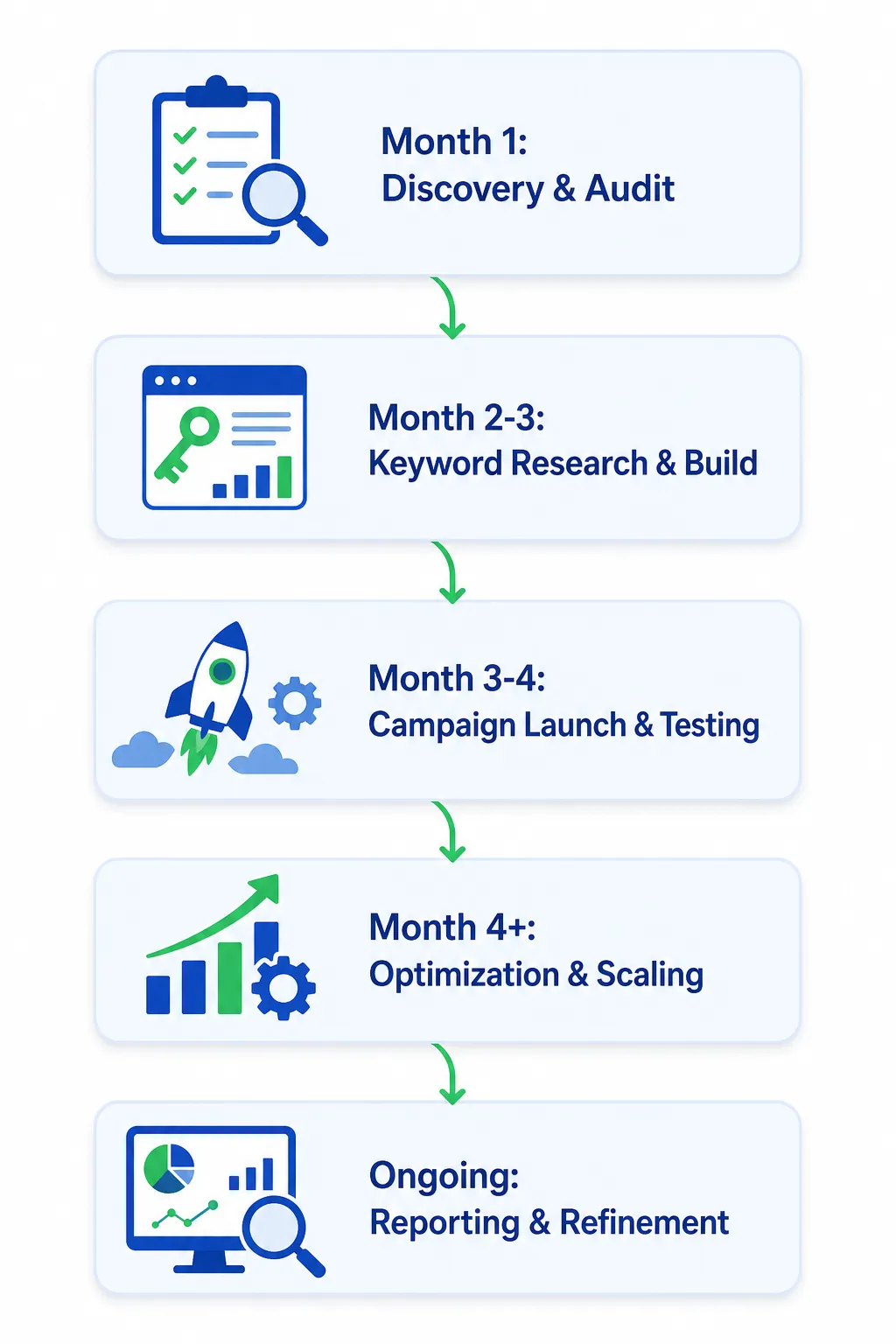
Month 1 — Discovery, Audit & Market Research. The agency reviews your current digital footprint, analyzes competitor PPC strategies, maps your actual service area, and identifies high-intent keywords unique to Lakewood Ranch. This is unglamorous work, but it's the foundation everything else sits on.
Month 2–3 — Localized Keyword Research & Campaign Structure. This is where a keyword list gets built that separates high-intent terms like "emergency plumber Lakewood Ranch" from broad, low-intent terms that just burn budget. Ad groups get organized by service, geography, and buyer stage — not lumped together in one generic campaign.
Month 3–4 — Campaign Launch & Initial Testing. Bids get set, budget gets allocated across campaigns, ads go live, and the team monitors quality score, click-through rate, and early conversion signals to catch problems before they compound.
Month 4+ — Optimization & Scaling. Low-performing keywords get paused, budget shifts toward high-ROAS keywords, ad copy and landing pages get refined based on real data, and bids adjust as patterns emerge.
Ongoing — Transparent Reporting. Monthly dashboards should show CPA, conversion rate, ROAS, and cost per lead, along with a candid discussion of what's working and what still needs adjustment.
- A true management fee (typically 15–25% of ad spend, or a flat monthly retainer) reflects the time and expertise required to run this process, not a markup on ad clicks.
- Many agencies skip or rush the discovery and keyword research phases — this is where localized strategy is built, and skipping it leads to wasted spend.
- Expect 30–60 days before seeing meaningful conversion data; jumping to conclusions too early leads to poor budget decisions.
Want to see how this process plays out across the broader region, including agencies that bundle PPC with other channels? Our Best Digital Marketing Near Me: Sarasota & Manatee Guide walks through how to compare providers side by side.
3. Paid Google Advertising for Local Businesses: ROI Metrics That Matter More Than Clicks
Here's where most agency-client relationships go wrong: the report shows clicks, impressions, and click-through rate, and everyone nods along because the numbers look busy. But none of those metrics pay your bills. Given that 76% of local searchers visit a business within 24 hours, every click on a well-targeted campaign represents someone close to a decision — which means the quality of that click matters far more than the quantity.
| Metric | Vanity / Not Reliable | ROI-Focused / What to Track |
|---|---|---|
| Click Volume | 100 clicks = success (?)—but if 70 are outside your service area, you've wasted 70% of spend | ✓ Cost per click + geographic origin; refine geo-targeting to eliminate waste |
| Impressions & CTR | 10,000 impressions sounds impressive; high CTR feels good but doesn't pay rent | ✓ Quality score and landing page relevance; focus on cost per lead or conversion |
| Cost Per Acquisition (CPA) | Often ignored or buried in agency reports | ✓ CRITICAL: If your average sale is $5K and CPA is $300, ROAS is 16.7:1 — that's healthy |
| Conversion Rate | 2% sounds low — but if your landing page is poor, it's a red flag, not your audience | ✓ Track by keyword, ad group, and landing page; test and iterate to improve |
| Return on Ad Spend (ROAS) | Agency says "spend is going well" without showing revenue | ✓ ESSENTIAL: Revenue generated ÷ ad spend; benchmark: $2–3 ROAS is solid for most local services |
| What to demand | Avoid agencies that lead with clicks and impressions | ✓ Demand monthly reports with CPA, conversion rate, and ROAS; track lead quality and close rates |
Cost per acquisition tells you the true cost of a lead. If your sales team closes 20% of leads at an average sale of $5K, a $250 CPA is excellent — it means every closed deal is generating revenue many multiples above what you spent to acquire it. Conversion rate by keyword reveals which searches actually drive results: "emergency plumber near me" might convert at a strong clip, while a research-stage term like "plumbing tips" barely converts at all. And ROAS is the bottom line — if you spend $10K and generate $20K in revenue, your ROAS is 2:1, which lines up with the broader industry benchmark of roughly $2 back for every $1 spent when campaigns are managed well.
None of this works, though, if the landing page can't close the deal. Landing page quality, mobile responsiveness, and call-to-action clarity directly impact conversion rate — a modest improvement in conversion rate can meaningfully change the math on your entire campaign's ROI.
- Ask your PPC agency to break down CPA by keyword and service type; if they can't or won't, that's a red flag.
- Track lead quality alongside quantity — a lower CPA on more leads is worse than a higher CPA on fewer leads if the latter group closes at a higher rate.
- Many businesses don't tie Google Ads data to actual revenue; work with your agency to set up conversion tracking that matches your sales process (lead form, phone call, purchase).
4. PPC Ad Management: Geo-Targeting Precision and Keyword Strategy for Lakewood Ranch
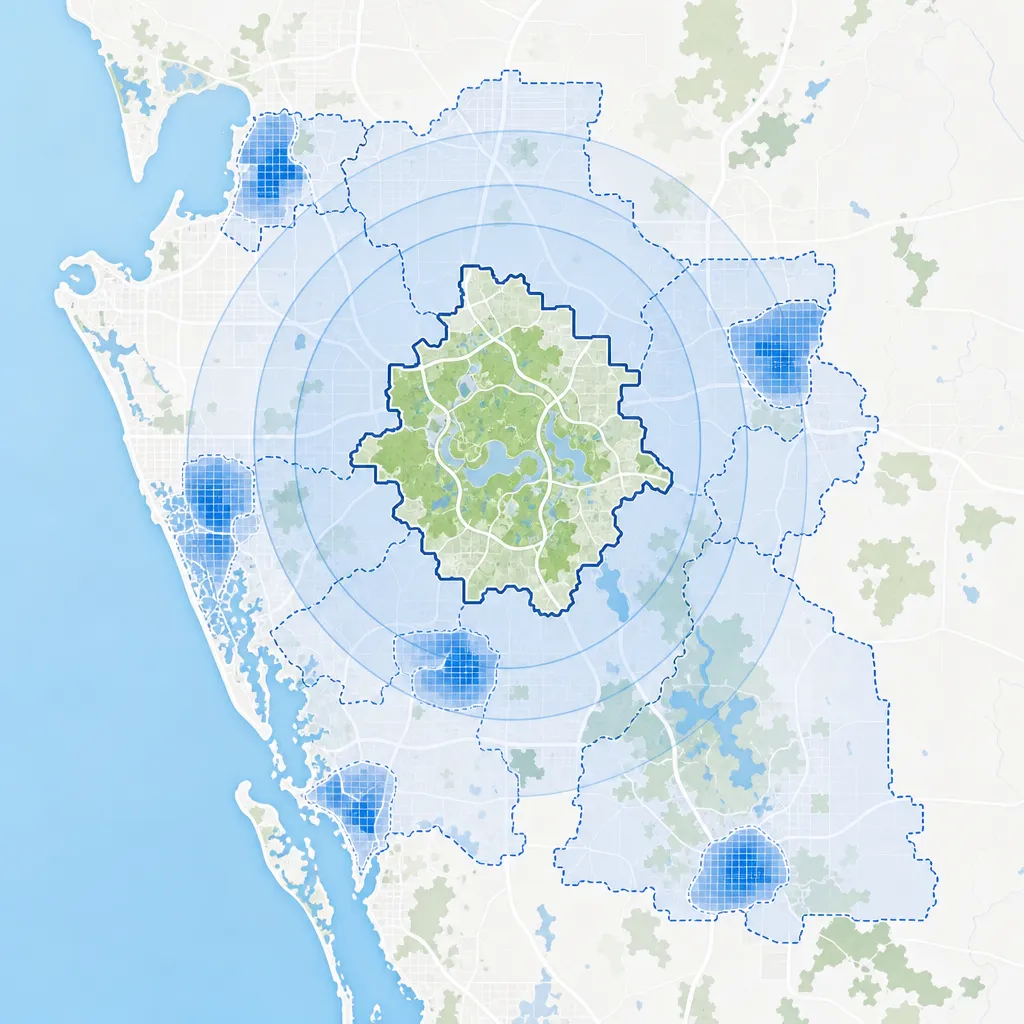
Geo-targeting is where theory turns into practice. At the campaign settings level, this means setting ad delivery to Lakewood Ranch, specific zip codes like 34202 and 34211, and any nearby towns your service area genuinely extends into — while explicitly excluding areas you don't serve. Location targeting at the village level, distinguishing "Lakewood Ranch proper" from "Sarasota proper," reduces the pool of competitors you're bidding against and attracts nearby residents who are closer to your business and statistically more likely to convert.
Keyword strategy needs the same precision. Bidding on "plumber" alone puts you in a national bidding war you can't realistically win on cost. Bidding on "emergency plumber Lakewood Ranch," "HVAC repair near me Sarasota," or "dentist accepting new patients Manatee County" narrows the field to searchers who are both local and ready to act. Negative keywords close the other end of the funnel — if you don't offer commercial HVAC service, add it as a negative keyword so your ad budget never gets spent on that mismatch in the first place.
Mobile behavior matters just as much as geography. Lakewood Ranch searchers on smartphones are typically looking for immediate help — "near me," "open now," "same day" — and bidding more aggressively on these urgent, mobile-first terms tends to produce disproportionately better results than treating all keywords equally.
- Competitor geo-targeting: if a competitor is bidding nationally and you're bidding locally, your quality score and relevance often win, allowing you to pay less per click.
- Seasonal adjustments: Lakewood Ranch attracts seasonal residents; adjust geo-targeting and bid strategy in winter versus summer for services like real estate, landscaping, and pool maintenance.
- Use Google Ads location insights (Search Terms Report, Geographic Performance Report) to see where your best customers actually search from, then double down on those zones.
5. Budgeting for Google Ads Services: What Should a Lakewood Ranch Business Spend?
Budget questions rarely have a single right answer, but they do have a right process: start with a realistic audit of your average customer value. If a typical sale is $2K and your close rate is 25%, a $300 CPA makes sense; a $1K CPA does not. Lakewood Ranch's affluent demographic and rapid growth attract competing ads from every direction, so budget accordingly so your ad doesn't get drowned out by better-funded competitors.
| Business Type / Size | Suggested Ad Spend / Month | Typical CPA | Expected Lead Volume |
|---|---|---|---|
| Solo Service Provider (Plumber, Electrician) | $800–$1,500 | $150–$300 | 3–10 leads |
| Small Local Business (10–20 employees) | $1,500–$3,500 | $200–$400 | 8–20 leads |
| Medium Business (20–50 employees, multi-service) | $3,500–$7,000 | $300–$600 | 15–40 leads |
| Real Estate, High-Ticket Services | $5,000–$15,000+ | $500–$1,500+ | 5–30 qualified leads |
| Why it matters | Underfunding ($200–500/mo) rarely produces meaningful leads; overfunding without optimization wastes dollars | CPA depends on market, service type, and landing page quality; higher-ticket services justify higher CPA | Lead volume + conversion rate = revenue; track both to optimize spend |
A test-and-scale approach works best in practice: start at roughly $1,500–$2,500 per month for the first 60 days, measure CPA and conversion rate, and then scale up only once ROAS is positive — at minimum, above 1.5:1. Management fees sit on top of that ad spend, typically 15–25% of ad budget or a flat monthly retainer, and that fee is what pays for the optimization work described in Section 2, not a markup on the clicks themselves.
The turnaround from underfunded DIY campaigns to properly budgeted, managed ones can be dramatic. Consider a small plumbing company in Lakewood Ranch, founded by a solo owner, that had been spending $400 a month on Google Ads through a DIY approach with no geo-targeting at all. Their ad ran nationally; they got roughly 40 clicks a month at $10 per click, but only two of those clicks came from Lakewood Ranch or nearby Sarasota — and neither converted. After switching to a managed PPC agency, they raised their budget to $1,200 a month (agency fee included), set precise geo-targeting to Lakewood Ranch plus a 10-mile radius, and shifted keyword targeting toward high-intent terms like "emergency plumber Lakewood Ranch" and "water heater replacement near me." Within 60 days, they were generating 12 qualified leads a month at a $100 CPA, with 3–4 converting into jobs worth $2K–$3K each. Their ROAS moved from roughly 0.5:1 to around 6:1 — the difference between a campaign that quietly bleeds money and one that funds its own growth.
- Underfunding is the #1 mistake; if you're spending $300/month on Google Ads in a competitive market like Lakewood Ranch, expect minimal results.
- Don't equate "more budget = better results"; a poorly targeted $5K/month campaign wastes more than a well-optimized $1,500/month campaign.
- Track payback period: if your CPA is $300 and average sale is $3K, payback is near-instant; if CPA is $300 and sale is $500, your margins are tight.
Industries like HVAC face some of the steepest competition in this budget conversation — if that's your category, our HVAC Marketing Sarasota guide breaks down keyword strategy and realistic budgets specific to contractors.
6. Choosing a PPC Ads Services Partner: Red Flags and Evaluation Checklist
Vetting a PPC agency is less about credentials on a website and more about how they answer direct questions. Do they have dedicated PPC expertise, or is paid search a side service handled part-time by a generalist juggling five other channels? Ask for two or three local business case studies similar to yours, showing actual CPA, ROAS, and how long it took to optimize the campaign. Transparency on strategy matters too: will they share keyword research, competitor analysis, and the reasoning behind budget allocation, or is it kept a black box?
| Red Flag / Warning Sign | What to Do Instead |
|---|---|
| Agency promises "guaranteed rankings" or "first position" on Google Ads (positions fluctuate based on bid and quality score, not promises) | ✓ Ask for realistic expectations: "What ROAS should we expect in 60 days, and how will we measure it?" |
| Reports focus on clicks, impressions, and CTR (vanity metrics that don't reflect revenue) | ✓ Demand monthly reports showing CPA, conversion rate, ROAS, and cost per lead tied to actual revenue |
| Agency bundles PPC with SEO, web design, social media but doesn't explain how each channel drives ROI (scope creep and buried accountability) | ✓ Ask: "How many dedicated PPC specialists do you have? Do they focus on paid search full-time or part-time?" Dedicated should mean better results |
| Contract locks you in for 12+ months with no performance exit clause (risk is all on you if they underperform) | ✓ Negotiate a 3–6 month contract with a performance review at 60 days; either side can exit if ROAS targets aren't met |
| No initial discovery or audit; they jump straight to campaign launch (signals shallow strategy) | ✓ Insist on a 2–4 week discovery phase; market research, competitor analysis, and keyword planning should precede any ad spend |
| They don't ask about your sales process, close rate, or average customer value (can't optimize CPA if they don't understand your business model) | ✓ A good agency will ask detailed questions and use that data to set CPA targets and landing page optimization priorities |
Technology matters here too: agencies using advanced bid strategies like Smart Bidding, Target CPA, or Target ROAS — with proper setup and enough conversion data feeding the algorithm — tend to outperform those relying purely on manual bid management. And communication cadence should go beyond a monthly PDF; a good partner proactively flags changes, opportunities, and problems as they happen, not 30 days later.
- Interview at least 3 agencies; compare their discovery questions, initial strategy recommendations, and contract terms.
- Ask for references and call them; ask "Did they deliver on their CPA and ROAS promises? Would you rehire them?"
- Verify they're Google Partners or Google Premier Partners; this indicates regular training and access to beta features.
If you're weighing PPC management against a broader web and digital strategy overhaul, our Web Agency Near Me guide covers how to evaluate full-service partners whose landing page and UX work directly multiplies the effectiveness of your ad spend.
What This Means for Your Business
- Lakewood Ranch business owners should expect to invest $1,500–$3,500/month in Google Ads (plus a 15–25% management fee) to generate meaningful leads in a competitive market; underfunding leads to invisibility.
- ROI-focused metrics — CPA, conversion rate, ROAS — are non-negotiable; any agency leading with clicks and impressions is not aligned with your bottom line.
- Localized, precise geo-targeting is the difference between a $100 CPA and a $400 CPA in affluent markets like Lakewood Ranch; a national broad strategy wastes a significant share of budget.
- The first 60 days are a test-and-learn phase; expect optimization, not perfection, on day one. Patience with the process pays dividends.
- Partnering with a dedicated, Lakewood Ranch-aware PPC specialist beats DIY or generalist agencies; market knowledge and ongoing optimization are worth the fee.
Frequently Asked Questions
How much does Google Ads management cost for a small business in Lakewood Ranch?
Most small local businesses should budget $1,500–$3,500 per month in ad spend, plus a management fee of 15–25% of that spend (or a flat monthly retainer). Solo service providers can often start smaller, around $800–$1,500, but should expect a longer ramp to meaningful lead volume.
How long does it take to see results from Google Ads in Lakewood Ranch?
Expect 30–60 days before you have reliable conversion data, since the campaign needs time to gather signals and for automated bidding strategies to learn. Treat the 60-day mark as your first real checkpoint rather than judging performance in week one or two.
What's the difference between clicks and conversions, and why does it matter?
Clicks measure traffic; conversions measure whether that traffic turned into a lead or sale. A campaign can generate hundreds of clicks and still lose money if those clicks come from outside your service area or from low-intent searchers — which is why CPA and ROAS matter far more than click volume.
Do I need geo-targeting if I already serve the whole Sarasota-Bradenton area?
Yes — even a wide service area benefits from village-level and zip-code-level targeting, because it lets you bid more aggressively in high-density zones like Lakewood Ranch proper while dialing back spend in lower-converting areas. Broad targeting without this layering tends to waste budget on the least profitable clicks.
How do I know if my current PPC agency is doing a good job?
Ask for a monthly report broken down by CPA, conversion rate, and ROAS — not just clicks and impressions. If they can't produce that breakdown by keyword and service type, or can't explain their geo-targeting logic, that's a strong signal to look elsewhere.
Keep Learning
- Google Ads Management Bradenton: Drive Real Local Results with Data-Driven PPC — A sister guide to the Lakewood Ranch market, focusing on Bradenton-specific PPC strategy, competitive landscape, and detailed month-by-month optimization workflows for local service businesses.
- Local SEO Bradenton: Drive Foot Traffic & Calls Now — Complements paid search with organic strategies; learn how to combine Google Ads with local SEO (Google Business Profile optimization, citations, reviews) to dominate local search visibility in Manatee County.
- HVAC Marketing Sarasota: A Contractor's Guide to Leads — A deep dive into PPC strategy for one of Lakewood Ranch's most competitive service categories; see real case studies and keyword strategies for HVAC contractors in the Sarasota-Bradenton market.
- Best Digital Marketing Near Me: Sarasota & Manatee Guide 2026 — A comprehensive buyer's guide to evaluating digital marketing agencies in the broader Sarasota-Manatee region; learn how to vet PPC firms, ask the right discovery questions, and benchmark agency performance.
- Web Agency Near Me: How to Choose the Right Sarasota Partner for Your Business — Beyond PPC: a framework for evaluating full-service digital partners, including web design, UX, and conversion optimization — critical components that multiply the effectiveness of your Google Ads investment.
- Medical SEO Sarasota: Get More Patients Finding You Online — For healthcare businesses in Lakewood Ranch and Sarasota; explores localized search strategy and cultural nuances that increase visibility to the area's diverse patient base.