

In this article
Medical SEO Sarasota isn't about vanity metrics. It's about ensuring that when a patient in Bradenton searches for a cardiologist, a resident of North Port needs an orthopedist, or a Spanish-speaking family looks for a family doctor near them, your practice appears first. The healthcare market in Sarasota and Manatee County is growing, competition is intensifying, and patient acquisition through organic search is now non-negotiable. This guide shows healthcare practice owners and office managers how to rank for medical SEO in Sarasota, why it matters more than paid ads, and how to navigate the unique compliance requirements that make healthcare marketing different from every other industry.
Three Questions Every Sarasota Practice Owner Should Be Asking
- Are your potential patients finding you in Google Maps when they search for your specialty locally?
- How do you acquire patients through organic search without violating HIPAA or patient privacy standards?
- What's the real ROI difference between organic patient acquisition and paid advertising in healthcare?
Key Findings
- 77% of patients use search engines before booking a medical appointment, with 63% specifically using "near me" or location-based search terms—meaning local intent dominates healthcare search behavior.
- Google Maps Local Pack captures 40-44% of all clicks for local healthcare searches, making Google Business Profile optimization the single highest-ROI tactic for patient acquisition.
- Patients acquired through organic search have 22-38% higher lifetime value than those acquired through paid ads, driven by initial trust and reduced acquisition friction.
- The Hispanic/Latino population in Manatee County (18.3%) and Sarasota County (10.7%) has grown significantly (48% and 44% respectively), creating urgent demand for bilingual medical SEO strategies.
- 70% of patients read online reviews when choosing a doctor, and 72% will only choose providers with 4-star ratings or higher—making review generation and reputation management critical.
Methodology
This guide combines verified data from healthcare search behavior studies, local market demographic analysis for Sarasota and Manatee County, and case studies from medical practices that have successfully grown patient acquisition through organic search. We focus on measurable outcomes—actual patient bookings and practice growth—rather than generic SEO vanity metrics. All recommendations comply with HIPAA regulations and align with Google's E-E-A-T standards for healthcare content.
1. Why Medical SEO Sarasota Matters More Than Paid Ads for Patient Acquisition
The patient journey rarely starts with a phone call anymore. It starts with a symptom, a nagging pain, or a life event—a new baby, a knee that won't heal, a parent needing a specialist. From there, the patient opens a search engine, types something specific ("orthopedic surgeon Sarasota accepting new patients"), and begins comparing options long before they ever pick up the phone. If your practice doesn't appear in that first search, you don't just lose a click—you lose the patient to whoever does.
This is where medical SEO Sarasota strategies outperform paid advertising over time. Paid ads work like a rented billboard: visible only as long as you keep paying, and every click costs money regardless of whether the patient trusts you yet. Organic rankings work differently. A patient who finds your practice through a search result has already skimmed your services, glanced at your reviews, and formed an initial impression of credibility before they ever dial your number. That pre-existing trust translates directly into lower acquisition friction and, as the data shows, meaningfully higher lifetime value once they become a patient.
Local intent compounds this advantage. With the majority of healthcare searches including a "near me" or location qualifier, patients aren't browsing nationally—they're looking for someone close, available, and reputable in Sarasota or Manatee County specifically. That's a fundamentally local buying decision, and it's one that organic, HIPAA-compliant SEO strategies are built to capture without ever exposing protected patient information.
- Patients who find you through organic search already trust your expertise before they call—they've read your content, reviewed your credentials, and seen your ratings.
- Organic patient acquisition costs less over time than maintaining paid ad spend, making it more sustainable for long-term practice growth.
- Search rankings are a practice asset that compounds; paid ads stop working the moment you stop paying.
None of this means paid campaigns have no place in a Sarasota healthcare practice's marketing mix—many practices combine both to accelerate growth while their organic footprint builds. But treating paid ads as the primary patient acquisition channel, rather than a complement to a strong organic foundation, is one of the most expensive mistakes a practice can make. For a deeper breakdown of the single highest-leverage tactic inside any medical SEO Sarasota strategy, see our Google Business Profile Optimization Sarasota guide.
2. Google Maps Local Pack: Where 40-44% of Healthcare Search Clicks Happen
Open Google on your phone and search "dentist near me" or "pediatrician Sarasota." Before you see a single traditional website listing, you'll see the Local Pack—the map with three highlighted business results, complete with star ratings, hours, and a "Directions" button. For healthcare searches, this block of real estate captures 40-44% of all clicks. It is, without exaggeration, the most valuable digital real estate a Sarasota medical practice can occupy.
Ranking in the Local Pack isn't about luck or budget size—it's about the completeness and activity level of your Google Business Profile (GBP). Google weighs relevance (does your profile match the search intent), distance (how close you are to the searcher), and prominence (your review volume, ratings, and overall online authority). A profile with an accurate specialty category, complete service descriptions, current hours, and a steady stream of recent reviews will consistently outrank a profile that was set up once and never touched again.
The anatomy of a high-ranking healthcare GBP includes a handful of non-negotiables: the correct primary category for your specialty (family medicine, orthopedics, dermatology, dental, etc.), a keyword-rich but natural business description, geo-tagged photos of your actual office and team, and consistent posting—announcements, health tips, or service highlights—at least a few times per month. Local citations, meaning your practice's name, address, and phone number listed consistently across directories like Healthgrades, Zocdoc, and Yelp, also reinforce the trust signals Google uses to rank you locally.
- A strong Google Business Profile is the foundation of all medical SEO; without it, you're invisible to the 63% of patients searching with local intent.
- Review management is continuous: practices that actively encourage patient reviews and respond to them rank higher and acquire more patients.
- Keeping your GBP information accurate (hours, specialty, insurance accepted, languages spoken) directly impacts Local Pack ranking and conversion rates.
We cover the full optimization checklist—including category selection, photo strategy, and posting cadence—in our detailed Google Business Profile optimization guide.
3. Healthcare Marketing Agencies vs. DIY Medical SEO: Know When to Hire Local Expertise
Most generic SEO agencies treat healthcare like any other local business—a plumber, a boutique, a restaurant. That approach fails fast in medicine. A cardiology practice's content needs clinical accuracy and E-E-A-T signals Google specifically scrutinizes for "Your Money or Your Life" (YMYL) topics. A dental practice searching for a dental Google Adwords agency needs someone who understands insurance-driven search behavior and appointment scheduling flows, not a marketer who last worked with a coffee shop. Specialty knowledge, compliance awareness, and patient psychology aren't optional extras in healthcare marketing—they're the entire job.
DIY medical SEO is technically possible, but the hidden costs add up quickly: 20-30+ hours per week of staff or owner time, a slow ramp-up as you learn what actually moves rankings, and real legal exposure if compliance isn't handled correctly from the start. Compare that to hiring a local healthcare marketing agency that already has HIPAA processes, a signed Business Associate Agreement (BAA) template, and existing knowledge of the Sarasota and Manatee County competitive landscape—the ramp-up disappears, and results typically show up in 3–6 months instead of 6–12.
The table below breaks down the real trade-offs across DIY, local specialized agencies, and generic national agencies:
| Criterion | DIY (In-House) | Local Healthcare Agency | Generic National Agency |
|---|---|---|---|
| HIPAA Compliance Setup | High risk; requires legal review & BAA documentation | ✓ Built-in; signed BAA standard | Often missing; compliance not prioritized |
| Local Sarasota/Manatee Market Knowledge | You learn as you go; slow ramp-up | ✓ Deep local knowledge; competitor intelligence | Generic approach; 'one-size-fits-all' tactics |
| Bilingual Content & Marketing | Limited unless you hire Spanish-speaking staff | ✓ Native bilingual team; cultural relevance | Translation-only; lacks cultural nuance |
| Time Investment | 20-30+ hours/week for staff or owner | Outsourced; focus on patient care | Outsourced but less responsive |
| Cost (Monthly) | $2,000–$5,000 (salary + tools) | $1,500–$3,500 (managed service) | $3,000–$8,000 (premium pricing) |
| ROI Timeline | 6–12 months (slow start) | ✓ 3–6 months (established processes) | 4–8 months (generic playbook) |
| Accountability & Reporting | Varies; hard to measure | ✓ Monthly reporting tied to patient acquisition | Metric-focused but not practice-focused |
| Best For | Large multi-location systems with dedicated marketing team | ✓ Solo/small group practices in Sarasota wanting fast, compliant growth | Larger practices with national scope |
Watch for red flags when vetting healthcare marketing agencies: if they don't ask about HIPAA before onboarding, don't offer a BAA, or promise "guaranteed first-page rankings" within weeks, walk away. The same regulatory rigor that matters for healthcare also applies to other regulated professional services—our guide to SEO for law firms Sarasota covers similar trust-and-compliance dynamics if you're evaluating agencies across multiple regulated verticals.
- Any agency handling healthcare marketing without a signed Business Associate Agreement (BAA) is putting your practice at legal and financial risk.
- Local agencies understand Sarasota's patient demographics, competition, and search behavior in ways national agencies never will.
- The fastest path to patient acquisition is hiring a local, bilingual healthcare agency that specializes in your market and complies with HIPAA from day one.
4. Reaching Spanish-Speaking Patients in Sarasota: Bilingual Medical SEO Strategy
The demographic shift in Southwest Florida is one of the most under-addressed opportunities in local healthcare marketing. The Hispanic/Latino population has grown 48% in Manatee County and 44% in Sarasota County, now representing 18.3% and 10.7% of the respective populations. That's not a niche segment—it's a substantial and rapidly expanding patient base, and most practices in the area still market exclusively in English.
Spanish-speaking patients don't just translate their search terms mentally and search in English—many search directly in Spanish, using terms like "ortopeda cerca de mí" or "pediatra en Sarasota que hable español." If your website, Google Business Profile, and local citations exist only in English, you are structurally invisible to a meaningful share of local search demand, regardless of how well your English-language SEO performs.
A real bilingual strategy goes beyond translated web pages. It means a Spanish-language version of your Google Business Profile description and service listings, Spanish-language content that addresses the specific health concerns and cultural context of the community, and genuine engagement—Spanish-language reviews, community partnerships, and messaging that reflects cultural nuance rather than word-for-word translation. Translation alone, without cultural adaptation, often reads as impersonal or even slightly off to native Spanish speakers, undermining the trust you're trying to build.
- Spanish-language medical content on your website ranks in Spanish-language searches and Google Maps Local Pack, capturing an audience your competitors may be ignoring.
- Google Business Profile with Spanish content (name, description, service areas) significantly improves visibility for "near me" searches in Spanish.
- Cultural nuance matters: medical messaging for Spanish-speaking patients often differs from English-language marketing; translation alone is insufficient.
- Local Hispanic community partnerships and Yelp/Google reviews in Spanish build trust faster than paid advertising.
Practices running bilingual campaigns should also track performance separately—language-specific keyword rankings, Spanish-language conversion rates, and inquiry volume by language—so you can see exactly how much of your growth is coming from this segment and adjust investment accordingly.
5. Medical SEO Services: What to Expect From a Results-Driven Healthcare Agency
When evaluating medical SEO services, it helps to understand what a comprehensive engagement actually includes. It's rarely one single tactic—it's a coordinated system where Google Business Profile optimization, technical SEO, and content strategy all feed into Local Pack visibility, which in turn drives patient inquiries, appointment bookings, and ultimately revenue growth.
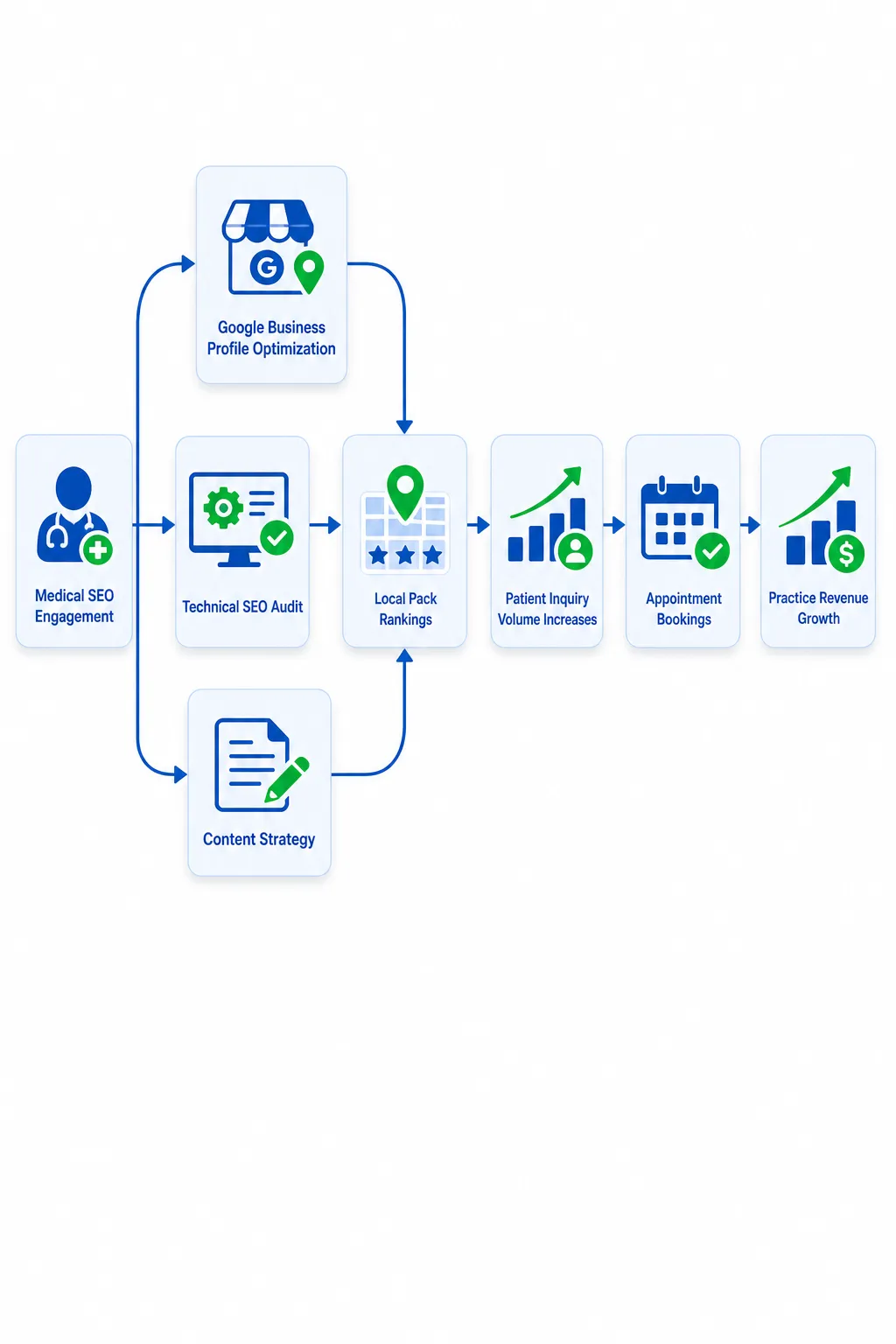
Core services typically include Google Business Profile management, a technical SEO audit of your website (site speed, mobile usability, schema markup for medical practices), ongoing content creation, local citation building, and structured review management. Content creation is where HIPAA compliance most often gets overlooked—every blog post, FAQ page, or patient testimonial needs to be written in a way that avoids exposing Protected Health Information while still meeting Google's E-E-A-T standards for medical content, which increasingly reward content reviewed or written by credentialed practitioners.
Ongoing optimization matters just as much as the initial setup. A capable agency should be monitoring your rankings for the specific medical keywords that matter to your specialty, tracking what competitors are doing in the Local Pack, and adjusting strategy month over month. Just as important: the reporting you receive should tie directly to patient acquisition metrics—inquiries, appointment bookings, cost-per-acquisition, and lifetime value—not just abstract traffic numbers that don't translate into revenue for your practice.
Set realistic timeline expectations from the start. Most practices see measurable Local Pack improvements within 3–6 months, with organic content beginning to drive significant patient volume in the 6–12 month range. Once traffic starts flowing, the next challenge is converting more of those visits into booked appointments—something we cover in depth in our guide to converting website clicks to patient appointments.
- A medical SEO agency should report on patient acquisition metrics, not just traffic and rankings; tie every tactic to revenue impact.
- HIPAA compliance means your content, ads, and data handling meet legal standards; any agency should show you their BAA and data security protocols upfront.
- Results take time: expect 3–6 months for noticeable Local Pack improvements and 6–12 months for organic content to drive significant patient volume.
6. Reviews, Ratings, and Patient Trust: Why 72% of Patients Only Choose 4-Star Doctors

Rankings get you seen; reviews get you chosen. It's tempting to treat these as separate marketing tasks, but for patients, they're inseparable—70% read reviews before booking, and 72% won't consider a provider rated below four stars, regardless of how prominently that practice appears in search results. A high ranking with a mediocre rating is a wasted opportunity; patients will scroll past you for the next listing.
The most effective practices treat review generation as a workflow, not an occasional favor asked of happy patients. That means building the request into an existing touchpoint—an after-visit text message, a follow-up email, or a kiosk at checkout—so it happens consistently rather than sporadically. Consistency also signals "freshness" to Google's ranking algorithm: a steady stream of recent reviews outperforms a large but stagnant review count from years ago.
Managing reviews compliantly requires discipline. Never reference specific treatment details, diagnoses, or any information that could identify a patient in a public response, even when replying to a review the patient themselves wrote. When a negative review appears—and eventually, one will—respond calmly, acknowledge the concern without admitting fault or discussing specifics, and invite the reviewer to continue the conversation privately. That kind of professional de-escalation, visible to every prospective patient reading your profile, often does more for trust than the negative review does damage.
- 70% of patients read reviews before booking; 72% will only choose providers with 4-star ratings or higher. A single negative review can cost you multiple patient bookings.
- Practices that systematically ask satisfied patients for reviews (via SMS, email, after-visit kiosks) rank higher in Local Pack and convert more leads.
- Responding to every review—positive and negative—with professionalism signals active management and builds patient trust in your entire online presence.
7. The Cost of Waiting: Competitive Landscape and Market Urgency in Sarasota Healthcare
Search Google Maps right now for your specialty in Sarasota, and you'll get an honest picture of where you stand. If three competitors already occupy the Local Pack, they are capturing patient inquiries from your shared market every single day—patients who never see your practice because they never scroll past the first three results. Some specialties in Sarasota (dermatology, dentistry, and orthopedics among them) are already competitive; others still have room for a well-executed SEO strategy to claim a top position relatively quickly.
Medical SEO rewards early movers disproportionately. Practices that invested in optimization 6–12 months ago are the ones occupying Local Pack positions today, and those positions tend to be sticky—Google favors established, consistently active profiles over new entrants. That means every month a practice delays is a month its eventual ranking timeline gets pushed further out, while competitors' lead only compounds.
This is also where the economics tilt clearly toward organic investment. Paid advertising—whether through a general PPC campaign or dedicated Google Ads management—can generate patient inquiries costing $50 to $200 per lead, and that cost resets to zero the moment you stop spending. Compare that to the amortized cost of an organic ranking maintained over two or more years, and the math favors medical SEO for any practice planning to operate in Sarasota long-term. That's not an argument against paid campaigns entirely—many practices use strategic PPC alongside organic SEO to accelerate early growth, particularly while Local Pack rankings are still building—but it does mean organic search deserves the majority of long-term marketing investment.
- If your top 3 competitors rank in the Local Pack and you don't, you're losing patient inquiries daily to their superior visibility.
- Medical SEO is a long-term asset; starting now means ranking 6–12 months from now. Waiting another 6 months means your competitors' lead grows.
- The cost of a new patient acquisition through paid ads ($50–$200) is often higher than the amortized cost of organic ranking maintained over 2+ years.
Assessing your competitive gap doesn't require a lengthy audit to get started—a 15-minute Local Pack search, as outlined earlier in this guide, gives you an honest baseline of where you stand against the practices actively competing for your patients today.
Think of It as Your Practice's Storefront on Main Street
Think of your Google Business Profile as your practice's "front window" on Main Street. The bigger, cleaner, and more inviting that window, the more patients stop in. Good reviews are like word-of-mouth reputation traveling through the neighborhood. Local Pack rankings are like owning prime real estate on the busiest block in town. Paid ads? That's renting a billboard—visible, effective while you're paying for it, but gone the moment the lease ends. Medical SEO is building a permanent storefront that patients trust and keep coming back to: organic, cost-effective, and compounding over time.
What This Looks Like in Practice
Consider a solo orthopedic surgeon in Sarasota who commits to medical SEO through a local, bilingual agency. In the first two months, the work is foundational: Google Business Profile optimization, a structured review generation campaign, and the launch of Spanish-language content. By month three, the practice begins appearing in the Local Pack for both "orthopedic surgeon Sarasota" and its Spanish-language equivalent, "ortopeda near me."
By month six, patient inquiries have grown from roughly five per month to twenty-five. By the end of year one, the practice has acquired more than 200 new patients, with an average patient lifetime value around $8,000—translating into a total revenue impact exceeding $1.6 million. Meanwhile, competitors still relying solely on a $3,000-a-month Google Ads budget are paying upward of $100 per lead, with no lasting improvement in organic visibility once the ad spend stops.
What This Means for Sarasota Healthcare Practices
For healthcare practice owners, office managers, and marketing decision-makers across Sarasota and Manatee County, the implications are direct:
- Medical SEO is no longer optional: 77% of patients search before booking, and if you're not ranking, competitors are capturing those leads daily.
- Local, bilingual expertise matters more in Sarasota than national agencies: HIPAA compliance, cultural understanding of the Hispanic market, and deep local knowledge drive faster ROI.
- Google Business Profile optimization is the single highest-ROI medical marketing tactic: 40-44% of local healthcare search clicks go to the Local Pack, and it's the fastest way to achieve visible results (3–6 months).
- Patient lifetime value from organic search (22–38% higher than paid ads) makes medical SEO a sustainable growth engine, not a one-off campaign.
- Review management and patient trust signals are conversion multipliers: practices with 4+ star ratings book significantly more appointments from the same lead volume.
- The window to establish dominance in your local market is closing: practices that prioritize medical SEO now will own Local Pack positions for the next 12–24 months, while late movers face a crowded, competitive landscape.
Keep Learning
- Google Business Profile Optimization Sarasota: The Highest ROI SEO Play — Deep dive into GBP optimization tactics: categories, keywords, posts, photos, and review management. The foundation of all medical SEO in Sarasota.
- Conversion Rate Optimization Manatee County: Turn Clicks Into Clients — Once you rank and drive traffic, convert more of those clicks into appointment bookings. Medical SEO + CRO = maximum patient acquisition ROI.
- SEO for Law Firms Sarasota: A Guide to Getting More Clients — While this guide focuses on legal practices, many principles apply to healthcare: local SEO tactics, trust-building, and professional services positioning translate across regulated industries.
- Sarasota PPC Agency: Get Faster ROI on Google & Facebook Ads — Understand how paid ads complement (not replace) organic medical SEO. Many practices combine local SEO and strategic PPC for faster initial growth.
Frequently Asked Questions
How long does medical SEO take to show results in Sarasota?
Most practices see measurable improvement in Google Maps Local Pack rankings within 3 to 6 months, particularly once Google Business Profile optimization and a review generation workflow are in place. Broader organic content strategies typically need 6 to 12 months to drive significant patient volume, since Google needs time to establish trust in newer content.
Is medical SEO HIPAA compliant, and what should I look for in an agency?
Medical SEO itself doesn't violate HIPAA, but how it's executed can. Content, review management, and any data handling must avoid exposing Protected Health Information, and any agency touching PHI—even patient emails—needs to sign a Business Associate Agreement with your practice before work begins.
Do I really need a bilingual SEO strategy for my Sarasota practice?
Given that the Hispanic/Latino population has grown 48% in Manatee County and 44% in Sarasota County, a bilingual strategy is increasingly a competitive necessity rather than a nice-to-have. Practices without Spanish-language content and Google Business Profile listings are effectively invisible to a large and fast-growing segment of local search demand.
How much does medical SEO cost compared to paid ads?
A local healthcare-focused agency typically charges between $1,500 and $3,500 per month for managed medical SEO services, with ROI timelines of 3 to 6 months. Paid ads, by comparison, can cost $50 to $200 per patient lead and stop generating results the moment spending stops, whereas organic rankings continue delivering value long after the initial investment.
What's the difference between general SEO, medical SEO, and something like a dental Google Adwords agency?
General SEO agencies rarely understand HIPAA, YMYL content standards, or the specific search behavior of patients researching health concerns. A dental Google Adwords agency, meanwhile, typically focuses only on paid search for dental practices, while a dedicated medical SEO service builds long-term organic visibility, Google Business Profile authority, and compliant content that keeps generating patients well after any ad campaign ends.