

In this article

Law Firm Marketing in Bradenton: A Channel Breakdown for Local Growth
Law firm marketing in Bradenton faces a unique challenge: 96% of potential clients start their search online, but the quality and cost of those leads vary wildly by channel. Whether you're managing personal injury cases, family law matters, or real estate transactions in Manatee County, the channel you choose—and how you execute it—will determine whether you're attracting tire-kickers or high-value clients. This breakdown shows you exactly what to expect from SEO, Google Ads, and reputation management, with realistic numbers for the Bradenton market.
Most firms here still lean on referrals and word-of-mouth, and that's understandable—it's how the local legal community has operated for decades. But sustainable growth in 2025 requires a multi-channel strategy that blends SEO, paid search, and reputation management, each with different ROI timelines and client acquisition costs. The twist most firm owners miss: the cheapest lead isn't always the best lead. The metric that actually matters is Cost Per Case Acquisition (CPAC), not Cost Per Lead (CPL)—and that single distinction changes how you should be spending every marketing dollar this year.
Three Questions Every Bradenton Managing Partner Is Asking
- Should my Bradenton law firm invest first in SEO or Google Ads to acquire clients faster?
- How much should I budget for digital marketing compared to what my competitors are spending?
- Does my practice area—personal injury vs. family law vs. real estate—change which channels work best?
These questions come up in almost every consultation we have with Manatee County attorneys, and the honest answer is: it depends on your practice area, your patience for ROI, and how disciplined you are about tracking cases rather than just leads. The rest of this article walks through the data behind each answer.
Key Findings: What the Numbers Actually Say
- 96% of people seeking legal services begin with a search engine, making local SEO non-negotiable for law firms in Bradenton.
- Google Ads delivers immediate visibility but at a steep cost—legal keywords in competitive markets exceed $150 per click, while search conversion rates average 7% across the sector.
- 90% of consumers read reviews before contacting a lawyer, yet most Bradenton law firms underinvest in reputation management relative to paid advertising.
- Referrals remain the primary source for 70.8% of attorneys, but relying on referrals alone leaves significant revenue on the table in a digital-first market.
- Cost Per Case Acquisition (CPAC) is the only metric that truly matters for law firms—not cost per lead or impressions.
Methodology: Where These Numbers Come From
This analysis draws on five key data points: search behavior research showing 96% of legal service seekers use search engines; conversion rate benchmarks from legal advertising campaigns (7% average for search ads); pricing data from competitive keyword analysis in the Bradenton market ($150+ CPC for high-intent legal terms); consumer review behavior (90% read reviews pre-contact); and attorney feedback on lead sources (70.8% cite referrals as primary). The breakdown accounts for Bradenton's specific market size and competition level, distinguishing it from larger metros like Tampa while recognizing its position within the broader Manatee County legal services ecosystem. ROI expectations reflect typical performance for mid-sized and solo practices, with adjustments for practice area specialization.
1. Why Law Firm Marketing in Bradenton Demands a Multi-Channel Approach
Referrals built most of the established practices in Bradenton, and they're not going away. In fact, 70.8% of attorneys still cite referrals as their primary source of new business. But here's the plateau nobody talks about at bar association meetings: referral volume tends to flatten out once a firm reaches a certain size, because it's bounded by the social network of your existing clients and colleagues. Without a digital presence layered on top, growth stalls.
The search-to-call journey in Bradenton is overwhelmingly mobile-first and locally intentioned. Someone searching "car accident lawyer near me" at 10 p.m. after a fender-bender on US-301 isn't comparing ten firms side by side—they're tapping to call whoever shows up first with credible reviews and a clear phone number. Google Maps results, tap-to-call buttons, and star ratings do more work in that moment than a polished homepage ever will.
Practice area dictates how you allocate across channels. Personal injury is high-volume and ruthlessly competitive in paid search, which means Google Ads becomes almost mandatory just to stay visible. Family law is relationship-driven and trust-focused, so reputation signals and organic search carry more weight than aggressive bidding. Real estate transactions sit somewhere in between—intent-rich but with shorter sales cycles and lower overall search volume.
The risk firms don't see coming is single-channel dependency. Practices that lean only on Google Ads watch their cost-per-click climb every renewal cycle as competitors bid up the same keywords. Firms that invest only in SEO often get impatient during the 4–6 month runway before case flow becomes measurable, and they abandon the strategy right before it starts paying off.
- Local SEO builds equity over time but requires 4–6 months before measurable case flow.
- Google Ads provides immediate visibility but demands continuous budget to maintain position.
- Reputation management acts as a force multiplier for both organic and paid channels—neglecting it wastes spend elsewhere.
If you want a deeper look at how local ranking factors work specifically for Bradenton-based businesses, learn how Bradenton-specific local SEO tactics break into the Map Pack.
2. SEO Services for Law Firms vs. Paid Search: A Realistic Comparison
Legal keywords cost $150 or more per click for a reason: the lifetime value of a single case can run into tens of thousands of dollars, which means agencies and larger firms bid aggressively, and the traffic itself is extremely intent-rich. Someone clicking a paid ad for "DUI attorney Bradenton" has already decided they need representation—they're not browsing.
The good news for local firms: Bradenton's market saturation in organic rankings is lower than in a metro like Tampa. That means SEO services for law firms here can produce traction faster than national SEO campaigns typically do elsewhere. A realistic payoff window of 4–6 months holds up across most practice areas we've observed in Manatee County, provided the technical foundation (site speed, local citations, Google Business Profile) is solid from day one.
Google Ads earns its keep in personal injury, criminal defense, and DUI cases—situations defined by urgency. A new practice that can't wait six months for organic traction will often lean on Ads to generate immediate case flow while SEO builds in the background.
The hybrid strategy is where most competitive Bradenton firms land: run Ads to capture demand today while SEO compounds for tomorrow. Neither channel alone tells the full story, and firms that try to force a single-channel decision usually end up overpaying for volume or underperforming on visibility.
- A $5,000/month SEO investment can deliver 15–25 qualified leads per month by month 6; Ads deliver 10–20 leads in week 2 but require continuous spend.
- SEO favors generalist practices and niche specialists equally; Ads favor high-intent, high-volume areas like personal injury.
- Bundling SEO + Ads reduces CPC over time as organic rankings lift search volume and improve quality score.
To understand how to evaluate and pair these two channels for your specific budget, explore how to evaluate and pair SEO and PPC strategies for maximum ROI, and if you're still unsure whether to run both at once, understand whether you should run both channels together or pick one.
3. Google Ads for Insurance Agents and Law Firms: Managing Cost Per Case Acquisition
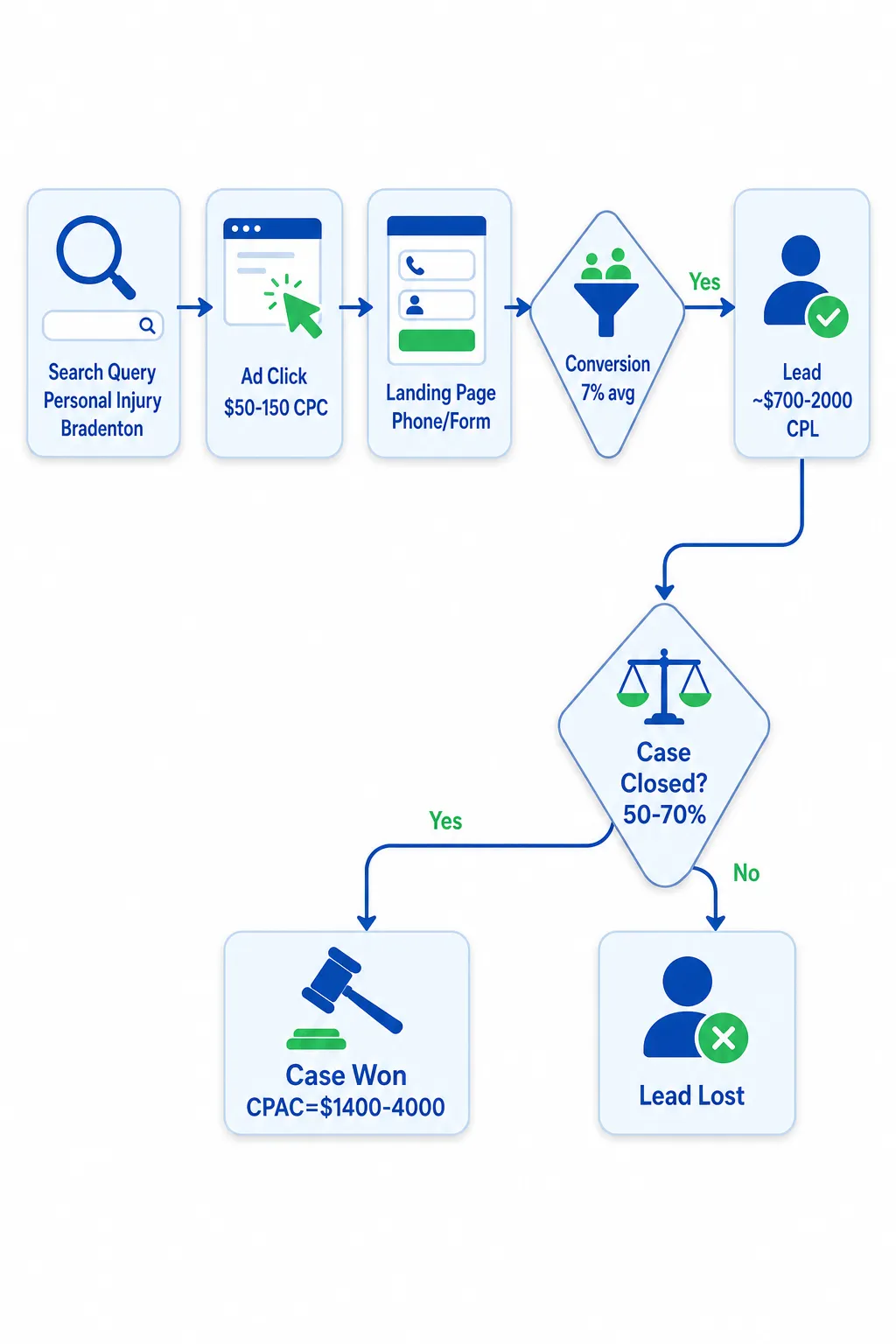
Cost per lead is a vanity metric dressed up as a performance metric. A $700 cost per lead sounds painful on its own, but it means nothing until you know what percentage of those leads actually turn into retained cases. If only half convert, your real CPAC is $1,400—and that's the number that should drive your budget conversations, not the headline CPL an agency reports back to you.
The same dynamics show up in adjacent industries—Google Ads for insurance agents follows nearly identical math, where high CPC on competitive terms only matters relative to close rate, not in isolation. For Bradenton specifically, personal injury Ads run $80–$150 per click, family law sits closer to $30–$60, and real estate is the most affordable entry point at $15–$40.
Run the conversion math all the way through: a 7% average conversion rate means every dollar spent on clicks produces roughly seven cents in leads. Factor in a 50–70% close rate on top of that, and you're looking at $0.035 to $0.049 in actual cases for every ad dollar spent. That's the real yield, and it's a sobering number for firms that have only ever looked at click-through rate.
Lowering CPAC without cutting budget comes down to three levers: reduce friction on your landing page (fewer form fields, a visible phone number above the fold), refine audience targeting to exclude low-intent searches, and A/B test ad copy by practice area instead of running one generic legal ad across every campaign.
- A personal injury campaign with $8,000 monthly budget, 7% conversion, and 60% close rate yields ~3–4 cases/month at ~$2,000 CPAC.
- Rebalancing: even a 1% improvement in conversion rate saves $10,000+ annually on your Ads budget at equivalent case volume.
- Real estate and family law Ads scale more efficiently (lower CPC, higher conversion rates) but require tighter geographic targeting.
For a longer-term complement to paid search, learn how to pair paid search with long-term SEO strategy.
4. Reputation Management: Why 90% of Potential Clients Check Reviews First
Here's the imbalance we see in almost every audit we run on Bradenton law firms: a typical practice spends roughly 60% of its marketing budget on Ads and maybe 5% on review generation, even though 90% of consumers read reviews before ever picking up the phone to contact a lawyer. That ratio is backwards relative to what actually influences conversion.
Reviews live in three places that matter most: Google Business Profile, where they directly influence Map Pack ranking and search visibility; Avvo, which carries legal-specific authority that generic review sites don't; and Facebook, which functions as a community trust signal, especially for family law and estate planning clients who are researching more personally.
The cost of a weak profile is steep. A 3.5-star profile converts 40–50% worse than a 4.8-star profile, and a single unaddressed negative review can suppress the visibility of ten positive ones in how prospects perceive your practice. This isn't a cosmetic issue—it's a direct hit to your conversion rate across every channel you're paying for.
Build a review funnel rather than hoping reviews show up organically: ask every closed case for a review as a standard part of your case-closing checklist, respond to all reviews within 48 hours to signal an active practice, and address negative reviews with empathy rather than defensiveness. A thoughtful, professional response to criticism often does more to convert fence-sitters than a wall of five-star reviews ever will.
Specialization should shape how you frame your reputation, too. Personal injury practices should emphasize case results and client gratitude. Family law should highlight confidentiality and compassion. Real estate practices should highlight smooth, stress-free closings.
- A 90-day reputation sprint (30–40 new reviews per month) costs ~$0 in direct spend but yields 15–20% lift in landing page conversion.
- Negative review responses are content; a thoughtful reply to a bad review often converts fence-sitters into clients more than ignoring it.
- Google Business Profile optimization (full description, service areas, FAQs, posts) costs $0 and ranks better for local searches than paid ads in many cases.
For a model of how local businesses optimize their Google Business Profile for Map Pack visibility, see how local businesses optimize Google Business Profile for Bradenton and Sarasota rankings.
5. Practice Area Specialization and Budget Allocation in Manatee County
| Practice Area | Primary Channel | Secondary Channel | Typical Monthly Budget | Expected Case Volume/Month | Avg. CPAC |
|---|---|---|---|---|---|
| Personal Injury | Google Ads (60%) | SEO (30%) | $5,000–$15,000 | 4–8 cases | $625–$1,875 |
| Family Law | SEO (50%) | Reputation (30%) | $2,000–$5,000 | 2–4 cases | $500–$1,250 |
| Real Estate | Google Ads (50%) | SEO (40%) | $2,000–$5,000 | 3–6 cases | $400–$800 |
| Criminal Defense / DUI | Google Ads (70%) | Reputation (20%) | $3,000–$8,000 | 3–6 cases | $500–$1,500 |
| Estate Planning | SEO (60%) | Reputation (30%) | $1,500–$3,500 | 2–3 cases | $500–$1,000 |
Personal injury carries the highest client lifetime value and the highest search volume, which also means the most saturated bidding environment. That combination justifies a $5,000–$15,000/month Ads investment, and at that scale, the Bradenton market can realistically support 4–8 cases per month.
Family law runs on trust and referrals more than urgency, which is exactly why Ads often underperform in this practice area—people shopping for a divorce attorney aren't clicking the first paid result the way someone in a post-accident panic would. SEO and reputation management tend to deliver 2–4 cases per month more efficiently here, at a lower overall spend.
Real estate sits in a comfortable middle ground: moderate CPC ($15–$40), genuinely high intent given closing timelines, and lower competition than personal injury. A $2,000–$5,000 monthly budget stays competitive, and a strong local SEO presence can meaningfully reduce how much you need to spend on Ads.
Criminal defense and DUI cases are defined by urgency and immediate need—someone arrested at 2 a.m. is searching right then. Ads dominate this category, but only if paired with quality landing pages and rapid response protocols; phone calls convert dramatically better than form submissions when someone is calling from a holding cell or a parking lot outside the courthouse.
Estate planning is relationship-based, lower-volume, and higher-value per case. SEO and content—guides, webinars, educational resources—tend to outperform paid search here, and Bradenton's aging population makes this an especially strong fit for the local market.
- Misallocating budget to the wrong channel for your practice area can waste 30–50% of your marketing spend.
- Bradenton's demographics (median age 58 vs. national 38) favor estate planning and family law; personal injury Ads still work but less efficiently than in urban centers.
- Multi-practice firms should segment budget allocation by department, not split evenly across all channels.
These specialization patterns aren't unique to legal services—learn how specialization shapes channel strategy in other professional service categories across the region.
6. The Hidden Cost of Low-Quality Leads: Beyond CPL to CPAC

Think of it like a fishing business that gets charged by the number of lines cast instead of by the pound of fish actually caught. Paying for lines cast—which is essentially what cost-per-lead measures—is vanity. You only profit when fish land in the boat, meaning cases close. CPAC is the only number that reflects what's actually happening to your bottom line.
The CPL trap catches even experienced firm owners. Agencies often optimize toward a low CPL of $200–$400 while quietly ignoring conversion rates. A $300 lead that converts at 3% works out to a $10,000 CPAC. A $600 lead that converts at 10% works out to a $6,000 CPAC—nearly half the cost, despite looking twice as expensive on the invoice. The headline number lied to you.
Referral comparison matters too, even though it rarely gets calculated. That 70.8% of attorneys citing referrals as their primary source never accounts for the "cost" of generating those referrals—years of networking, bar association dues, reduced billable efficiency from relationship-building. Digital channels force a discipline around cost tracking that referral-based growth never demanded, which is uncomfortable but ultimately healthier for the business.
The Bradenton market reality check: agencies frequently promise $200–$400 per lead, but industry benchmarks show 50–70% of those leads never become cases. True CPAC often runs 2–3x the advertised CPL, which is exactly the gap that sinks marketing budgets built on the wrong metric.
Consider a five-attorney personal injury firm in Bradenton that was spending $8,000/month on Google Ads, generating 20 leads/month at $400 CPL, but closing only 40% of them—a true CPAC of $2,000. Meanwhile, their SEO investment of $2,500/month generated just 8 leads/month, but at a 65% close rate. After reallocating $2,000 from Ads into reputation management—reviews and GBP optimization—their Ads conversion improved to 50% thanks to better social proof, while SEO leads held steady. The new math: the same $10,500 total spend produced 18 closed cases per month instead of 12, with CPAC down to $583. Within 12 months, they reduced their total budget to $8,000 while still maintaining 15 cases per month.
The metrics that actually predict CPAC: lead qualification (does the prospect match your practice area, or are they calling about something you don't handle?), response time (a same-day callback converts roughly 30% better than next-day follow-up), and landing page fit (does a personal injury searcher land on a personal injury page, or a generic "legal services" page that tells them nothing?).
- Calculate your own CPAC monthly: (Total marketing spend) ÷ (Cases closed) = true cost per case. Use this to bench against industry benchmarks and justify budget increases.
- A $5,000 monthly Ads budget generating 20 leads at $250 CPL is worse than $6,000 generating 15 leads at $400 CPL if the second group closes at 70% vs. 40%.
- Reputation and SEO excel at CPAC because they deliver higher-intent, self-qualified leads—people already decided to contact you.
When vetting a marketing partner, evaluate marketing partners based on CPAC outcomes, not just lead volume.
What This Means for Your Firm
- Law firm owners must shift from lead metrics (CPL, volume) to case metrics (CPAC, close rate). This requires better CRM discipline and monthly reporting.
- Bradenton practices benefit from longer-term patience with SEO than national firms would need, because local competition is lower; a 4–6 month payoff is realistic vs. 8–12 months in bigger markets.
- Reputation management is the most underrated lever for lowering CPAC. A 90-day reputation sprint (30–40 reviews) costs $0 in direct spend but improves conversion across all channels by 10–20%.
- Practice area specialization dictates channel mix; firms that try to optimize the same budget across personal injury, family law, and real estate all at once will underperform in each. Separate budgets and strategies by line of business.
- Bradenton's aging population (median age 58) suggests estate planning, elder law, and probate practices will see stronger SEO ROI than personal injury; budget accordingly.
Frequently Asked Questions
Should my Bradenton law firm invest first in SEO or Google Ads?
It depends on urgency and cash flow. If you need case volume immediately, start with Google Ads while SEO builds in the background—most competitive Bradenton practices run both simultaneously once budget allows, using Ads for speed and SEO for long-term equity.
How much should I budget for law firm marketing in Bradenton compared to competitors?
Budget should track your practice area, not a flat percentage. Personal injury and criminal defense firms typically need $3,000–$15,000/month to stay competitive, while family law, real estate, and estate planning can operate effectively at $1,500–$5,000/month with a heavier SEO and reputation mix.
Does my practice area change which marketing channels work best?
Yes, significantly. High-urgency practices like personal injury and DUI defense respond well to Google Ads, while relationship-driven practices like family law and estate planning get better returns from SEO and reputation management. Trying to run one blended strategy across multiple practice areas usually underperforms in all of them.
How important are online reviews for a law firm in Manatee County?
Extremely important—90% of consumers read reviews before contacting a lawyer, and a weak star rating can cut conversion rates nearly in half compared to a strong profile. Reputation management is one of the lowest-cost, highest-impact levers available to local firms.
What is CPAC and why does it matter more than cost per lead?
Cost Per Case Acquisition (CPAC) measures how much you actually spend to close a case, factoring in both lead cost and conversion rate. A cheap lead that rarely converts can cost far more per case than a more expensive lead with a high close rate, which is why CPAC—not CPL—should drive your budget decisions.
Keep Learning
- Local SEO Bradenton: Drive Foot Traffic & Calls Now — Dive deeper into Bradenton-specific local SEO tactics, Google Business Profile optimization, and Map Pack ranking strategies for law firms and service businesses.
- Best Digital Marketing Near Me: Sarasota & Manatee Guide 2026 — A comprehensive guide to evaluating digital marketing agencies in the region, comparing SEO vs. PPC outcomes, and understanding partner expectations for law firms.
- What Do Digital Marketing Companies Near Me Actually Do? A Sarasota & Manatee Guide — Learn what to expect from digital marketing partners, red flags in proposals, and whether you need both SEO and PPC or can rely on a single channel.
- Top SEO Companies Near Me in Sarasota & Manatee County — Evaluate local and national SEO agencies, understand their methodologies, and learn how to vet partners for legal services marketing in Bradenton and surrounding counties.
- HVAC Marketing Sarasota: A Contractor's Guide to Leads — While focused on HVAC, this guide demonstrates how to optimize Google Business Profile, manage reviews, and rank in the Map Pack—tactics directly applicable to law firm local SEO.
- Medical SEO Sarasota: Get More Patients Finding You Online — Learn how professional services (medical practices, law firms) handle specialization, multi-language targeting, and trust-based SEO in the Sarasota and Manatee market.