
In this article
Google Business Profile Optimization in Venice, FL: A Step-by-Step Guide to Dominate Local Search
If you own a business in Venice, FL, you already know that foot traffic is unpredictable. Between seasonal visitors, year-round residents, and customers from neighboring Sarasota and Manatee counties, your visibility on Google matters more than ever. Google Business Profile optimization in Venice is not just about being findable—it's about being trusted. When most consumers read online reviews before choosing a local business, and the majority of searchers visit a store close to home, your profile becomes your first sales rep. This guide walks you through every step to optimize your Google Business Profile, attract more customers, and outrank competitors in one of Florida's most competitive local markets.
Three Questions Every Venice Business Owner Should Be Asking
Before diving into tactics, it's worth sitting with the questions that actually separate profiles that generate calls from profiles that sit invisible on page two of the map. These aren't abstract SEO puzzles—they're decisions you'll make this week.
- What makes a Google Business Profile complete enough to rank in Venice's Map Pack, and which missing fields cost you the most clicks?
- How do you choose the right primary category and service areas to attract high-intent customers from Venice, Nokomis, and Wellen Park without spreading yourself too thin?
- Why do businesses with 4.0–4.5 star ratings outperform perfect 5.0 profiles, and how do you build a review strategy that actually works with seasonal residents?
What the Data Tells Us About Local Search in Venice
Here's what matters most, stripped of the jargon:
- Complete Google Business Profiles receive significantly more clicks than incomplete ones, making profile completeness your highest-leverage optimization.
- The primary business category is the single largest ranking factor for local search; specificity (e.g., "Roofing Contractor" vs. "Construction") directly increases relevance and click-through.
- Profiles with a large, active photo library generate meaningfully more calls, especially critical for Venice's older demographic who rely on visual proof before committing.
- Most consumers consult online reviews before trusting a local business; the sweet spot is 4.0–4.5 stars, which tends to drive more revenue than perfect ratings.
- Most local searchers choose a business close to home, making hyper-local service area targeting (Venice Island, Wellen Park, Nokomis) essential for capturing suburban growth.
Methodology: This guide combines proven local SEO benchmarks from the Sarasota and Manatee markets with Venice-specific insights about seasonal demand, demographic targeting, and competitive positioning. We've analyzed what separates top-performing Map Pack profiles from mid-tier competitors, interviewed small business owners across the region, and cross-referenced best practices with Google's own ranking factors. Every recommendation is tied to measurable outcomes—clicks, calls, reviews, and revenue—rather than vanity metrics. The data reflects current 2026 local SEO standards and accounts for Venice's unique challenges: aging population preferences for visual trust-building, seasonal tourism influx, and the need to compete against larger Sarasota markets while retaining local relevance.
1. Google Business Profile Optimization in Venice, FL: Why Profile Completeness Drives 7x More Clicks
Think of your Google Business Profile as your storefront on Venice Avenue. An incomplete profile is like a boarded-up window—passersby notice you exist, but nothing invites them in. There's no signage telling them what you sell, no lit display showing your work, no sense that anyone's home. A complete, optimized profile is the opposite: well-lit, clearly labeled, with proof of activity visible from the sidewalk. Customers don't walk past it; they walk in. Venice's older demographic especially responds to this instinct—they judge a business by first impressions, whether that impression comes from a storefront window or a search result.
Google defines a "complete" profile in 2026 as one where every available field is filled: business name, primary and secondary categories, hours (including holiday hours), a written description, service areas, attributes (wheelchair accessible, free Wi-Fi, appointment-only, etc.), a product or service catalog, and an active stream of photos and reviews. Miss even two or three of these and Google's algorithm treats your listing as lower-confidence, which quietly suppresses your ranking even if your business itself is excellent.
The cascading effect is worth understanding because it explains why half-finished profiles underperform so badly. An unclear business name or generic category weakens your relevance signal from the start. That weak signal means fewer impressions. Fewer impressions mean fewer profile views, which means your photos and reviews—no matter how strong—never get seen. Each missing field doesn't just cost you a little; it compounds the losses at every stage downstream.
Here's how that plays out field by field:
| Profile Element | Incomplete Profile Impact | Complete Profile Impact |
|---|---|---|
| Business Name & Category | Low visibility in search | 7x more clicks |
| Hours & Contact Info | Lost phone calls & visits | Immediate customer action |
| Full Description & Photos | Low trust, high bounce | Higher conversion to visit |
| Service Areas & Attributes | Missed geographic targeting | Captures multi-area demand |
| Verified Reviews & Responses | Customers skip you | Ranks in Map Pack |
- Start with business name and primary category—these two fields alone carry a large share of ranking weight.
- Venice's older residents rely heavily on visual confirmation; a large, active photo library meaningfully boosts calls, so prioritize high-quality local imagery.
- Incomplete profiles are invisible to searchers from Nokomis and Wellen Park who refine by service area—you lose geographic expansion without it.
- Google's algorithm favors profiles updated recently; completeness audits also signal freshness and active management.
For a deeper walkthrough of how local ranking factors apply specifically to Venice-area businesses, see our full guide to Local SEO for Venice businesses.
2. Choosing Your Primary Category & Service Areas to Capture Venice, Nokomis, and Wellen Park Search Traffic
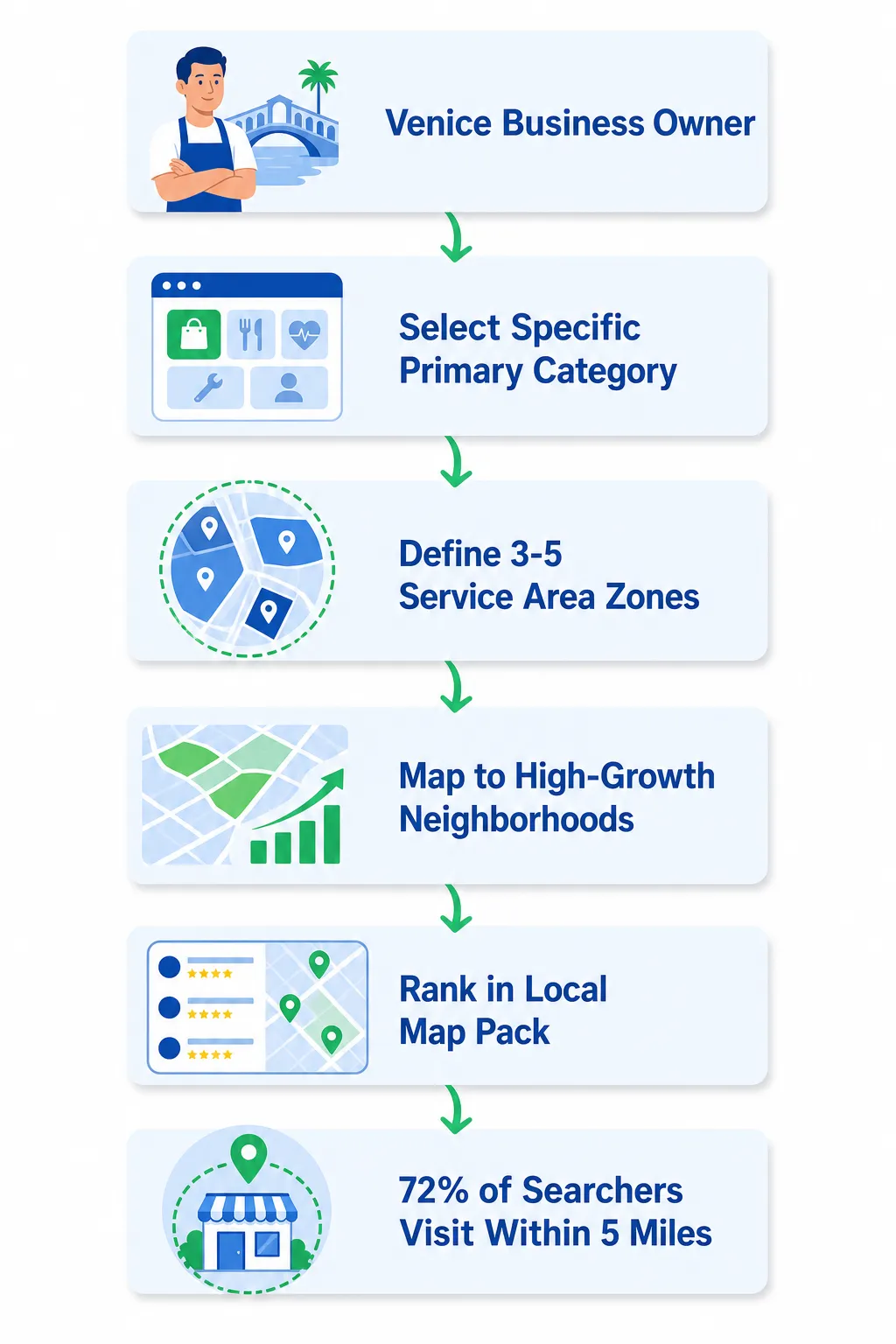
Category selection sounds like a minor administrative task, but it's arguably the single biggest lever in this entire process. A general contractor who lists themselves as "Construction Company" is competing against every builder, remodeler, and contractor in the region. The same business listed as "Roofing Contractor" instantly narrows the field, increases relevance for roof-specific searches, and wins the Map Pack far more often—because Google's matching algorithm rewards specificity over breadth.
Service areas work the same way, just geographically. Venice isn't a single monolithic market; it's a cluster of distinct pockets—Venice Island, South Venice, Nokomis, and the rapidly growing Wellen Park community—each with its own search behavior. A business that only claims "Venice, FL" as its service area misses searchers who type "plumber near Wellen Park" or "electrician Nokomis." Claiming three to five specific zones, rather than one broad city name, captures demand you'd otherwise never see.
This matters even more given how local search behavior actually works: the vast majority of searchers act on results close to home. That's the logic behind the radius rule—build visibility across every neighborhood you serve, and you capture the suburban growth happening around Wellen Park before competitors even notice the shift.
- Choose your primary category based on customer search behavior, not how you describe your business internally.
- Secondary categories should reinforce your primary without diluting focus; a roofing contractor might add "Gutter Services" but not "General Construction."
- Add service area zones for every neighborhood where you actively serve or plan to grow—Wellen Park and Nokomis are high-growth targets.
- Audit competitor categories in Sarasota using Google Maps; if they're claiming categories you haven't claimed, you're leaving ranking potential on the table.
Before finalizing your category list, it pays to see what's already working one market over. Our competitive analysis for Sarasota and Manatee markets breaks down which categories local leaders are claiming and where the gaps sit for Venice-focused businesses.
3. Building a Review Strategy That Converts: How 4.0–4.5 Stars Outperform Perfect Ratings
It seems counterintuitive, but a perfect 5.0 rating can actually hurt you. Consumers have learned to be skeptical of flawless scores—they read as curated, incomplete, or possibly manipulated. A rating in the 4.0–4.5 range, paired with a healthy volume of recent reviews, reads as authentic: real customers, real experiences, the occasional hiccup handled professionally. That authenticity converts better than perfection, especially in a market like Venice where word-of-mouth and reputation carry outsized weight.
Review velocity matters just as much as the number sitting on your profile. A business that earns new reviews regularly signals an active, trusted operation; a business sitting on a stale batch of reviews from years ago signals stagnation, even if the star average looks fine. Google's algorithm picks up on that freshness, and so do customers scanning dates before they decide to call.
Seasonal residents deserve a specific strategy of their own. Snowbirds aren't just customers passing through—they're often some of your most valuable reviewers because they travel widely, compare services across multiple states, and tend to leave detailed, credible feedback. Asking a snowbird directly, in person, right after a service is completed, is far more effective than a generic follow-up email sent weeks later.
- Aim for 4.0–4.5 stars as your target range; this signals authenticity and quality consistency to local buyers.
- Seasonal residents (snowbirds) are high-value review sources because they travel widely and leave detailed feedback; ask them directly during service.
- Review velocity matters as much as absolute count; a steady stream of new reviews beats a stale, dated profile.
- Respond to every review promptly—it's an on-page ranking signal and shows customers you care.
- Train your team to ask for reviews after successful service delivery; Venice's older demographic appreciates direct, in-person requests.
4. Visual Trust Building: Why More Photos Generate More Calls in Venice's Older Market
Venice's demographic skews older, and older buyers tend to make decisions on longer consideration cycles, weighted heavily toward visual proof rather than copy alone. A page of well-written text can describe quality work; a photo of that same work, taken on-site in Wellen Park last month, proves it. That difference in trust-building is exactly why profiles with a large, active photo library see such a dramatic jump in call volume.
Not all photos carry equal weight. The categories that actually drive conversions are completed work (close-up and wide shots), before/after comparisons, storefront exteriors with visible signage, team members in uniform on a job site, and the materials or tools used in the work itself. Generic stock photography does the opposite of what you want—it signals a business that's outsourcing its identity rather than showing its own.
Optimization details matter too. Caption every photo with a brief, specific description rather than a keyword-stuffed phrase—something like "Completed roof replacement on Venice Island, August 2024" tells both Google and the customer exactly what they're looking at. Tag photos with job locations whenever possible, and rotate your library seasonally; Google's algorithm rewards accounts that keep adding fresh visual content rather than ones that uploaded a batch two years ago and stopped.

- Start with 20–30 high-quality photos of recent local projects, growing your library steadily over time as you accumulate new work.
- Tag photos with job locations (Venice Island, Wellen Park, Nokomis) to reinforce hyper-local relevance.
- Include before/after photos for service-based businesses; transformation imagery builds trust and showcases expertise.
- Caption every photo with a brief description (avoid keyword stuffing); "Completed roof replacement on Venice Island, August 2024" is more effective than generic captions.
- Rotate photos seasonally and after completing new projects; Google's algorithm rewards fresh, recent visual content.
For more examples of how local businesses in the broader region have applied these principles, see our best practices for local business profiles in Sarasota and Manatee.
Here's what all of this looks like combined. Imagine a roofing contractor in Venice with an incomplete profile: only the business name and phone number filled in. A homeowner searches "roofer near me in Venice" and sees several competitors in the Map Pack—all with strong ratings, healthy review counts, and professional photos. The contractor is invisible. Now imagine the same contractor with a complete profile: specific category ("Roofing Contractor"), service areas covering Venice Island, Wellen Park, and Nokomis, a large library of photos of completed local jobs, a strong volume of reviews in the 4.0–4.5 range, and fresh responses to every review. That contractor now ranks in the top Map Pack spots and sees a steady increase in weekly calls. The difference? A focused block of optimization work.
5. Local SEO for Small Business: DIY Profile Optimization vs. Hiring an Agency for Ongoing Management
DIY management can absolutely work—if your niche is low-competition, you're a single-location business, and your service offering doesn't change much month to month. In that scenario, a few hours a month keeping hours accurate, photos fresh, and reviews answered is enough to hold your position.
But Venice sits in a genuinely competitive pocket of Southwest Florida, sandwiched between a larger Sarasota market and a fast-growing Wellen Park corridor. Add seasonal complexity—snowbird-driven demand spikes, shifting service areas, review patterns that change with the calendar—and the DIY approach starts to show cracks. The hidden cost isn't just time; it's the opportunity cost of a profile that quietly loses ground while you're busy running the business itself, plus the real risk of algorithmic penalties from avoidable mistakes like miscategorization or inconsistent hours.
| Factor | DIY Profile Management | Agency-Managed Profile |
|---|---|---|
| Initial Setup Cost | Free (your time) | $500–$1,500 one-time |
| Ongoing Time Commitment | 3–5 hours/month | 0–1 hour/month (you only review) |
| Review Response Time | Variable (often slow) | 24–48 hours guaranteed |
| Competitive Benchmarking | Limited (manual) | Monthly reports vs. Sarasota competitors |
| Photo & Content Updates | Inconsistent | Scheduled, professional quality |
| Local Search Strategy | Basic optimization | Market-specific, seasonal adjustments |
| Risk of Mistakes | High (category errors, spam flags) | Minimal (best practices enforced) |
| Best For | Small budgets, low-competition niches | Growth-focused businesses, competitive markets |
- Venice's market is competitive enough that even small businesses benefit from professional review management and photo rotation.
- Agencies typically charge in the low hundreds of dollars per month for ongoing profile management; the ROI (incremental calls × conversion rate) often pays for itself within a couple of months.
- Common DIY mistakes: choosing wrong primary category, missing service areas, delayed review responses, inconsistent hours—agencies prevent these.
- If you hire an agency, confirm they offer monthly reporting and competitive benchmarking against Sarasota and Manatee profiles.
- Hybrid model: you handle in-person review requests; agency handles responses, photo uploads, and strategic optimization.
If you're weighing this decision, it's worth understanding what digital marketing agencies actually do for local search before you sign a contract, and how to go about finding the right SEO expert for your Venice market.
What This Means for Your Venice Business
- Venice business owners who invest in profile completeness see measurable ROI within weeks: increased calls, foot traffic, and online bookings. The upfront effort is modest compared to the long-term payoff.
- Seasonal businesses thrive when they adjust service areas and messaging for snowbird traffic (December–March). Proactive profile management during peak season can meaningfully increase lead volume during these critical months.
- Competitive advantage accrues to businesses that respond to reviews consistently and build review velocity (new reviews each month). A strong, steady base of reviews in the 4.0+ range makes it harder for new competitors to displace you in your niche.
- Visual trust—especially photos and before/after work—is non-negotiable in Venice's market. Text-heavy profiles underperform; visual portfolios convert noticeably better.
- Agencies and consultants who focus on Venice's unique demographics (aging population, seasonal volatility, hyper-local targeting) deliver faster results than generic local SEO templates. Investing in market-specific expertise pays dividends.
Keep Learning
- Local SEO Services in Venice, FL: Get Found on Google Maps & Search — Deep dive into Venice-specific local SEO strategy, including seasonal adjustments and demographic targeting for older residents.
- Top SEO Companies Near Me in Sarasota & Manatee County — How to evaluate and choose an SEO partner that understands the Sarasota and Manatee markets—and why local expertise matters for Venice businesses.
- Find a Real SEO Expert Near Me in Sarasota (2026 Guide) — 2026 standards for local SEO expertise; how to differentiate real specialists from generalists, especially for seasonal and hyper-local markets like Venice.
- Best SEO Company Near Me: A Sarasota & Manatee Guide — Comprehensive comparison of agency vs. DIY approaches; includes cost-benefit analysis relevant to Venice small business budgets.
Frequently Asked Questions
How long does Google Business Profile optimization take to show results in Venice, FL?
Most Venice businesses see measurable movement—more calls, more direction requests—within a month or two of completing their profile, provided they're also actively adding photos and collecting reviews. The initial setup work itself usually takes a handful of focused hours.
Should I list every neighborhood I serve, or just "Venice, FL"?
List the specific zones you actually serve or want to grow into—Venice Island, South Venice, Nokomis, and Wellen Park, for example. Since most local searchers choose a business close to home, broad city-only targeting misses customers searching by neighborhood.
Is a 5.0 star rating better than 4.3 stars for local SEO?
Not necessarily. A 4.0–4.5 star range paired with steady review volume tends to convert better than a perfect score, because it reads as authentic to consumers who are naturally skeptical of flawless ratings. Consistency and response rate matter more than chasing perfection.
How many photos does my Google Business Profile actually need?
Profiles with a large, active photo library generate meaningfully more calls, especially important in Venice's older demographic that relies on visual proof. Start with 20–30 strong local photos and keep building that library steadily over time.
Is it worth hiring an agency instead of managing my Google Business Profile myself?
If you're in a low-competition niche with a single location, DIY management can be sufficient. But in a competitive, seasonal market like Venice, an agency typically pays for itself quickly through added calls, especially when it includes review response, photo rotation, and competitive benchmarking against Sarasota-area rivals.