

In this article
Web Design Companies Near Me in Sarasota: Costs, Comparison & What to Expect

You're ready to invest in a website. You've searched for web design companies near me and found dozens of local agencies in Sarasota. But when the quotes arrive, they range from $1,500 to $15,000. What are you actually paying for? Without knowing the breakdown, you risk either overspending on features you don't need or underfunding critical elements like user experience and mobile optimization. This guide decodes the real costs of web design in Sarasota and teaches you how to evaluate proposals like a professional.
Most small business owners in Sarasota and Manatee County don't know what they're paying for when they get a web design quote—and that confusion costs them money. Here's the twist: the difference between a $2,000 website and a $10,000 website isn't always proportional to quality or ROI. Understanding what drives cost—and what actually matters for your business—changes everything.
The Questions Every Sarasota Business Owner Asks Before Hiring
- What's the actual price range for web design in Sarasota, and why do quotes vary so widely?
- Which factors drive cost the most—design complexity, functionality, or content creation?
- How do I read a web design proposal and know if I'm getting fair value?
Key Findings
- Small business websites in Sarasota typically cost $3,000–$5,000 for a solid semi-custom build; template-based sites run $500–$2,500; fully custom sites with advanced features exceed $20,000.
- The biggest cost drivers are number of pages, personalization level, e-commerce/booking features, copywriting, and SEO optimization—not hours billed.
- A strong proposal includes detailed scope, page count, content responsibility, platform choice, revision limits, timeline, and total cost; vague quotes signal hidden fees.
- 75% of consumers judge business credibility by website design; investing in quality design directly impacts customer acquisition and trust.
- Hidden costs (domain, hosting, plugins, stock photos, ongoing maintenance) can add $100–$500+ annually and are often overlooked in initial quotes.
| Tipo de sitio | Rango de precio | Nivel de personalización |
|---|---|---|
Methodology
This guide synthesizes research into Sarasota and Manatee County web design pricing, industry cost drivers, and proposal evaluation frameworks. Data reflects typical quotes from local agencies, vendor pricing (hosting, domains, premium tools), and conversion research showing the business impact of professional web design. All figures are based on 2024–2025 market rates for the Southwest Florida region and should be validated against current local quotes.
1. Web Design Companies Near Me: Understanding the Sarasota Market & Price Tiers
Search "web design companies near me" in Sarasota and you'll get agencies charging $800 and others charging $18,000 for what sounds, on paper, like the same deliverable: "a professional website." The spread isn't random. It reflects differences in overhead, experience, team size, and—most importantly—what's actually included in the build. A one-person freelance operation working from a home office has a radically different cost structure than a 10-person studio with an account manager, a dedicated designer, a developer, and a QA process.
There are, broadly, four price tiers in the Sarasota market, and understanding which one fits your business is the single most useful thing you can do before requesting a quote.
Template-based sites ($500–$2,500) use a pre-built theme—WordPress, Wix, or Squarespace—with your logo, colors, and content swapped in. There's minimal customization, but for a simple brochure site, blog, or portfolio, this gets you live in one to three weeks. Semi-custom builds ($3,000–$5,000) start from a template foundation but add custom-designed homepage sections and unique layouts for your most important pages. This is where most Sarasota small businesses land, and for good reason: it balances cost, speed, and a brand feel that doesn't look like everyone else's Wix site.
Fully custom design ($5,000–$10,000) means the site is built from scratch—custom CSS, bespoke interactions, no template skeleton underneath. This tier makes sense if you're in a competitive industry where your website needs to visually differentiate you, or if your brand identity is central to your sales pitch. Advanced custom builds ($10,000–$20,000+) add e-commerce, booking systems, API integrations, or complex user workflows—think online retail, service marketplaces, or SaaS platforms where the website is effectively a product, not just a brochure.
Before you request a single quote, try to place your own project honestly into one of these four categories. If you need a simple five-page site with a contact form, you don't need a $12,000 quote—and if an agency gives you one anyway, that's a red flag. Conversely, if you need live inventory sync, membership logins, or custom booking logic, an $800 quote should make you suspicious, not excited. A website creation company that quotes a full custom build for the price of a template job is either inexperienced, underbidding to win the contract and planning to cut corners, or padding the scope with change orders later.
| Tipo de sitio | Rango de precio | Nivel de personalización |
|---|---|---|
- Template sites are fast and affordable but may feel generic; good for startups or secondary projects.
- Semi-custom is the "Goldilocks" zone: enough personality for small brands, reasonable investment, faster than full custom.
- Fully custom and advanced projects are mandatory if you're competing on design aesthetics or need unique functionality (e-commerce, booking).
- Price alone doesn't equal quality; a $4,000 site from a skilled Sarasota designer often outperforms a $10,000 site from an inexperienced shop.
If you want a deeper framework for vetting how to choose the right Sarasota partner, that guide walks through red flags and vetting criteria that go beyond price alone.
2. What Actually Drives Web Design Costs in Sarasota: The Hidden Factors Behind the Quote
Here's a misconception worth correcting early: web design pricing isn't primarily about hours billed. It's about complexity, and complexity compounds across several specific factors—not all of which are obvious when you're staring at a quote.
Design complexity is the biggest driver. Bespoke layouts, custom animations, and brand-specific UI elements take significantly more design time than dropping your logo into a pre-built theme. This is the single factor that separates a $2,500 template site from a $7,000 custom one, even when the page count is identical.
Number of pages matters too, but not in a linear way. Each additional page adds design time, content integration, mobile testing, and QA—but more pages don't automatically mean more value to your visitors. A tight, well-structured six-page site often converts better than a sprawling fourteen-page site nobody can navigate.
Functionality is where costs multiply fast. A basic contact form is nearly free to implement. A booking engine, a membership portal, an e-commerce catalog, or an API integration with your CRM or payment processor—those are entirely different projects wearing the same "website" label. If your business needs any of these, budget accordingly from the start rather than being surprised mid-project.
Content creation is the most underestimated line item in the entire process. Most agencies either charge extra for copywriting, photography sourcing, and video, or they quietly shift that burden back onto you. If you write your own copy and source your own images, you can save $500–$2,000 off a typical quote—but only if you budget the time to actually do it before the deadline arrives.
SEO optimization—keyword research, meta tags, schema markup, and local optimization for Sarasota and Manatee searches—typically adds $300–$1,500 depending on depth. And post-launch support is almost always quoted separately: ongoing updates, security patches, backups, and performance tuning commonly run $50–$300 per month, a recurring cost many first-time buyers forget to factor into their first-year budget.
- Content is often the most underestimated cost. Agencies either charge heavily for copywriting or shift that burden to you.
- E-commerce and integrations (Shopify, Zapier, CRM sync) are cost multipliers; a basic contact form costs far less than a product catalog.
- Design revisions should have limits (usually 2–3 rounds). Unlimited revisions kill profitability and delay launch.
- Hosting and domain are recurring costs that many quotes bury or omit; budget $120–$300/year minimum.
3. Web Design Firms vs. Freelancers vs. DIY: A Sarasota Buyer's Decision Framework
Once you understand the price tiers and cost drivers, the next decision is who builds the site. In Sarasota, you generally have three paths: a web design firm, an independent freelancer, or a DIY platform. Each has legitimate use cases, and picking the wrong one for your situation is how projects stall or require an expensive rebuild within two years.
Web design firms charge more because you're paying for more than one person's time—team overhead, account management, quality assurance, warranty periods, and the ability to scale the project if your needs grow. This is the right call for established businesses, competitive industries, or anyone with complex needs like e-commerce or multi-system integrations. A firm also tends to bring a formal process: contracts, timelines, and service-level commitments that protect you if something goes wrong.
Freelancers make sense when you want a local relationship, your project is relatively simple, or you need ongoing tweaks without the minimums that firms often impose. The trade-off is variability—quality depends entirely on that individual's skill and availability, and if they get busy or move on, you may not have a formal recourse path the way you would with a firm.
DIY platforms like Wix, Squarespace, or GoDaddy are genuinely viable for basic sites—a sole practitioner, a nonprofit with urgent timing, or anyone willing to learn the tools. But DIY doesn't solve the strategy or copywriting problem, and it caps your growth: you're confined to whatever the platform's toolkit allows.
A hybrid approach often works well: hire a firm for strategy and the initial build, then use a freelancer for small ongoing updates, or hire a firm to build the site and manage day-to-day maintenance yourself through a DIY-friendly CMS. Whichever path you choose, there's a real local advantage to working with a Sarasota-based firm or freelancer—face-to-face meetings, familiarity with local search behavior, and easier accountability than a remote shop three time zones away.
| Criteria | Local Web Design Firm | Freelancer (Sarasota-based) | DIY (Wix, Squarespace, GoDaddy) |
|---|---|---|---|
| Upfront Cost | $3,000–$20,000+ | $1,500–$8,000 | $300–$1,200/year |
| Timeline | 4–16 weeks (structured process) | 2–8 weeks (variable, depends on workload) | Days–2 weeks (self-paced, learning curve) |
| Design Quality & Uniqueness | High; professional branding strategy included | Highly variable; depends on freelancer's portfolio | Medium; limited by template constraints |
| Support After Launch | Often included (maintenance packages available) | Ad-hoc; may require separate ongoing contract | Self-service; platform support available |
| Scalability & Features | Highly scalable; custom integrations, e-commerce possible | Moderate; depends on freelancer's skillset | Limited; confined to platform's tools |
| Best For | Established businesses, competitive industries, complex needs | Startups, tight budgets, straightforward sites, local connections matter | Solo practitioners, nonprofits, urgency, willingness to learn |
- Firms protect you with contracts, timelines, and SLAs; freelancers offer flexibility but less formal recourse if something goes wrong.
- DIY is never truly free; you're paying with your time learning the platform, and you'll likely hit feature ceilings that force an expensive rebuild later.
- The cheapest option upfront often becomes the most expensive long-term if it doesn't support growth or can't be easily updated.
- Ask for references and inspect past work. A $5,000 site from a skilled designer beats a $3,000 site from someone new to the craft.
Think of this decision the way you'd think about buying a car: a $12,000 used Honda is reliable and gets the job done; a $35,000 new sedan offers more features and a warranty; a $500 DIY kit car is possible but risky. The right choice depends on your budget, your reliability needs, and how long you plan to keep it. If longevity and scalability matter, skip the cheapest option—just as you would with a vehicle you intend to drive for years, not months.
For a more detailed breakdown of vetting criteria, our detailed guide on choosing the right partner covers contract negotiation and interview questions worth asking before you sign anything.
4. How to Evaluate a Web Design Proposal: What a Quality Quote Includes
This is the step most buyers rush through, and it's where most money gets wasted. A professional proposal from a web design company reads like a contract, not a sales pitch. If what you receive is two paragraphs and a price, that's not a serious quote—it's a placeholder.
A quality proposal should walk through scope first: exactly how many pages, which features, and which platform (WordPress, Shopify, a custom stack) will be used. From there it should specify deliverables—what files you'll receive, what credentials and account access you'll retain, and whether you own the final design outright. Timeline should include actual milestones and review windows, not just a vague launch date. Revision limits matter too: two or three rounds is standard; "unlimited revisions" sounds generous but usually signals a vague scope that will balloon the timeline.
Cost should be itemized, not a single lump sum. You want to see labor, software licensing, and any third-party tool costs broken out so you can tell whether you're being quoted fairly or whether the number is padded. And the proposal should spell out post-launch support terms clearly: what happens after launch, who fixes bugs, and at what cost.
Before anything is signed, clarify who owns what. Who writes the content—you or them? Who owns the final design files if you ever switch providers? Who manages hosting and domain setup, and what happens to those accounts if the relationship ends? These questions prevent painful disputes six months down the road.
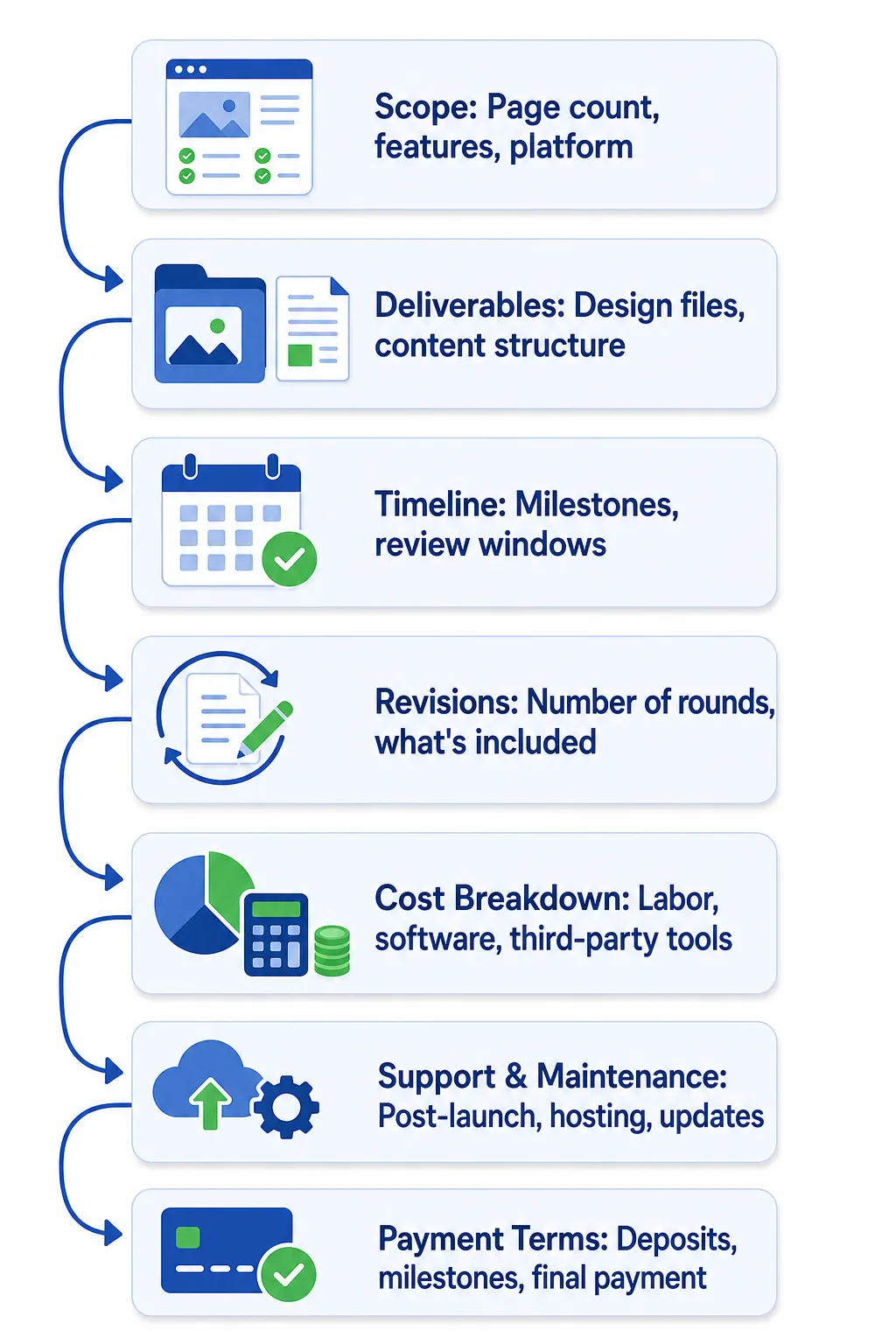
Payment structure is worth scrutinizing too. Be wary of "pay entirely upfront" terms, and even a simple 50/50 split can leave you exposed if the project stalls midway. Better terms look like 30% deposit to begin, 40% at design approval, and 30% at launch—this ties payment to actual progress and protects both sides. Finally, check whether the proposal includes any accountability language: response time commitments, uptime guarantees, revision turnaround windows, or bug-fix timelines. Their absence doesn't necessarily mean a bad vendor, but their presence is a strong signal of professionalism.
- A professional proposal reads like a contract, not a sales pitch. If it's two paragraphs, it's not serious enough.
- Get proposals in writing; email is fine, but confirm all terms before signing anything.
- Compare 3 proposals minimum. Huge gaps in price usually mean a gap in scope—ask clarifying questions before discounting the low or high bidder.
- Ask for a reference who had a similar project; call them and ask about timeline accuracy, cost overruns, and ongoing support.
5. The Hidden ROI: Why Web Design Investment Pays for Itself (The Numbers)
Here's the part most small business owners skip over when they're focused purely on upfront price: design is not a cosmetic expense. It's a trust and sales lever, and the data backs this up. Roughly 75% of consumers judge a business's credibility by its website design—meaning three out of four people deciding whether to trust you, call you, or buy from you are making that call based largely on how your site looks and feels before they read a single word of your copy.
This matters even more in local search contexts. When someone searches "web design firms near me" or "[your service] near me" in Sarasota, they expect a professional, mobile-ready result. A clunky, dated, or broken-looking site signals unprofessionalism and loses the lead before anyone even picks up the phone—regardless of how good your actual service is. And with the majority of web traffic now coming from mobile devices, responsive design isn't optional; it's a baseline requirement that typically adds only $200–$500 to a project but prevents a significant share of visitors from bouncing immediately.
Consider the math on a modest scenario: if a redesigned site brings in just five extra qualified leads per month, and one of those converts to a $2,000 client, that's $10,000 per month—or $120,000 annually—from a $5,000 investment. That's roughly a 24x return in year one alone, and it compounds: a well-built site keeps generating leads for three to five years before it needs a meaningful refresh, not every 18 months.
Every month spent without a professional site, or stuck with a poor one, is lost lead generation that competitors are capturing instead. Pairing a strong design investment with pairing design with SEO for sustainable growth compounds this effect further, since traffic and trust reinforce each other.
- Design is not an expense; it's a lead-generation tool. Budget accordingly—$3,000–$5,000 is an investment in your sales engine, not a cost.
- Poor design isn't just ugly; it's invisible. Bounce rates spike, local searches skip over you, and competitors win the sale before you're in the conversation.
- Professional design compounds over time. A site built well in 2024 will drive qualified traffic and trust for years; a cheap, neglected site becomes a liability.
- Updating or redesigning every 3–5 years (not every 18 months) is normal and healthy; budget $1,500–$3,000 for a refresh when market trends shift.
Here's a concrete example of this trade-off in action. A Sarasota real estate agency owner needs a website and collects three quotes. A local firm proposes $5,500 for a semi-custom, eight-page design with IDX integration, mobile optimization, a four-week timeline, and basic SEO included. A freelancer offers $3,200 for a template-based build with six pages, manually updated listings, a three-week timeline, with maintenance billed separately. The DIY route through Wix costs about $600 per year, is entirely self-built, allows unlimited pages, but has no IDX sync, slower load times, and limited SEO capability.
The firm's quote costs $2,300 more upfront, but it includes live listings sync, a professional design that closes more deals, and ongoing support. The freelancer is cheaper, but she'll spend roughly five hours a week manually updating listings by hand. DIY saves money on paper but looks generic and sacrifices the local search edge entirely. Over 24 months, the firm's investment is likely to return 40–50% more qualified leads simply because the site looks trustworthy and functions like a real MLS gateway rather than a static brochure. In this scenario, the firm wins on ROI—even though it wasn't the cheapest option on day one.
6. Website Design for Company Growth: Avoiding Common Pitfalls & Budget Traps
Even with a solid proposal in hand, there are predictable ways a web design project can run over budget and timeline. Knowing these traps ahead of time is the cheapest insurance you'll ever buy.
Scope creep is the number one budget killer. Define your minimum viable product—the essential pages and features your site needs on day one—before design work begins. Every "nice-to-have" that comes up mid-project should go into a separate phase-two budget rather than getting squeezed into the current scope for free.
Underestimating content work comes a close second. You will be asked "what should this page say?" more times than you expect, and if you don't have an answer ready, the project stalls. Budget time—or a freelance copywriter at $500–$1,500—upfront rather than scrambling during the build.
Choosing the wrong platform for your long-term needs can be expensive in hindsight. A $2,000 Wix site might need a full $10,000 rebuild within 18 months if your business outgrows it. Think about where your business will be in three years, not just at launch, when deciding on a platform.
Many quotes also quietly omit hosting and ongoing costs—$100–$200 a month for hosting, SSL, backups, and maintenance adds up. A $5,000 build plus $150 a month in maintenance comes to roughly $6,800 in year one; budget for that reality rather than being surprised by it. Similarly, don't forget SEO optimization: a beautiful site with zero organic traffic is a liability, not an asset. Budget $500–$1,000 for on-page SEO during the build itself, with ongoing SEO treated as a separate, recurring line item.
Finally, don't skip analytics and feedback. Require your proposal to include GA4 setup and regular performance reporting. Without data, you have no way to justify future digital investments to yourself—or to any stakeholders you answer to.
- Lock the scope in writing before design starts. Every change after design approval = cost multiplier and timeline delay.
- Negotiate revision limits and approval windows upfront. A site that takes 6 months because of slow feedback is worse than a site that takes 4 weeks.
- Test the site across devices, browsers, and connection speeds before final payment. Mobile, slow networks, and older browsers must all work.
- Build a content calendar with your designer; content planning at the start costs less than retrofitting it after launch.
For a complete walkthrough of how to structure this entire process from first contact to signed contract, see the full guide to selecting the right web agency partner.
What This Means for Sarasota Business Owners
- Budget $3,000–$5,000 for a professional semi-custom site that positions your business credibly. Cheaper is risky; more expensive is only justified if you need advanced features (e-commerce, integrations, complex workflows).
- Expect the proposal to be detailed and in writing. Vague quotes signal inexperience or hidden costs. Get 3 proposals and ask clarifying questions on any gaps.
- Include post-launch support in your long-term budget. $150–$300/month for maintenance, updates, and hosting is normal and prevents costly emergency fixes later.
- Design is not cosmetic; it's a sales and trust lever. 75% of consumers judge your credibility by your site's design. Invest accordingly.
- Avoid scope creep by locking the MVP (minimum viable product) before design starts. Everything else is a future phase and a separate budget line.
- Local partnerships (Sarasota-based firms or freelancers) offer face-to-face collaboration, local SEO knowledge, and easier accountability than remote shops.
- Measure ROI by tracking leads, conversions, and customer acquisition cost before and after launch. Without data, you can't justify future digital investments to stakeholders.
Frequently Asked Questions
How much should a small business website cost in Sarasota?
Most small businesses in Sarasota should budget $3,000–$5,000 for a solid semi-custom site, which includes a professional design, mobile optimization, and basic SEO setup. Template sites can run as low as $500–$2,500, while fully custom or e-commerce-heavy builds can exceed $10,000–$20,000 depending on complexity.
Why do web design quotes vary so much between Sarasota companies?
Quotes vary based on team overhead, design complexity, the number of pages and features, and whether content creation and SEO are included. A $1,500 quote and a $10,000 quote are rarely describing the same scope of work, even if both are labeled "website design."
Should I hire a web design firm or a freelancer?
Firms make sense for established businesses with complex needs, scalability requirements, or competitive industries, since they offer formal contracts, QA, and ongoing support. Freelancers are a good fit for simpler projects, tighter budgets, or when a local, flexible relationship matters more than formal process.
What should I look for in a web design proposal?
A quality proposal includes detailed scope (page count, features, platform), itemized costs, a timeline with milestones, clear revision limits, and post-launch support terms. If a quote is vague or lacks a cost breakdown, treat that as a warning sign before signing anything.
Are there hidden costs I should ask about before signing a contract?
Yes—domain registration, SSL certificates, premium plugins, stock photography, email accounts, backups, and ongoing maintenance are commonly left out of initial quotes. These can add $100–$500 or more annually, so ask for a full breakdown upfront rather than discovering them after launch.
Keep Learning
- Web Agency Near Me: How to Choose the Right Sarasota Partner for Your Business — Deep dive into evaluating and selecting a web design partner in Sarasota. Includes red flags, contract negotiation, and vetting criteria beyond price.
- Top SEO Marketing Near Me: A Sarasota Buyer's Guide (2026) — A professional website is just the start. This guide pairs web design with SEO strategy to capture local search traffic and compete in Sarasota's digital landscape.
- Top SEO Companies Near Me in Sarasota & Manatee County — After your site launches, ongoing SEO optimization drives long-term ROI. Learn how to choose an SEO partner that amplifies your design investment.
- Sarasota PPC Agency: Get Faster ROI on Google & Facebook Ads — While your new website builds organic reach, paid ads can accelerate lead generation. Understand the role of PPC to maximize your digital ROI faster.