
In this article
Best Website Design Company Near Me in Sarasota & Manatee
If you're searching for the best website design company near me in Sarasota or Manatee County, you're already ahead of most local business owners — because you understand that your website isn't a brochure, it's your hardest-working salesperson. But the local market is crowded: freelancers, agencies, template resellers, and marketing shops all claim they can build you a great site. This guide cuts through the noise with a data-backed framework for evaluating web design firms, the red flags to watch for, and why a partner who knows Bradenton, Lakewood Ranch, and downtown Sarasota can outperform a remote vendor every time.
Most Sarasota and Manatee business owners assume any competent designer will do — after all, everyone builds websites now. But 75% of consumers judge your credibility on design alone, and picking the wrong website design company near me can quietly cost you customers every single day the site is live.
The Questions This Guide Answers
- How do I evaluate a local website design company beyond just their portfolio?
- What are the real advantages of hiring a Sarasota or Manatee-based web designer over a remote agency?
- Which red flags should immediately disqualify a web design firm from consideration?
- How does website design directly impact credibility, conversions, and local SEO in the Sarasota market?
Key Findings at a Glance
- 75% of consumers judge a company's credibility based on website design — meaning your homepage is doing more sales work than your team realizes.
- 88% of online consumers won't return after a bad experience, so a mediocre site permanently loses customers instead of just underperforming.
- 61% of mobile users are more likely to contact a local business with a mobile-friendly site — critical for Sarasota's tourism-driven, on-the-go audience.
- Local web design partners deliver measurable advantages: in-person strategy sessions, market fluency, and connections to local photographers and SEO specialists.
- The biggest project risks aren't technical — they're vague scopes, unclear ownership, and missing post-launch support.
How We Built This Guide
This guide combines consumer behavior research on web design and credibility, on-the-ground experience working with Sarasota and Manatee County businesses, and a review of common evaluation criteria used by marketing decision-makers. Statistics referenced come from widely cited web usability and consumer research studies. Recommendations focus on tangible, repeatable evaluation steps any local business owner can apply — regardless of budget or industry.
1. Why a Local Website Design Company Near Me Beats a Remote Agency
The first advantage of hiring locally shows up before a single pixel is designed: the discovery meeting. When your web designer can meet you at your office in Lakewood Ranch, walk your showroom in Bradenton, or grab coffee near St. Armands, they absorb the kind of brand nuance a Zoom call flattens. The way your team talks to customers, the artwork on your walls, the smell of your bakery — those signals shape design choices that generic remote agencies simply miss.
Local designers also understand who's actually buying from you here. Sarasota isn't a monoculture. You've got seasonal snowbirds with different expectations than year-round retirees. You've got the Lakewood Ranch growth corridor pulling in younger families with different search habits than Longboat Key vacationers. A web designer who's worked across these micro-markets writes headlines and structures navigation with that fluency baked in.
Then there's the ecosystem effect. A good local partner brings a rolodex: photographers who know how the light hits Siesta Key at 4pm, videographers who've filmed on Anna Maria Island, copywriters familiar with the local voice, and SEO specialists tracking Bradenton search trends week over week. That network is invisible on a proposal but shows up in every deliverable. And when something breaks post-launch, you can literally drive to their office — a form of accountability that hourly rates can't replicate. If you want a deeper vetting framework, see how to choose the right Sarasota web design partner.
- A local partner treats your site as an ongoing asset, not a one-time deliverable.
- Proximity translates directly into faster iterations and stronger creative alignment.
2. How Design Quality Shapes Credibility: 75% of Consumers Judge You Instantly
Here's what a dated website silently communicates to a Sarasota buyer landing on your homepage: "This business may not be around next year." "They probably don't take security seriously." "If they cut corners here, where else are they cutting corners?" The visitor never articulates those thoughts consciously — but the back button gets pressed anyway. That's the credibility gap, and it's the most expensive part of any tired website.
Trust signals matter even more in a market like ours, where reputation travels through word of mouth, Nextdoor threads, and chamber networks. Real photos of your actual team beat stock imagery every time. Verified Google reviews embedded on the page carry more weight than a testimonials slider. Clear service areas — "Serving Sarasota, Bradenton, Venice, and Lakewood Ranch" — tell both humans and search engines you belong here.
Beyond content, the mechanics of design carry trust. Typography with proper hierarchy, generous whitespace, and load times under three seconds all read as "professional" to visitors who couldn't tell you why. When a website creation company does a redesign well, they audit these signals systematically: they measure Core Web Vitals, they replace hero images with authentic photography, they rewrite navigation labels to match how customers actually think. Small design fixes often outperform full rebuilds — sometimes tightening contrast, simplifying the nav, and swapping stock photos moves the needle more than starting from scratch.
- If a prospect distrusts your website, they'll never call — and you'll never know they visited.
- Small design fixes (photography, contrast, navigation) often move conversion rates more than a full rebuild.
3. The Mobile Imperative for Web Design Firms Serving Sarasota Businesses
Sarasota lives outdoors. Your customers are searching from a boat launch in Cortez, a beach chair on Lido Key, or a car parked outside a Bradenton lunch spot. That means the phone — not the desktop — is where most local buying decisions start. If your website doesn't load fast, tap cleanly, and surface a phone number in one thumb-swipe, you've lost the sale before the conversation started.
There's a meaningful gap between "responsive" and "mobile-first." Responsive means the desktop layout squeezes down to fit a phone. Mobile-first means the designer built the phone experience first — deciding what matters most on a five-inch screen — and then expanded it up. The second approach produces sticky call-to-action bars, tap-to-call buttons that trigger the dialer, and location-aware CTAs like "Get directions to our Bradenton showroom" that actually work.
Google reinforces this with mobile-first indexing: the mobile version of your site is what ranks. So a beautiful desktop experience with a clunky mobile counterpart isn't just an inconvenience — it's a search visibility problem. Before you hire any web design firm, open their own site on your phone. Time the load. Try to find their phone number in one tap. Ask for Lighthouse or PageSpeed Insights scores on their three most recent client launches. If they can't produce numbers, that's the answer. Once your mobile experience is solid, the next lever is conversion — here's how to turn mobile clicks into paying clients.
- Open the agency's own website on your phone — if it's slow or clumsy, that's your answer.
- Ask for Core Web Vitals scores on their recent client sites.
4. What a Great Website Creation Company Actually Delivers (Beyond Pretty Pages)
| Métrica | Valor |
|---|
The visible part of a website — the "pretty pages" — is maybe 20% of the actual work. The other 80% is what separates a full-service website creation company from a template reseller or a discount freelancer. And it's exactly the work that cheap providers skip.
Discovery and strategy come first. Before any wireframe exists, a good partner interviews your team, audits your competitors, maps your buyer personas, and defines what "success" looks like in measurable terms (leads per month? e-commerce revenue? phone calls from mobile?). Skip this phase and you get a site that looks fine but doesn't sell. Information architecture and user flows come next — deciding what pages exist, how they link, and what path a visitor takes from the homepage to a booked consultation.
Then comes copywriting. Not filler paragraphs pulled from a template, but conversion-focused copy that speaks to a Sarasota HVAC customer differently than it speaks to a Lakewood Ranch dentist. Custom design follows, ideally built on your actual content rather than dropped into a stock theme. Development quality — clean code, solid security, fast page speed — is invisible to visitors but non-negotiable. Local SEO foundations (schema markup, location pages, Google Business Profile alignment) should be baked in from day one, not bolted on after launch. And finally, analytics, heatmaps, and post-launch optimization turn the site from a static deliverable into a learning system. For the SEO side of that equation, review the top local SEO companies in Sarasota & Manatee.
- The cheapest quote almost always means fewer of these deliverables — not a better deal.
- Ask any web design firm to walk you through their process, not just show you their portfolio.
5. Red Flags: How 88% of Bad Experiences Kill Return Visits
If nearly nine out of ten visitors won't come back after a bad experience, then the stakes of choosing the wrong partner aren't "we'll fix it in version two." They're permanent. Here are the red flags that should immediately disqualify a website design firm from your shortlist.
Red flag #1: Suspiciously low pricing. A serious business website — with real discovery, custom design, development, copywriting, and local SEO — rarely comes in under $2,500. When someone quotes $800, they're either dropping your content into a template with no strategy, or they're planning to disappear after payment. Both outcomes cost you more than a proper build.
Red flag #2: Slow or vague responses during the sales process. How they sell you is how they'll serve you. If it takes five days to answer a scoping email now, imagine trying to get a homepage edit two months after launch.
Red flag #3: No written scope, milestones, or ownership terms. "We'll figure it out as we go" is how projects double in cost and triple in timeline. You need pages defined, revision rounds capped, and delivery dates written down.
Red flag #4: The agency's own website is outdated or slow. If a website design company can't make their own site fast and modern, why would they make yours?
Red flag #5: No post-launch support plan or hosting transparency. Ask what happens the week after launch. Ask where the site will be hosted, who owns the account, and what monthly maintenance costs.
Red flag #6: A portfolio full of near-identical template designs. Rotate through their case studies. If the layouts are interchangeable — same hero pattern, same three-column feature block, same footer — you're looking at a template shop, not a design studio.
- How they sell you is how they'll serve you — pay attention to communication early.
- Insist on seeing live client sites, not just screenshots.
6. The Local Web Design Company Evaluation Process (Step-by-Step)
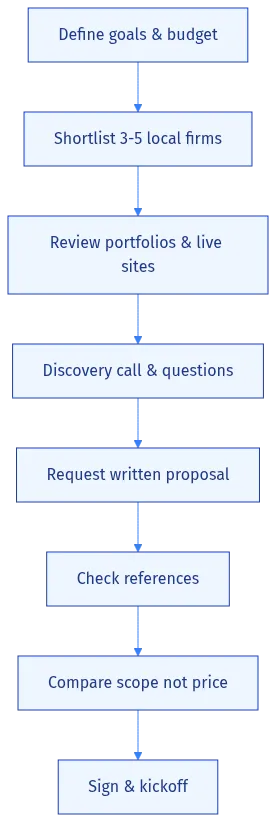
Choosing a web partner shouldn't be a gut call. Here's a repeatable process that works whether you're a solo owner or a marketing director with a committee.
Step 1: Get clear on goals and budget. Are you trying to generate leads, sell products online, rebuild credibility, or all three? A lead-gen site and an e-commerce site are different animals — and firms specialize accordingly. Set a realistic budget range before conversations start so you can compare proposals meaningfully.
Step 2: Build a shortlist of three to five local firms. Combine Google searches ("website design company near me," "web design firms Sarasota"), referrals from your chamber or BNI chapter, and Clutch or Google reviews. Aim for a mix of full-service agencies and boutique studios.
Step 3: Audit each firm's own site and three to five client sites on desktop and mobile. Time load speeds. Check for typos. Try to book a demo or find a phone number. Notice how you feel — that's your customer's experience predicted.
Step 4: The discovery call. Ask about their process, their team structure, who actually does the design work, what happens after launch, and what recent projects taught them. Answers should be specific, not rehearsed.
Step 5: Request written proposals and compare apples-to-apples. Don't compare bottom-line prices — compare scope. Line by line, what's included in discovery, design rounds, copywriting, SEO setup, training, and post-launch support?
Step 6: Reference checks with past Sarasota/Manatee clients. Ten minutes on the phone with a real client tells you more than any portfolio. Ask about timeline adherence, communication, and what they'd do differently. For a broader vendor-vetting framework, see the full Sarasota digital marketing buyer's guide.
- Never skip references — a 10-minute call reveals what portfolios hide.
- Match the firm's specialty to your goal (lead gen vs. e-commerce vs. brand).
7. What a Sarasota Web Design Engagement Actually Looks Like

To set expectations correctly, here's what a real 12-to-14-week engagement looks like when you hire a full-service local partner.
Weeks 1–2: Discovery, brand audit, and competitor analysis. Stakeholder interviews, review of current analytics, side-by-side competitor teardown, and definition of measurable success criteria. You leave this phase with a written strategy document, not a wireframe.
Weeks 3–4: Sitemap, wireframes, and content strategy. Page-by-page structure gets locked in. Wireframes are grayscale on purpose — they force decisions about hierarchy and flow before anyone gets distracted by color palettes.
Weeks 5–8: Design mockups and revisions. Two to three rounds of visual design, typically starting with the homepage and a key internal template, then rolling out across the sitemap. Copywriting typically runs in parallel here.
Weeks 9–12: Development, integrations, and SEO setup. Design becomes code. Forms connect to your CRM, analytics get instrumented, schema markup gets added, and technical SEO foundations are laid down.
Week 13: QA, training, and launch. Cross-browser testing, mobile QA, accessibility checks, staff training on the CMS, and coordinated launch — ideally at a time that won't tank your rankings if something needs a fix.
Ongoing: Analytics review, optimization, and content updates. The best partnerships continue with monthly or quarterly reviews, iterating based on real user behavior data rather than assumptions.
- Most business sites take 8–14 weeks — beware anyone promising a 2-week turnaround for a real project.
- The best partnerships continue long after launch with monthly reviews.
An Analogy That Makes This Obvious
Hiring a web designer is like hiring a contractor to build your storefront. You could pick the cheapest bid from someone three states away who's never seen your neighborhood — or you could hire a local builder who knows the building codes, the foot traffic patterns, the sunlight, and the tradespeople. Both can technically deliver a building. Only one delivers a building that fits where it stands, opens the front door where customers actually approach, and pulls in the right kind of natural light. Your website is that storefront. Pick accordingly.
A Real-World Example
Picture a Sarasota HVAC company that hired an out-of-state agency for a $1,800 template site. It looked fine on desktop but loaded in seven seconds on mobile, buried the phone number three scrolls down, and had no local schema markup — meaning Google couldn't tell it served Sarasota specifically. After six months of stagnant leads, the owner hired a local Manatee County web design firm for a rebuild focused on mobile speed, a sticky tap-to-call CTA, dedicated service-area pages for Sarasota and Bradenton, and proper LocalBusiness schema. Within 90 days, mobile call volume tripled — not because the new site was prettier, but because it respected how their customers actually searched.
What This Means for Your Business
If you're a local business owner or marketing decision-maker in Sarasota or Manatee County, four takeaways should shape your next move:
- Your website is your top salesperson — investing in a qualified local web design partner pays back through credibility, conversions, and search visibility.
- Vetting a website design company near you is a repeatable process, not a gut decision — use portfolios, references, and proposals as parallel data points.
- Mobile performance and local SEO are non-negotiable in the Sarasota/Manatee market — insist that any firm you hire treats them as core deliverables, not add-ons.
- The cheapest option almost always costs more long-term through lost leads, redesigns, and technical debt — measure ROI, not just invoice size.
Keep Learning
- Web Design Agency Near Me: How to Choose the Right Sarasota Partner — A deeper dive into evaluating Sarasota web design agencies, including specific questions to ask on your discovery call.
- Conversion Rate Optimization Manatee County: Turn Clicks Into Clients — Once your new site is live, CRO is how you turn traffic into actual booked business.
- Top SEO Companies Near Me in Sarasota & Manatee County — Great design without local SEO is invisible; here's how to evaluate SEO partners in the region.
- Digital Marketing Agency Near Me: A Sarasota Buyer's Guide — The broader companion guide for choosing any marketing partner in the Sarasota area.
- Ad Agencies Near Me: Why Sarasota Businesses Thrive Locally — Why local partnerships consistently outperform remote vendors for Sarasota and Manatee businesses.
Frequently Asked Questions
How much does a professional business website cost in Sarasota or Manatee County?
For a full-service local build with real discovery, custom design, copywriting, development, and local SEO, budgets typically start around $5,000 and scale up based on scope. Anything under $2,500 usually means a template drop with minimal strategy, which tends to cost more long-term through lost leads and rebuilds.
How long does it take to build a new website with a local web design firm?
Most business websites take 8 to 14 weeks from kickoff to launch when done properly. That timeline covers discovery, wireframes, design, development, SEO setup, QA, and training. Be skeptical of any firm promising a two-week turnaround for a serious business project — corners are being cut somewhere.
Do I really need a local website design company, or can I hire a remote agency?
Remote agencies can technically build the same website, but local partners bring in-person discovery, Sarasota and Manatee market fluency, and a network of local photographers and SEO specialists you can't replicate on Zoom. For lead-generation sites where local trust matters, hiring locally usually delivers better outcomes and faster iterations.
Who owns my website after it's built?
You should — always confirm this in writing. The contract needs to specify that you own the final site files, source code, domain registration, and hosting account. Some agencies retain ownership as leverage against you leaving; that's a red flag to catch before signing anything.
What questions should I ask on a discovery call with a website design company?
Ask about their process step-by-step, who on their team actually does the design and development, how they handle post-launch support, what recent projects taught them, and whether they can share Core Web Vitals scores on recent client sites. Also request three references from Sarasota or Manatee clients you can call directly.