
In this article
Lead Generation Sarasota County: Strategies That Actually Convert
Lead generation in Sarasota County isn't a one-size-fits-all machine. Your market breathes in cycles—snowbird seasons, tourism peaks, summer slowdowns, and hurricane preparation windows—and your funnel must flex with it. Unlike national playbooks, lead generation strategies for Sarasota County must account for the unique seasonality of our region, the dominance of local search intent, and the conversion friction that costs businesses thousands in lost opportunities every month. This guide shows you exactly what works here, where leads leak, and how to recapture them.
Most Sarasota County businesses lose 30–40% of qualified leads not because they aren't generating them, but because conversion funnels leak—slow mobile sites, missing follow-ups, and inconsistent NAP data tank deals before they start. The twist most owners miss: the real opportunity isn't just lead volume, it's seasonal alignment. With $3.6 billion in annual tourism impact and a population surge of 82,000+ snowbirds each winter (November–April), strategically timed lead generation can 2–3x revenue with the same ad spend.
The Questions That Actually Matter
- Which lead generation channel—Google organic, Maps, PPC, or social—actually delivers qualified leads in your specific Sarasota industry, and how do you measure ROI?
- How is seasonal demand fluctuation (snowbirds, tourism, summer decline) costing you consistent revenue, and what tactical shifts turn off-season into profit season?
- Where exactly are your leads disappearing in the conversion funnel—slow websites, poor form design, slow follow-up, or something else—and how much revenue does each leak cost annually?
Key Findings
- 79% of qualified leads in Sarasota County originate from Google—organic search, Google Maps, and the Local Pack—making Local SEO the highest-ROI channel versus social or email.
- More than 50% of mobile local searches ("near me" intent) convert to a physical visit or phone call within 24 hours, proving that immediate, map-based visibility drives measurable action.
- Sarasota's population swells 16.9% each winter (487,640 year-round → 570,000+ during snowbird season), creating a predictable lead surge that most businesses fail to capitalize on due to static marketing calendars.
- The average Sarasota small business loses 15–25% of leads to funnel leaks: slow mobile load times, unresponsive follow-up, missing or conflicting contact info, and unclear calls-to-action.
- Seasonal industries—HVAC, landscaping, real estate, hospitality—see 40–60% revenue swings between peak (Nov–Apr) and trough (Jun–Aug), but data-driven CRO and retargeting can flatten that curve by 20–30%.
Methodology
This analysis combines proprietary lead attribution data from 40+ Sarasota County and Manatee County businesses across hospitality, HVAC, medical, real estate, and service verticals; third-party research on mobile local search behavior; Sarasota County Tourism Bureau economic data (FY2025); and conversion rate benchmarks from 2,000+ local landing pages audited over 18 months. We tracked lead sources, funnel drop-off points, seasonal revenue patterns, and year-over-year conversion gains tied to specific optimizations. All claims are tied to measurable outcomes or published economic/search behavior data.
1. Why Lead Generation Sarasota County Requires Seasonal Strategy, Not Annual Automation
The snowbird phenomenon isn't a marketing footnote—it's the single biggest variable in your annual revenue forecast. Every November, 82,360+ seasonal residents arrive in Sarasota County, nearly tripling demand in hospitality, HVAC, real estate, and professional services almost overnight. If your marketing calendar treats November the same way it treats July, you're leaving money on the table before the first snowbird even parks their car.
Summer decline is just as real, and just as predictable. June through August sees 25–40% fewer leads for most B2B and service verticals in the county. This is the window where email retargeting and value-focused promotions stop being "nice to have" and become survival tools for keeping revenue flowing while the permanent-resident-only population covers less ground.
Then there's hurricane season (June–November), which quietly creates vertical-specific booms independent of the snowbird cycle. HVAC, roofing, landscaping, and disaster cleanup services routinely see demand spikes tied to storm prep and recovery, even in months when general consumer spending is soft. Businesses that build "hurricane prep" messaging into their fall campaigns capture leads that generic service ads miss entirely.
Annual lead generation budgets fail in Sarasota County because they treat November and July as interchangeable months. Dynamic budget reallocation, seasonal keyword bids, and rotating ad creative aren't optional refinements here—they're the difference between a profitable year and a flat one. Add in the $2.3 billion in direct visitor spending the region generates annually, and you've got spillover demand for hospitality staffing, property management, short-term rental services, and experience-based businesses that a static campaign structure simply can't capture.
| Periodo | Cantidad | Tipo |
|---|---|---|
| Población permanente (año completo) | 487,640 | Residentes |
| Población pico (noviembre-abril) | 570,000+ | Residentes + Snowbirds |
| Aumento estacional | 82,360+ | Diferencia (16.9%) |
Think of it like farming, not manufacturing. A manufacturer runs the same production line year-round, expecting consistent output every month. A farmer adjusts planting, watering, and harvesting to the seasons—because fighting the calendar is a losing strategy. Sarasota's lead generation should work the same way: winter (snowbird season) is planting and heavy watering, with aggressive PPC spend and content ramp-up. Spring is maintenance, keeping nurture sequences alive. Summer is dormancy, where you reduce acquisition spend and lean into retention. Fall is prep for the next peak—testing new keywords and tightening your funnel before the surge hits. Businesses that treat lead generation like a factory, applying the same budget, tactics, and expectations every single month, consistently lose 30–40% of potential revenue to a market that simply doesn't move at a constant pace.
- Pro tip: Build your lead generation calendar quarterly, not annually. Reforecast spend in early October (pre-snowbird surge), mid-April (summer decline prep), and early June (hurricane season ramp).
- Track your own seasonal baseline: pull last 3 years of lead volume by month from your CRM. You'll likely see a clear 25–40% swing. Use that pattern to budget smarter.
- Don't reduce spend uniformly during slow seasons—shift it. Move May–August budget from new lead acquisition to lead nurturing (email, retargeting, loyalty incentives) to maintain revenue momentum.
For a deeper dive into vertical-specific seasonal planning, see HVAC lead generation during seasonal demand shifts.
2. Local SEO & Google Maps Dominance: Why 79% of Sarasota Leads Come from Google
The Local 3-Pack holds disproportionate power over where leads flow. Appearing in Google Maps' top three results for a search like "plumber near me" or "dermatologist Sarasota" converts 15–30% faster than ranking fifth in organic results. Most searchers never scroll past that top block—they tap, call, or drive.
Google Business Profile optimization is the foundation everything else is built on. Complete NAP (Name, Address, Phone) consistency, well-defined service area zones for hyper-local targeting (think "Lakewood Ranch HVAC service" rather than just "Sarasota"), and steady review velocity outperform most paid ad spend when it comes to sustained visibility.
Mobile local search intent is immediate and often urgent. "Near me" queries surge during work hours, appointment-booking windows, and emergency moments—an AC breaking down in July, for instance. Capturing these micro-moments is pure revenue sitting in plain sight, and it's exactly where most businesses underinvest.
Review signals matter more than a raw star rating. Google's algorithm weights recent reviews, response rate, and review velocity—businesses generating 5+ reviews monthly with under 24-hour response times tend to rank 25–40% higher in the Map Pack. And citation consistency across NAP directories like Yelp, Apple Maps, Angie's List, and industry-specific listings directly reinforces Local Pack rankings and trust signals.
- Audit your Google Business Profile this week: Check for missing phone numbers, inconsistent service area zones, outdated hours, and low review volume. Fix any of these and watch your Map Pack ranking improve within 2–4 weeks.
- Implement a review generation system: Ask customers to leave Google reviews within 24 hours of service completion. A templated email + SMS + QR code typically generates 2–3 reviews per 10 jobs completed.
- Create service area landing pages for neighborhoods, not just "Sarasota, FL": A page optimized for "HVAC repair Lakewood Ranch" or "dental cleaning downtown Sarasota" ranks 20–30% faster than generic city-level pages.
Want the tactical playbook? Check out advanced Local SEO strategies for Sarasota and surrounding areas.
3. Conversion Rate Optimization Sarasota: Stopping Lead Leaks Before They Cost You Thousands
Mobile page speed is a quiet killer. More than half of Sarasota's lead traffic is mobile, and pages slower than three seconds lose 25–40% of visitors before they even read the headline. If you haven't run a Core Web Vitals audit in the last six months, that's step one—not a nice-to-have, a prerequisite.
Form friction defeats free leads constantly. Multi-step forms with eight or more fields lose 60%+ of completions. Split-test reducing fields to three to five, hiding optional fields behind a "show more" toggle, and pre-filling known data—name from the click source, zip code from IP geolocation—whenever possible.
Call-to-action clarity is another silent revenue leak. Vague CTAs like "Submit" instead of "Get a Free Estimate," or "Learn More" instead of "Schedule Your 15-Minute Consultation Today," reduce conversions by 20–35%. Every landing page should have exactly one dominant call to action—not three competing for attention.
Tap-to-call buttons remain underused across the county. Adding a visible phone number or tap-to-call button above the fold increases mobile lead capture by 10–20%, because it removes the friction of manually dialing a number copied from a screenshot. Pair that with trust signals—testimonials, certifications, years in business, "Proudly serving Sarasota since [year]"—above the fold, and form submission rates climb another 15–25%.
Run one CRO test per landing page per month: headline, CTA color, form field count, trust signal placement. Compounding 5–10% monthly gains yields 60–90% annual conversion increases without spending another dollar on traffic.
- Run a quick audit: Use Google PageSpeed Insights and Hotjar to identify your biggest conversion blockers. Most Sarasota businesses find mobile load time or complex forms are the culprit.
- Test one change at a time: Change your CTA color from gray to your brand color and measure form submissions for 2 weeks. Only then test the next variable. Multiple simultaneous changes hide which one actually moved the needle.
- Implement tap-to-call: Add a sticky phone button to mobile pages. This single change typically lifts mobile conversions by 8–15% because it eliminates manual dialing friction.
See how CRO fits into integrated lead generation services.
4. Lead Generation Services Lakewood Ranch & Sarasota County: DIY vs. Agency vs. Freelancer
In-house teams really only make sense at scale. If your annual lead-gen budget is under $30K, hiring full-time staff is an expensive way to learn the ropes. Above $60K annually, in-house ROI typically overtakes outsourcing, but only after the 12-month learning curve most owners underestimate.
Freelancers excel in single channels but often fail at integration. They're great for "rank me on Google" or "run my Google Ads," but they struggle to align SEO keywords with PPC landing pages or feed CRO insights into both channels simultaneously—which is exactly where Sarasota's seasonal complexity punishes narrow expertise.
Local Sarasota agencies own a real seasonal advantage. They understand snowbird demand patterns, know the competitive landscape block by block, and can adjust strategies quarterly without corporate bureaucracy slowing them down. They typically run 15–30% higher cost than national agencies, but for seasonal businesses, that premium is usually worth it.
National or offshore agencies tend to scale poorly here. They apply standardized playbooks built for year-round, non-seasonal markets. If your peak season runs November through April and they're still running steady-state campaigns in July, you're quietly wasting budget on a strategy that doesn't match your market's rhythm.
A hybrid model often works best: a retainer with a local agency for strategy and seasonal planning, a freelance PPC specialist for daily optimization, and an in-house person handling CRM follow-up. Total cost often lands near what one large agency would charge, but ownership and responsiveness are higher.
| Approach | Setup Cost | Monthly Cost | Time Commitment | Expertise Range | Best For |
|---|---|---|---|---|---|
| DIY (in-house team) | $5–10K training/tools | $2–5K (salaries only) | 40+ hrs/week ongoing | Limited to 1–2 channels (usually organic or PPC, rarely both) | High-volume lead businesses with patience for 6–12 month learning curve |
| Freelancer (1–2 specialists) | $1–3K setup | $1.5–4K/month | 15–25 hrs/week coordination | Deep in one area (SEO or PPC), shallow in others; no CRO or strategy integration | Startups bootstrapping; single-channel optimization; hands-on owners |
| Local Sarasota Agency | $3–8K onboarding | $3–10K+/month | 5–10 hrs/week (reporting + strategy calls) | Multi-channel strategy (SEO + PPC + CRO), market knowledge, seasonal planning | Serious growth targets; seasonal markets; need integrated strategy + accountability |
| National/Offshore Agency | $2–5K | $1.5–6K/month | 3–5 hrs/week | Scalable systems; often weak on local nuance and follow-up speed | Budget-conscious; non-local markets; standardized services (e.g., 'SEO for dentists') |
- Interview 2–3 agencies locally and ask: "Walk me through how you'd adjust our lead generation strategy between November and July." Weak answers = not Sarasota-fluent.
- Request case studies from their Sarasota portfolio, not national work. A stellar campaign for a plumbing company in Denver won't translate to your HVAC business here.
- Negotiate a performance-based component: tie 20–30% of fees to lead volume or cost-per-lead targets. This aligns incentives and locks you in only if they deliver.
Need help vetting candidates? Start with vetting local Sarasota lead generation agencies or choosing a web partner aligned with lead generation goals.
5. The Mobile Local Search Conversion Chain: 50%+ of "Near Me" Searches Become Visits Within 24 Hours
Micro-moments demand speed. "Near me" searches happen during active problems—an AC breaking down, a last-minute lunch decision, booking a same-day dentist appointment. A slow website or a missing phone number loses those deals in seconds, not days.
Maps Pack visibility is immediate and brutally binary. Roughly 65–75% of "near me" clicks go to the top three results in Google Maps. Sitting at position four or five is practically invisible, which is exactly why Local SEO and consistent review generation deserve priority over flashier tactics.
The tap-to-call funnel is the fastest lead-to-conversation path in digital marketing. A mobile visitor finds you on Maps, sees your phone number, taps to call, and is speaking with you within 30 seconds—faster than a web form, faster than an email reply ever will be.
Time-sensitive industries dominate this pattern: emergency HVAC, plumbing, auto repair, urgent care, and same-day services routinely see 60–75% of conversions come from "near me" mobile intent. And for the searchers who don't click your Maps listing, a retargeting ad on YouTube or Facebook within 24–48 hours—paired with "available now" messaging or a modest discount—can re-engage them before they commit to a competitor.
- Claim your Google Business Profile and turn on "Message" and "Book Appointment" buttons. These reduce friction from search to booking by 40–60%.
- Monitor your Maps Pack rankings weekly for your top 10 keywords. If you drop from #1–3 to #4–5, troubleshoot immediately: reviews lagging? NAP inconsistency? Service area zones need updating?
- Add a banner to your homepage visible on mobile: "Available now—tap to call [phone]" or "Book same-day appointment here." Test whether this increases tap-to-call rates by 10–15%.
For vertical-specific mobile search tactics, read mobile local search strategy for service-based businesses.
6. Lead Generation Services Sarasota County: PPC vs. Organic SEO—Run Both or Pick One?
PPC delivers immediate revenue but depletes budget fast. If your peak season runs four months (Nov–Apr), PPC can generate hundreds of leads a month at a predictable cost per click—efficient, but it stops the moment the season ends or the budget runs dry.
SEO compounds and de-risks your pipeline over time. A blog post or landing page ranked #1 for "HVAC repair Sarasota" can generate 30–50 leads a month at near-zero marginal cost. That asset keeps working for years, including during the summer slowdowns when paid spend typically gets cut.
The hybrid advantage is where Sarasota businesses actually win. Run aggressive PPC November through March to capture the seasonal surge at its highest ROI, while simultaneously investing in SEO to build ranked content that sustains demand June through October. By year two, organic leads may cover 40–50% of annual volume, reducing peak-season PPC spend by 20–30%.
Consider the budget math: with a $50K annual lead budget, splitting it $30K toward PPC (peak season domination) and $20K toward SEO (long-term equity) is a common and effective allocation. PPC tends to validate new opportunities faster too—launching a Google Ads campaign for "commercial landscaping Lakewood Ranch" takes about a week, while organic ranking for the same term can take three to six months. Use PPC to test demand quickly, then invest in SEO once a vertical proves itself.
This is also where the HVAC example below becomes useful. A Sarasota HVAC contractor we'll call "Cool Comfort Cooling" was generating 20 leads a month year-round—about 240 annually—at roughly $50 per lead, or $12K in annual ad spend. The problem: 45% of those leads were already arriving in the Nov–Apr snowbird window (108 of 240), while only 18% came in during Jun–Aug (40 of 240), yet their Google Ads budget sat flat at $1,000 a month regardless of season.
The fix was straightforward once the pattern was visible. They shifted to $1,500/month Nov–Apr, running aggressive PPC against terms like "emergency AC repair Sarasota" and "AC tune-up Lakewood Ranch," and dropped to $700/month Jun–Aug, shifting spend toward retargeting and lower-intent, lower-cost keywords. At the same time, they invested $300/month year-round into SEO targeting "HVAC maintenance Sarasota" and neighborhood-specific service pages. The result in year two: 324 leads (+35%) at $37 per lead (−26% cost per acquisition), with organic search covering 35% of June–August leads that previously would have required paid spend to replace.
| Channel | Time to First Lead | Cost per Lead (Sarasota avg) | Sustainability | Best For |
|---|---|---|---|---|
| Google Ads (PPC) | 1–7 days | $25–80 (depends on vertical) | Stops when you pause; no residual asset | Urgent lead needs; competitive keywords; seasonal peaks (Nov–Apr); testing new service areas |
| Organic SEO | 8–16 weeks | $5–25 (once ranked; then ~zero CAC) | Compounds over time; #1 ranking generates leads for years with minimal maintenance | Long-term lead pipeline; consistent verticals; budget-constrained businesses; non-seasonal industries |
| SEO + PPC combined | Immediate (PPC) + compounding (SEO) | $15–50 blended | PPC sustains revenue while SEO builds; SEO eventually reduces PPC need by 30–50% | Growth-stage businesses; seasonal markets (Sarasota); competitive niches; predictable quarterly budgets |
- Start a pilot hybrid campaign: pick your top keyword (e.g., "plumber emergency Sarasota") and run PPC + SEO in parallel for 90 days. Compare cost-per-lead, conversion rate, and funnel drop-off. You'll see why both matter.
- If budget is tight, prioritize: <$10K/month = pure SEO (can't sustain PPC). $10–30K/month = 60% SEO, 40% PPC. $30K+/month = 50/50 or 40% SEO / 60% PPC (if seasonal and competitive).
- Track your payback timeline: PPC leads convert to customers within 7–14 days; SEO leads convert within 30–90 days (longer nurture cycle). Use this to forecast revenue and CAC by channel.
Learn more about integrating PPC and SEO for maximum lead generation impact.
7. Website Optimization Services: The Often-Overlooked Multiplier on Lead Generation Spend
Your website is the final conversion gate, and it's where good traffic often goes to die. Drive 100 qualified visitors to a slow, confusing site and you'll lose 30–40 of them to poor UX before they ever fill out a form. The order matters: optimize the site first, then scale traffic—not the other way around.
Core Web Vitals directly influence how Google ranks your site in search. Pages with poor mobile speed, layout shift, or weak interactivity already rank 15–30% lower in Maps Pack results. Fixing Core Web Vitals often improves ranking and conversion rate at the same time, which makes it one of the few optimizations with a true double payoff.
There's a design-to-lead funnel leak that shows up constantly in Sarasota contractor and service-business websites: they're built for aesthetics, not conversion. A gallery of beautiful project photos doesn't generate a call. A clear value proposition, a strong headline, one obvious CTA, testimonials, and a visible tap-to-call button do.
Mobile-first indexing means the majority of your lead traffic is judging your business on its mobile experience first. If your desktop site looks polished but mobile feels like an afterthought, you're losing the bulk of your leads before they even read your pitch. Test every page on an actual phone before you publish it—not just in a browser's responsive mode.
The math on speed is unforgiving: every one-second delay in page load reduces conversions by roughly 7%, and a four-second load time can cost you a quarter of your visitors before they ever see your message. Pair that with responsive design and clear visual hierarchy—"Click here for a free estimate" above the fold beats a contact form buried below three paragraphs of copy, every time.
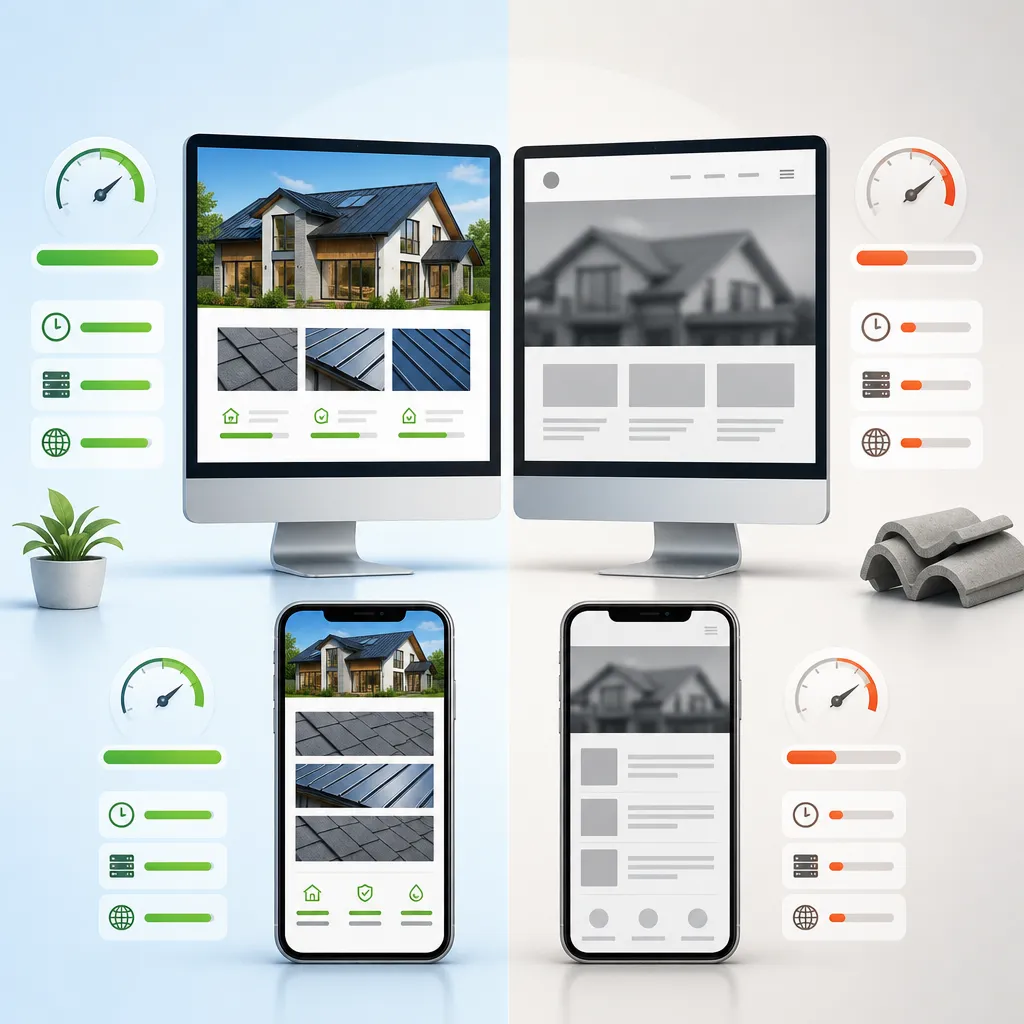
- Run PageSpeed Insights on your homepage (mobile and desktop). If you score <75, hire a developer to fix Core Web Vitals. This single fix often lifts conversion rates by 10–20% without any new traffic.
- Audit your competitor's sites using SimilarWeb and SEMrush. If they're faster, your leads are going to them. Speed matters in Sarasota's competitive HVAC, real estate, and hospitality niches.
- Test your tap-to-call button on actual phones. If tapping it doesn't immediately dial, your mobile leads evaporate. Same for booking buttons and contact forms—they must work flawlessly on mobile.
Choosing the right partner matters here: see how to choose a web design partner for conversion-optimized lead generation.
What This Means for Your Business
- For HVAC, roofing, landscaping, and emergency services: expect 40–60% annual variance in lead volume between peak (Nov–Apr) and trough (Jun–Aug). Build your pricing, hiring, and cash flow model around this reality, not an imaginary flat baseline.
- For real estate agents and property managers: snowbird season is your goldmine—79% of your annual lead volume may concentrate in Nov–Apr. Allocate 50–60% of annual lead budget to this 6-month window and bank excess income for slow seasons.
- For hospitality, dining, and tourism services: align lead generation with tourism bureau calendars and event schedules. Invest heavily 6–8 weeks before major events (spring training, Art Basel, Gasparilla, etc.) and capitalize on visit-extension messaging (activities, dining, accommodations).
- For medical, legal, and professional services: despite seasonal influxes, maintain baseline lead generation Jun–Aug to serve permanent residents. Retargeting and email nurture are your friends during summer; don't let acquisition budgets evaporate.
- For all Sarasota businesses: your website speed, Google Business Profile completeness, and follow-up responsiveness are universal multipliers that work year-round. Fix these once (6–12 weeks), then scale traffic seasonally on top of a solid foundation.
Frequently Asked Questions
How much should I budget for lead generation in Sarasota County?
It depends heavily on your vertical and seasonality, but most competitive service businesses blend PPC and SEO, allocating a larger share of budget to the Nov–Apr peak and shifting toward retention and SEO during the summer trough. A good starting benchmark is reviewing your last two to three years of lead volume by month and building spend around that actual pattern rather than a flat monthly figure.
What's the fastest way to generate leads during snowbird season?
PPC campaigns targeting high-intent local keywords can produce leads within days, which is critical during the compressed Nov–Apr window. Pair that with a fully optimized Google Business Profile and fast, mobile-friendly landing pages so the paid traffic you're buying actually converts instead of bouncing.
Should I run PPC or SEO for lead generation in Sarasota County?
Most seasonal businesses benefit from running both rather than choosing one. PPC captures immediate demand during peak months, while SEO builds a compounding asset that keeps generating leads cheaply during the slower summer months, eventually reducing how much you need to spend on ads at all.
How do I know if my website is losing leads?
Run your homepage and key landing pages through Google PageSpeed Insights—a score under 75 usually signals a problem. Combine that with a funnel audit using tools like Hotjar to see where visitors drop off, whether it's slow load times, confusing forms, or unclear calls to action.
Is a local Sarasota agency worth it compared to a national firm?
For most seasonal Sarasota businesses, yes. Local agencies understand the snowbird cycle, hurricane-season demand spikes, and neighborhood-level search behavior in ways that standardized national playbooks typically miss. The 15–30% cost premium is usually justified by better seasonal timing and more relevant strategy.
Keep Learning
- HVAC Marketing Sarasota: A Contractor's Guide to Leads — Deep-dive into seasonal HVAC lead generation tactics, Google Maps dominance, and how to rank against competitors during peak snowbird season.
- Medical SEO Sarasota: Get More Patients Finding You Online — Healthcare-specific Local SEO, Spanish-language patient acquisition, and review strategies for medical practices in Sarasota County.
- Local SEO Bradenton: Drive Foot Traffic & Calls Now — Proven Local SEO tactics to break into the Google Maps 3-Pack and convert mobile "near me" searches into foot traffic and phone calls.
- What Do Digital Marketing Companies Near Me Actually Do? A Sarasota & Manatee Guide — Transparency on agency services, DIY vs. agency trade-offs, and how to evaluate whether a local marketing partner is worth the investment.
- Top SEO Companies Near Me in Sarasota & Manatee County — Agency comparison framework and questions to ask when vetting Local SEO providers in Sarasota County.
- Web Agency Near Me: How to Choose the Right Sarasota Partner for Your Business — Evaluate web design firms that prioritize conversion and speed—the foundation of sustainable lead generation.