

In this article

Social Media Agency Sarasota County: A Buyer's Guide to Finding the Right Fit
A social media agency Sarasota County can be the fastest way to scale your local brand visibility, generate qualified leads, and build genuine customer relationships. But only if you hire the right one. Too many small business owners in the area sign contracts with agencies that promise viral posts and "brand awareness"—metrics that look good in monthly reports but don't move the needle on revenue. This guide cuts through the noise and shows you exactly what a solid social media agency actually does, the red flags to watch for, and the five questions that separate the serious operators from the tire-kickers.
Here's the uncomfortable truth: most Sarasota County business owners hire their first agency based on a sales pitch, not a strategy—and end up regretting it within 90 days. The good news is that the difference between an agency that wastes your budget and one that drives real leads isn't complicated. You just need to know what to look for before you sign.
What You Need to Know Before You Start Vetting Agencies
- What does a social media agency actually do for a small business, and how does that differ from what a freelancer or in-house manager can do?
- How much should I expect to pay for professional social media management in Sarasota, and what's included at different price points?
- What are the red flags that signal a low-quality agency, and how do I spot them before I sign a contract?
Key Findings
- A quality social media agency plans content, manages organic growth, handles paid advertising, responds to customer comments, and reports on metrics that actually move business outcomes—not vanity metrics like likes.
- 68% of small business owners recognize social media as their highest-value marketing channel, but most aren't running it strategically enough to capture that potential.
- Sarasota-Manatee's 5.09% annual job growth signals an active business market with real demand for local marketing services, and 74% of the U.S. population actively uses social media, making local paid campaigns highly efficient.
- Pricing for social media management in Florida ranges from $303 to $2,020 per month, but the lowest price rarely delivers the best results; you're usually paying for different service levels and strategic depth.
- The agencies worth hiring ask questions about your goals, industry, and current challenges before promising anything—not the other way around.
Methodology
This guide draws on industry pricing data from Florida social media management firms, market growth statistics for Sarasota-Manatee County, and the most common questions business owners ask before hiring an agency. We've also flagged the most frequent complaints about bad agency relationships—contract lock-in, lack of transparency, overpromising on speed, and obsession with irrelevant metrics. The goal isn't to recommend specific agencies, but to give you a framework to evaluate any agency you're considering, ask the right questions, and avoid the most common mistakes.
1. What a Social Media Agency Sarasota County Actually Does (and What It Doesn't)
Before you compare quotes, it helps to understand exactly what you're buying. Social media agency services typically cover five core functions: content planning, content creation, scheduling and publishing, community management, and paid advertising. A serious agency doesn't just post pretty graphics on a schedule—it builds a content calendar tied to seasonal demand, manages your presence across platforms, engages with comments and DMs, and runs paid campaigns designed to generate measurable outcomes.
Agencies exist because managing this well takes more time and specialized skill than most owners expect. Someone has to monitor comments after hours, test ad creative against different audiences, track which posts drive traffic versus which just look nice, and adjust strategy based on what the data shows. A single freelancer can often keep up with content and scheduling, but juggling paid ads across Meta, TikTok, and LinkedIn simultaneously—while also managing community response and reporting—is where a small team starts to earn its fee.
Where social media management companies add real value beyond a solo freelancer is in the strategic layer: cross-platform consistency, A/B testing on ad creative and copy, audience research, competitive analysis of what similar businesses in your market are doing, and quarterly planning that ties content back to business seasonality. That strategic depth is hard to replicate part-time.
That said, agencies aren't a cure-all. They can't replace the product knowledge your in-house team has, they typically move slower than a dedicated full-time employee sitting in your building, and they cost meaningfully more than a single freelancer handling one platform. Knowing this trade-off upfront helps you set realistic expectations—and it's part of how to measure real social media results beyond vanity metrics from day one.
| Responsibility | Social Media Agency | Freelancer/Solo Manager | In-House Employee |
|---|---|---|---|
| Content Planning & Calendar | ✓ Strategic + Seasonal | ✓ Basic Planning | ✓ Varies by role |
| Content Creation (Copy/Design/Video) | ✓ Full-service team | ~ Limited (often outsourced) | ✓ In-house only |
| Post Scheduling & Publishing | ✓ 24/7 automation | ✓ Scheduled posts | ✓ On-demand or routine |
| Community Management (Comments/DMs) | ✓ 24/5 monitoring + responses | ~ Slower response | ✓ Real-time (if dedicated) |
| Paid Ads Management (Meta, TikTok, LinkedIn) | ✓ Strategy + optimization | ~ Basic setup only | ✗ Often not included |
| Analytics & ROI Reporting | ✓ Detailed monthly reports tied to goals | ~ Basic metrics only | ✓ Depends on sophistication |
| Best for | Scaling fast; limited internal bandwidth; need strategic guidance | Budget-conscious; hands-on owner; single-platform focus | Long-term consistency; full creative control; high volume of content |
- Agencies are best for businesses that need to delegate the entire social function, run paid campaigns at scale, or want strategic guidance from experienced practitioners.
- If you're early-stage and budget is tight, a freelancer can deliver solid content for a fraction of the cost—but you'll manage ads, strategy, and analytics yourself.
- If you have an in-house marketer, an agency can specialize in paid ads and community management, letting your team focus on content strategy and brand voice.
2. Social Media Management Pricing in Florida: What $303–$2,020 Per Month Actually Buys
Pricing for social media management companies in Florida spans a wide range, and understanding what sits at each tier will save you from either overpaying or underestimating what a project should cost. At the entry level—roughly $300 to $600 per month—you're typically getting single-platform content posting, basic community responses, no paid ad management, and a monthly summary report. It's a reasonable starting point if your budget is tight and you just need consistent presence.
The mid-tier, running $600 to $1,500 per month, is where most Sarasota County small businesses land. This usually includes management across two to three platforms, daily engagement, paid ad management (often tied to a separate ad budget of $1,000 to $5,000 per month), strategic content planning, and bi-weekly check-ins with your account manager. This tier tends to offer the best ratio of strategic depth to cost.
Premium service, from $1,500 up to $2,020 or more per month, includes full-service strategy, original content creation with professional graphics and video, paid ads with active performance optimization, real-time community management, detailed ROI reporting, and quarterly planning sessions. This level makes sense once you're running significant ad spend or competing in a saturated local category like restaurants or med spas.
What actually moves the price within these ranges: how many platforms you're on, how much original content versus curated content is produced, whether the agency manages your ad budget directly, whether video production is included, whether they run competitor analysis, and your industry. E-commerce and finance brands typically cost more to manage than service trades because the content and compliance requirements are heavier.
- Don't assume the cheapest agency is a bad investment—sometimes a lean operator can do solid work. But if the quote seems too low (under $300/month), ask exactly what's included and what isn't.
- Mid-tier agencies ($600–$1,200) usually offer the best balance of strategic depth and affordability for most Sarasota County small businesses.
- Premium pricing ($1,500+) makes sense if you're running significant ad spend (over $5K/month), need professional video content, or operate in a competitive local market.
- Always clarify what's included: Does their fee cover ad spend, or is that separate? Do they create original graphics, or just post what you provide? How often do you get reporting?
3. The Metrics That Matter: Why Likes Don't Mean Revenue
Vanity metrics—reach, impressions, follower counts, likes—look impressive in a slide deck, but they don't tell you whether anyone actually became a customer. This is the single biggest disconnect between social media marketing near me searches that turn into a hire and the results those business owners actually get.
The metrics that matter are cost per lead, lead quality, click-through rate to your website, phone calls generated, form submissions, and return on ad spend (ROAS). These are the numbers that connect your monthly invoice to actual business outcomes. Before you sign with any agency, ask to see their reporting template. A serious operator will show you cost-per-lead and ROAS front and center—not a wall of screenshots of posts with engagement percentages next to them.
Here's a real-world illustration of why this matters. A restaurant owner in Sarasota hired Agency A at $400 per month for "brand awareness," and after six months had gained roughly 2,000 new followers but zero increase in table reservations. Frustrated, the owner switched to Agency B at $800 per month. Within two months, Agency B had generated 8 qualified leads—people who called about events or private dining—two of which booked tables worth a combined $1,200 in revenue. Agency B's cost per lead worked out to $50, with a 3:1 return on ad spend. Agency A was cheaper, but it measured the wrong thing entirely. Agency B cost more upfront but was actually connected to the business outcome that mattered.
A post with 500 likes and 10 clicks is a failure if your goal is lead generation. A post with 50 likes and 20 qualified phone calls is a win. If an agency's monthly report is mostly screenshots of posts and engagement numbers with no connection to your business goals, you're paying for content posting, not strategy. Learn more about turning clicks from social ads into actual conversions through optimized landing pages and funnels—because even great social strategy falls flat if your website can't close the loop.

- A post with 500 likes and 10 clicks is a failure if your goal is lead generation. Conversely, a post with 50 likes and 20 qualified phone calls is a win.
- The best agencies will tie social media performance back to your revenue: "This campaign generated 12 leads at $45 per lead, and 3 of those closed as $5K projects."
- Before you hire, ask the agency: "How will we measure success, and what metrics do you report on monthly?" If they default to engagement rate or follower growth, keep looking.
4. Red Flags: How to Spot a Weak Social Media Agency Before You Sign
Hiring a social media agency is a lot like hiring a contractor for a home renovation. You wouldn't hire someone who promises to "make your house awesome" without asking what you want, showing past work, or giving you a detailed quote. The same rules apply here: clear scope, portfolio proof, transparent pricing, and a defined timeline. A weak agency behaves like a contractor who disappears mid-project—vague updates, missed deadlines, and excuses when you ask for results. A solid agency checks in regularly, shows you progress against a plan, and delivers what was promised on schedule.
Unrealistic promises are the first tell. No one can guarantee virality, guaranteed follower counts, or overnight results. Anyone who claims otherwise is either overselling or planning tactics that will eventually get your account flagged or banned. Transparency problems are the second tell: hidden fees, vague "custom" pricing with no written breakdown, and no reporting template available before you sign. A weak strategic process shows up as a one-size-fits-all pitch—no questions about your industry, your goals, or your current challenges, and a recommendation to run every platform at once regardless of where your customers actually are. Finally, watch for a thin or irrelevant portfolio. If an agency can't show three examples of work in your industry or market, or won't provide client references, that's worth a direct follow-up question.
| Red Flag | What It Means | What To Do |
|---|---|---|
| Promises 'viral' results or guaranteed followers | No one can promise virality. If they claim they can, they're either selling snake oil or planning black-hat tactics. | Walk away. Viral is luck + timing + resonance, not a deliverable. |
| No clear pricing; everything is 'custom' | They want to lock you in without being transparent. Custom pricing often means markup. | Ask for a written quote that breaks down what's included at each price tier. |
| Wants a long-term contract (12+ months) upfront | Good agencies earn your loyalty month-to-month. Long contracts protect mediocrity. | Negotiate for 3–6 months initial commitment with monthly renewal. |
| Recommends ALL platforms (TikTok, Instagram, LinkedIn, Facebook, Pinterest, Twitter) | Spreading budget thin across channels wastes money. Most small businesses don't need all five. | Ask them to justify 2–3 platforms based on your audience and goals. |
| Doesn't ask about your goals, budget, or industry before pitching | They're selling a service, not solving your problem. Generic pitches = generic results. | Good agencies spend 20+ minutes asking questions before they recommend anything. |
| Can't show relevant portfolio or case studies | Either they're new (fine, but admit it), or their results aren't worth showing (red flag). | Ask for 3 portfolio examples in your industry or market. If they deflect, move on. |
| Focuses entirely on 'brand awareness' with no link to leads or sales | Awareness matters, but it's not the only goal for most small businesses. This is a cop-out metric. | Make sure at least 50% of the strategy is tied to lead generation or revenue. |
- The best question to ask early: "Can you show me three portfolio examples in my industry, and explain what metrics improved for those clients?" If they can't or won't, that's a signal.
- Trust your gut. If a sales rep feels pushy or evasive about pricing or contracts, they're usually evasive about results too.
- A solid agency will say, "Here's what we've done for similar businesses, here's our process, and here's what we'd need from you to succeed." That clarity is a good sign.
5. Five Questions to Ask Before You Sign a Contract with a Social Media Agency
Once you've screened out the obvious red flags, use these five questions to separate a genuinely strategic partner from an agency that's just busy filling a content calendar. Ask them in a discovery call, not over email, so you can hear how confidently and specifically they answer.
Question 1: Have you worked with businesses like mine before, and what specific results did you drive? Listen for concrete examples, real industry knowledge, and metrics tied to business outcomes—not generic reassurances.
Question 2: Walk me through your content creation and approval process. Who writes copy? Who designs graphics? How many revisions am I allowed? A structured workflow with clear roles and realistic revision limits signals an agency that has actually run this process before.
Question 3: How will you measure success for my business, and what metrics will you report on monthly? You want to hear leads, conversions, or ROAS—not just reach and likes.
Question 4: What's included in your contract? Ask about payment terms, minimum commitment, exit clauses, and how much notice you need to give if you want to cancel. Flexibility and transparency here matter more than a polished sales deck.
Question 5: Can you show me three recent client case studies, and are there clients I can reference? Specific examples, willingness to connect you with references, and a track record in your space all point to an agency that delivers, not just pitches.
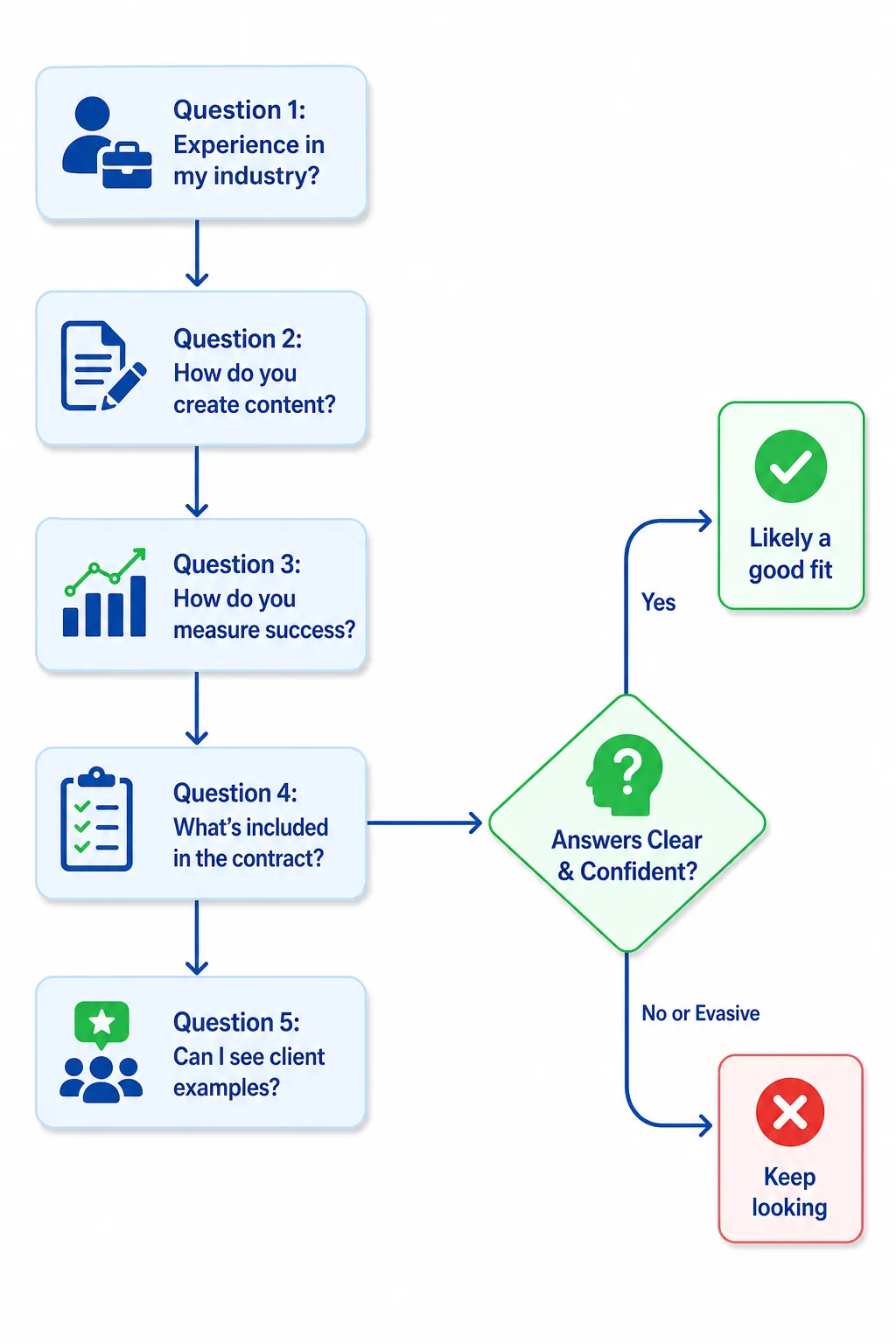
- Good agencies will have confident, specific answers to all five questions and will volunteer their contract terms without being asked.
- If an agency hesitates or gives vague answers, that's your signal to ask follow-up questions or move on.
- Schedule a 30-minute discovery call before the sales pitch—it's the best way to feel out whether they actually want to understand your business or just close the sale.
These same evaluation principles apply whether you're vetting social media advertising agencies or comparing them against local SEO providers. If you want a broader framework, how to evaluate any local marketing service (same vetting principles apply to agencies across channels) is worth reading alongside this guide.
6. Which Platforms Should Your Sarasota Business Use?
Not every platform is right for every business, and one of the clearest signs of a weak pitch is an agency recommending you show up everywhere at once. Facebook remains the largest and oldest platform, and it's still strong for local targeting and retargeting—good for restaurants, local service businesses, and B2C retail. Instagram is visual-first and performs well for ecommerce, beauty, fitness, restaurants, and hospitality, particularly with under-40 audiences.
LinkedIn is the right home for B2B and professional services—law firms, consultants, financial advisors—where lead generation for higher-ticket services and thought leadership content do the heavy lifting. TikTok is the fastest-growing platform and skews under 35; it's a tougher fit for traditional service businesses but can work extremely well for hospitality, fashion, fitness, and consumer brands willing to embrace a more creative, less polished style.
The simplest way to choose: ask where your customers actually spend time (survey them directly if you're unsure), pick the top one or two platforms, and master those before adding a third. Manatee County's 17% population growth between 2020 and 2025, combined with Sarasota's active business market, means there's healthy and growing local demand specifically on Facebook and Instagram—both platforms are built for the kind of local, geographic targeting that a growing customer base rewards.
- Most small businesses do best with Facebook + Instagram (owned by Meta, easy to manage together) unless your audience is strictly B2B (LinkedIn) or very young (TikTok).
- If an agency recommends you go all-in on all five platforms, that's a budget waste. Focus beats sprawl.
- Manatee County's 17% population growth (2020–2025) and Sarasota's active business market mean there's healthy local demand on Facebook and Instagram specifically—those platforms are built for local targeting.
What This Means for Sarasota and Manatee County Businesses
- Small and mid-market business owners in Sarasota and Manatee County can compete directly with larger competitors on social media because strategy and execution matter far more than budget size. A $800/month agency running the right strategy will outperform a $2,500/month agency wasting spend on irrelevant channels.
- The 5.09% annual job growth in Sarasota-Manatee and 17% population growth in Manatee County mean the local customer base is expanding—social media becomes increasingly valuable as a cost-effective way to reach new people in your geographic area.
- 68% of small business owners already believe social media is their highest-value marketing channel. The gap between those who see results and those who don't isn't the channel—it's the strategy and execution. Hiring a solid agency is one of the clearest ROI bets a small business can make.
- The range of pricing ($303–$2,020/month) means there's an option for nearly any budget. The risk isn't cost; it's choosing the wrong agency and wasting money on low-quality work. Focus your evaluation on strategy and portfolio, not price.
Keep Learning
- Local SEO Sarasota County: Win in 2025 — Social media and local SEO work together. Learn how to rank higher on Google while your social media agency builds awareness and drives leads from social platforms.
- Conversion Rate Optimization in Sarasota: Turn More Visitors Into Leads — Social media drives traffic, but your website converts it. See how to optimize landing pages and forms so the leads your agency generates actually turn into customers.
- Top SEO Companies Near Me in Sarasota & Manatee County — Many businesses pair social media agencies with SEO services for integrated local marketing. Use the same vetting criteria to evaluate any marketing partner.
- Restaurant Marketing Sarasota: Fill Your Tables Year-Round — If you're a restaurant or hospitality business, see how social media (especially Instagram and Facebook) integrates with paid ads to drive reservations and repeat visits.
Frequently Asked Questions
How do I know if I need a social media agency versus a freelancer?
If you need to delegate the entire social function, run paid ads at scale, or want strategic guidance across multiple platforms, an agency is usually the better fit. If your budget is tight and you're comfortable handling ads and analytics yourself, a freelancer can deliver solid content at a lower cost.
What's a fair monthly budget for social media management in Sarasota County?
Local pricing generally falls between $303 and $2,020 per month depending on platform count, content volume, and whether paid ad management is included. Most small businesses find the best balance of strategy and affordability in the $600–$1,200 range.
Should I sign a long-term contract with a social media agency?
No—be cautious of any agency pushing a 12-month commitment upfront. A good agency should be confident enough in its results to work on a 3–6 month initial term with monthly renewal, since results, not contract lock-in, are what should keep you as a client.
Which social media platforms should my Sarasota business actually be on?
Start with where your customers actually spend time rather than trying to cover every platform. Most local businesses do well starting with Facebook and Instagram, while B2B and professional services often see better results focusing on LinkedIn.
What metrics should I expect in a monthly report from my agency?
You should see metrics tied to business outcomes—cost per lead, click-through rate, form submissions, phone calls, and return on ad spend (ROAS)—not just reach, impressions, or follower growth. If a report is mostly post screenshots with engagement numbers, ask the agency to reconnect their reporting to your actual goals.