

In this article
Social Media Marketing Sarasota: A Local Growth Guide
Social media marketing Sarasota is no longer optional—it's the foundation of how customers discover and trust your business. Whether you run a vacation rental, an HVAC company, a medical practice, or a local service business, your social presence shapes whether potential customers choose you or your competitor. The challenge isn't just posting; it's posting the right content to the right audience on the right platform, at the right time, in a market as unique as Southwest Florida. This guide walks you through why local expertise matters, which platforms deliver real results for Sarasota and Manatee County businesses, what to expect to spend, and how to measure ROI—so you can confidently invest in growth.
Here's the twist most business owners don't see coming: the average social media marketing budget in Sarasota ranges from $500 to $5,000 a month, yet nearly 8 in 10 consumers check a brand's social media before buying. That gap—between what businesses spend and what customers expect to see—is where money gets left on the table. Most local businesses either skip the investment entirely or hire a generic, out-of-state agency that treats Sarasota like any other zip code. Neither approach works, and this guide explains why.
Questions Every Sarasota Business Owner Asks Before Investing
Before committing budget to social media, most owners want straight answers to three questions: Why do national agencies often underperform in a market like Sarasota, and what does local expertise actually buy you? Which platforms—Facebook, Instagram, LinkedIn, or Nextdoor—genuinely produce customers for your specific type of business in Southwest Florida? And realistically, how much should you budget, and what return can you expect once the dust settles? We'll answer all three, with specifics, throughout this guide.
Key Findings on Social Media Marketing Sarasota
- 78% of consumers check a brand's social media before purchasing, making an active, professional presence non-negotiable for Sarasota businesses.
- Companies actively using social media see 23% higher revenue growth than competitors who don't—a measurable, direct impact on the bottom line.
- Local agencies in Sarasota offer granular market knowledge: seasonal tourism patterns, retiree-focused demographics, family and lifestyle segments, and neighborhood-level targeting that national firms simply cannot replicate.
- Facebook remains the dominant platform for reaching 35+ demographics crucial in Sarasota and Manatee; LinkedIn dominates B2B lead generation, capturing 80% of all social-based business leads.
- Average ROAS (return on ad spend) for Facebook and Instagram campaigns is 4:1, meaning every $1 spent typically returns $4 in revenue or qualified leads.
Methodology
This guide synthesizes research-backed statistics, direct market analysis of Sarasota and Manatee County demographics, and insights from local business trends. We examined platform adoption rates across age groups, seasonal tourism patterns specific to Southwest Florida, and case studies from service-based, hospitality, and B2B businesses operating in the region. We also cross-referenced social media marketing cost benchmarks, typical ROAS metrics, and platform performance data to provide actionable, localized guidance. All claims are either sourced from published industry data or tied to observable market conditions in Sarasota and Manatee counties.
1. Why Social Media Marketing Sarasota Requires Local Expertise (Not National One-Size-Fits-All)
Sarasota isn't a generic Florida market, and treating it like one is the fastest way to burn through an ad budget. Between November and April, the population swells with seasonal residents and tourists who behave, search, and buy differently than the year-round locals who carry your business through summer. A national agency running the same campaign in July that it ran in January isn't being efficient—it's missing the two most profitable windows of your calendar.
The demographic layering here matters just as much as the seasonality. Retirees in Sarasota proper skew toward Facebook, where they read local news, join community groups, and research businesses before calling. Families in Lakewood Ranch respond to a different tone and different platform mix—more Instagram, more school and youth-sports tie-ins. Siesta Key vacationers are a third audience entirely, driven by lifestyle imagery and last-minute booking urgency. A local agency builds separate strategies for each segment; a national firm applies one template to all three and calls it "targeting."
Proximity also changes the quality of the work itself. A Sarasota-based team can walk into your business, photograph your actual staff and storefront, and write copy that sounds like it was written by someone who has eaten at the restaurant next door—because they have. That authenticity shows up in engagement rates and, eventually, in reviews and referrals that amplify whatever you're spending on paid ads. National agencies, by contrast, tend to lean on generic stock photography and templated copy that a Sarasota resident can spot from a mile away.
There's also a growing multicultural dimension to this market that out-of-state agencies routinely miss. Sarasota and Manatee's Hispanic population has been expanding, and businesses that ignore Spanish-language content are leaving a real segment of potential customers unaddressed. Local agencies who work in this market daily tend to build bilingual content into the plan from day one, not as an afterthought.
| Factor | Local Sarasota Agency | National/Generic Agency |
|---|---|---|
| Market Knowledge | Deep understanding of seasonal tourism, retiree demographics, local competition | Limited; applies generic templates to all markets |
| Seasonal Strategy | Adjusts ad spend, messaging, and platform mix for peak season (Nov–Apr) vs. summer slump | Runs same campaigns year-round; misses high-ROI windows |
| Audience Targeting | Knows Siesta Key vacationers, Lakewood Ranch families, medical tourists, and service-area neighborhoods | Broad Florida or USA targeting; wasted ad spend on irrelevant audiences |
| Relationship & Accountability | Face-to-face meetings, direct owner access, community reputation at stake | Account manager rotations, support tickets, minimal personal connection |
| Content Authenticity | Creates content that resonates with local culture, values, and humor | Generic stock photos and templated copy |
| Cost | $1,500–$5,000/month typical for full-service management | $2,000–$10,000+/month; often includes bloat and unnecessary services |
| Best for | Established local businesses, hospitality, contractors, medical practices, service-based SMBs | National chains, large budgets, brands with no local nuance |
- A local Sarasota agency knows that peak tourism season (November–April) demands different ad strategy than summer; national firms don't adjust.
- Local agencies understand Spanish-language and multicultural marketing nuances—critical in Sarasota and Manatee's growing diversity.
- Direct relationships with local agency owners mean faster pivots, honest feedback, and accountability—you're not a ticket in a CRM system.
If you want a broader comparison of how local versus national providers stack up across the full digital marketing stack, not just social, this deeper comparison of local vs. national digital marketing providers is worth reading before you sign a contract.
2. Platform Strategy for Sarasota & Manatee: Which Social Channels Drive Real Results
The biggest mistake we see local business owners make isn't picking the wrong platform—it's trying to be everywhere at once. Sarasota and Manatee County have a specific demographic mix, and matching your platform choice to that mix is what separates a social media agency Bradenton businesses actually trust from one that just burns budget.
Facebook still carries the widest reach in this market, particularly among the 35-and-up crowd that dominates Sarasota's population. Retirees use it to follow local news pages, join neighborhood groups, and vet businesses before they ever pick up the phone. If your customer base skews older—medical practices, home services, financial planners—Facebook isn't optional, it's foundational.
Instagram earns its keep with anything visual: hospitality, real estate, wellness studios, restaurants, boutiques. Sarasota's lifestyle appeal—beaches, sunsets, downtown events—gives visual-first businesses an enormous advantage if they lean into it instead of posting generic product shots. Tourists and prospective transplants alike browse Instagram to decide where to eat, stay, and shop before they arrive.
LinkedIn is the platform most local business owners underestimate, and it's the one professional services firms can't afford to ignore. It captures the overwhelming majority of B2B leads generated through social media, which makes it essential for consultants, staffing firms, industrial suppliers, and any business selling to other businesses rather than directly to consumers.
Nextdoor deserves more attention than most agencies give it. It's a hyper-local platform built exactly for the kind of trust-based decisions homeowners make about HVAC contractors, landscapers, and home repair services. Claiming and actively managing your neighborhood presence there can capture service requests that never show up in a Facebook or Google search.
- Facebook remains the largest user base in Sarasota/Manatee; underestimating it leaves audience untapped, especially in 50+ demographics.
- Instagram performance for Sarasota businesses peaks when content showcases local lifestyle, beaches, events, and seasonal activities—not generic stock images.
- LinkedIn for B2B: A local HVAC, medical practice, or consulting firm in Sarasota should allocate 30–50% of social budget here if lead generation is the goal.
- Nextdoor adoption is rising among Sarasota homeowners; local service businesses should claim and actively manage neighborhood pages to capture foot traffic and service requests.
For service contractors trying to translate this into an actual lead-generation plan, this platform strategy for service contractors in Sarasota breaks down what's worked specifically in HVAC. Medical practices weighing how social fits alongside SEO and patient acquisition should also review this multi-channel marketing guide for medical practices in Sarasota.
3. Social Media Advertising Cost & ROI: What You'll Spend and What You'll Earn in Sarasota
Budget conversations tend to get uncomfortable fast, so let's put real numbers on the table. At the low end, starter budgets of $500–$1,500 a month buy basic posting and limited paid ads with minimal strategy behind them. This tier works for very small businesses testing the waters, but inconsistency is the real risk—sporadic effort at this level rarely produces measurable ROI because there isn't enough spend or cadence to optimize against.
The sweet spot for most Sarasota small and mid-sized businesses sits in the $1,500–$3,500 monthly range. This is enough to run a genuine content calendar across three or four platforms, mix organic posts with paid campaigns, and actually analyze what's working. Typical ROAS at this level lands between 3:1 and 4:1—meaning for every dollar spent, you're seeing three to four dollars back in revenue or qualified leads.
Full-service budgets of $3,500–$5,000 or more bring dedicated strategists, professional copywriting, custom design, advanced analytics, and often CRM integration with a client success manager overseeing the relationship. ROAS here often climbs to 4:1 or 5:1, reflecting the compounding effect of better creative, tighter targeting, and continuous optimization.
As a rule of thumb, paid ad spend should make up roughly 60–70% of your total budget, with organic content creation taking 20–30% and strategy, analytics, and optimization filling the remaining 10–15%. If your current provider can't break down spend along these lines, that's worth asking about directly.
- Average ROAS for Facebook and Instagram campaigns is 4:1—meaning $1 spent typically returns $4 in revenue or qualified leads.
- Seasonal adjustments: Sarasota agencies increase ad spend Nov–Apr (tourism peak) and optimize for lead volume, then dial back May–Oct to preserve budget for local/service-based targeting.
- Most Sarasota SMBs underestimate the power of consistency; a $1,500/month budget run for 12 months outperforms sporadic $3,000/month bursts.
- Hidden costs often overlooked: design refresh (quarterly), strategy audits (quarterly), CRM integration (one-time), staff training—reputable local agencies include these; cheap national agencies don't.
4. How to Choose a Social Media Agency in Sarasota & Bradenton: Vetting Checklist
Choosing among social media management companies in this market gets confusing fast, especially once every agency's website claims "proven results" and "custom strategy." The vetting process doesn't need to be complicated, but it does need to be specific.
Start by asking for case studies from businesses similar to yours—ideally in Sarasota or Manatee County, not a generic national portfolio. Ask to see actual numbers: lead volume, cost per lead, revenue attributed to campaigns. An agency that can't produce this for a local client should raise questions about whether they've actually worked in this market before.
Check the agency's own social presence next. If a company is pitching itself as a social media agency Bradenton businesses should trust, but their own Facebook or Instagram account is stale, poorly designed, or inactive, that tells you something important about how they'll treat your account.
Insist on real reporting—impressions, engagement, clicks, conversions, cost per lead, and ROAS, not just follower counts. And if geography allows, meet in person. A physical office in Sarasota or Bradenton signals a level of accountability that a remote account manager rotating through a national roster simply can't match. Finally, look closely at contract terms: legitimate agencies typically offer 30- to 90-day cancellation clauses, not multi-year lock-ins.
| Red Flag | Green Flag |
|---|---|
| Guarantees a specific number of leads/sales in writing | Provides realistic projections based on your historical data and market benchmarks |
| Promises 'viral' content or no contract commitment for easy exit | Focuses on audience fit, engagement, and conversion over viral vanity metrics |
| Uses only generic stock photos and templated copy | Shows local case studies, uses original photography, tailors messaging to your market |
| Slow communication, no dedicated point of contact | Weekly check-ins, named account manager, transparent dashboards and reporting |
| Recommends all 6+ platforms equally; no platform prioritization | Identifies 2–3 priority platforms based on your goals, audience, and business model |
| No mention of seasonal strategy or local market knowledge | Discusses seasonal tourism, neighborhood targeting, local competition, demographic shifts |
| Charges per post or per follower; lacks outcome-based metrics | Charges by management level and ties success to conversions, leads, or revenue impact |
| Best for | Established, transparent, data-driven, locally rooted, relationship-focused agencies |
- Request a free strategy audit or 30-minute consultation; agencies confident in their value will invest this time to win your business.
- Check Google reviews and Better Business Bureau (BBB) rating for the agency itself; look for patterns in customer feedback.
- Ask how they handle creative: Do they hire in-house designers, writers, and videographers—or outsource cheaply? Quality matters for ROI.
- Transparency on tools: Reputable agencies use Meta Business Manager, Google Analytics 4, and CRM platforms that you can audit; avoid black-box "proprietary systems."
If you're comparing multiple providers side by side, this how to vet local marketing providers in Sarasota and Manatee resource walks through the same red-flag/green-flag framework applied to SEO firms, which overlaps heavily with social agency evaluation.
5. Content Strategies That Work in Sarasota: Platform-Specific Tactics & Seasonal Angles
Strategy without content execution is just a slide deck. Here's what actually performs on each platform in this market, and why generic content calendars fall flat.
On Facebook, community-oriented posts outperform hard sells. Event promotions, customer testimonials, and seasonal offerings resonate with the 35+ demographic that dominates local engagement. This is the platform where being genuinely part of the community—not just advertising to it—pays off.
Instagram rewards lifestyle imagery and authenticity: behind-the-scenes content, user-generated photos, and short-form video. The algorithm has increasingly favored video content, which means Reels aren't optional for hospitality, wellness, real estate, or any visually driven local business trying to compete for attention.
LinkedIn strategy for B2B companies looks entirely different—industry insights, company culture posts, case studies, and lead-generation content like webinars or whitepapers aimed squarely at decision-makers in professional services, staffing, and consulting.
Nextdoor calls for a more understated approach: hyper-local service announcements, practical community tips, neighborhood event participation, and genuine customer reviews. It's not a broadcast channel; it's a trust-building one.
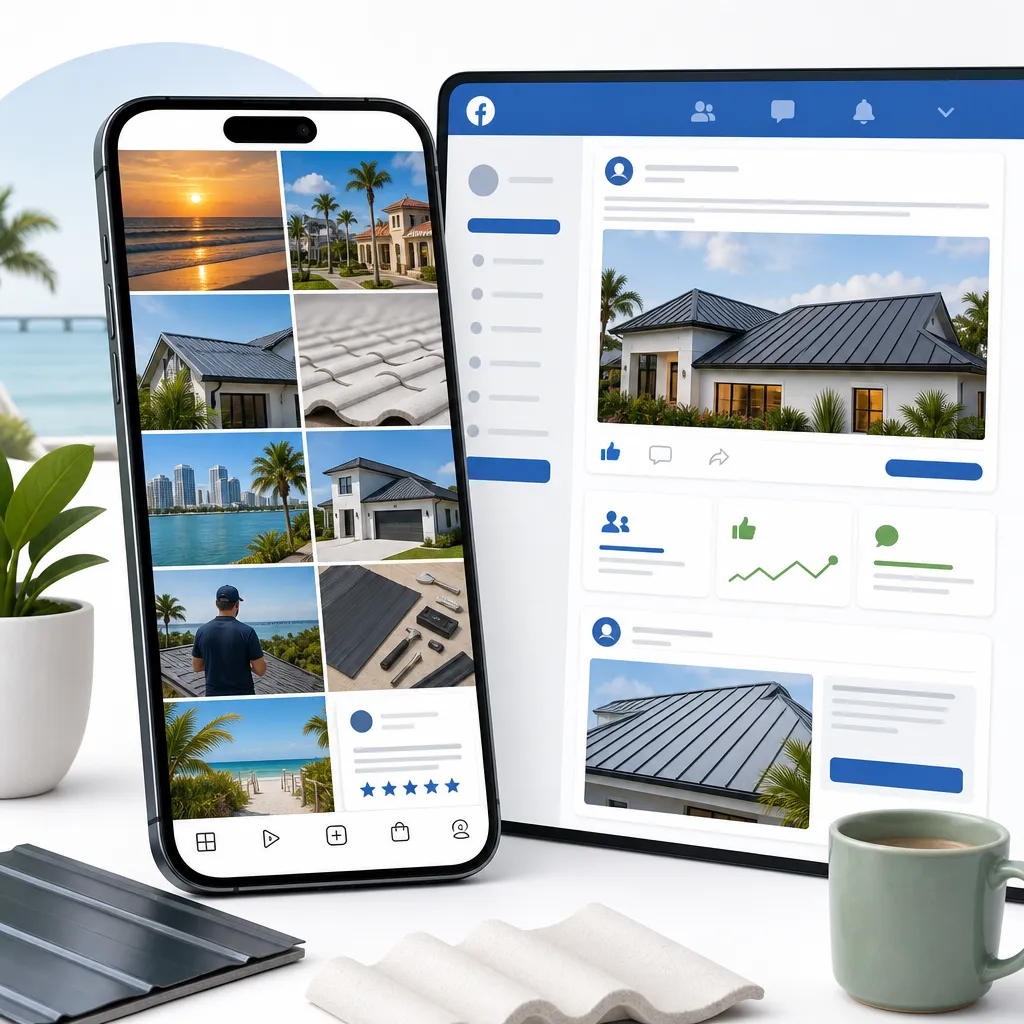
Seasonality should shape your content calendar directly. From November through April, lean into tourism, winter visitors, holiday events, and travel appeal. From May through October, shift toward local service-based messaging, family activities, back-to-school content, and summer entertainment. Businesses that run the same messaging year-round are, in effect, ignoring half their addressable audience for six months at a time.
- Seasonal content calendar: Nov–Apr emphasize tourism, winter visitors, holiday events, travel appeal; May–Oct shift to local service-based, family activities, back-to-school, summer entertainment.
- Spanish-language content: Sarasota's growing Hispanic population searches and engages in Spanish; bilingual social presence is a growth lever, not a nice-to-have.
- User-generated content (UGC): Customer reviews, testimonials, photos of your product/service; UGC outperforms brand-generated content by 2–3x in engagement and trust.
- Reels and video: Instagram and Facebook Reels get 3–5x higher reach than static posts; 15–60 second educational or entertaining clips drive conversions.
- Hashtag strategy: Mix branded (your business name), local (#SarasotaSmallBusiness, #BradentonLocal), and industry tags; research trending Sarasota hashtags monthly.
Think of this whole approach like fishing. A national agency hands you a generic net and casts it anywhere in the ocean, hoping something bites. A local Sarasota agency knows these specific waters—which bays hold tarpon, where the snapper school, the best tides and seasons—and adapts its technique to that ecosystem. Same net, same investment, dramatically different yield, because expertise matches the market instead of ignoring it.
That difference plays out concretely, not just theoretically. A Sarasota-based orthopedic clinic partnered with a local social media agency in August after realizing their Facebook and Instagram pages had zero engagement, outdated bios, and no paid strategy whatsoever. Over the following six months, the agency refreshed the branding, built a content calendar mixing patient testimonials, injury-prevention tips, and seasonal wellness content—post-summer sports injuries, holiday injury prevention—and launched targeted Facebook and Instagram ads in both English and Spanish on a $1,500 monthly budget, focused on zip codes with strong insurance coverage and patients aged 40–65. They also integrated patient reviews and clear call-to-action buttons across both profiles.
By January, the clinic saw 340 new patient inquiries compared to a baseline of roughly 40 per month. Cost per lead dropped from an estimated $25 through Google Ads alone to $12 through social, and ROAS reached 3.8:1. The clinic doubled down, increasing its social budget to $2,200 a month, and now attributes about 35% of its new patient growth directly to social media. That's not a fluke—it's what happens when local knowledge, seasonal timing, and disciplined spend line up.
6. Measuring ROI: Metrics That Matter (Vanity vs. Real)
Follower counts feel good to look at, but they don't pay invoices. Likes, reshares, and raw impressions are vanity metrics that, left unchecked, encourage spend on irrelevant audiences chasing engagement for its own sake. The metrics that actually matter are cost per lead (CPL), lead-to-customer conversion rate, customer lifetime value (CLV), and ROAS.
Getting accurate numbers requires some setup: UTM parameters on every campaign link, call tracking tools like CallRail or CallTrackingMetrics tagging phone leads, and CRM integration—HubSpot or Pipedrive, for example—connected directly to Meta Business Manager. Without this infrastructure, you're guessing at attribution rather than measuring it.
The calculation itself is straightforward: revenue from social campaigns divided by total social ad spend equals ROAS. If a campaign generates $4,000 in qualified leads or sales against $1,000 in ad spend, that's a 4:1 return. But not every lead converts equally—a B2B agency might see 15% conversion from LinkedIn leads compared to 3% from Facebook leads, which is exactly why platform-specific tracking matters more than aggregate numbers.
Attribution is genuinely messy, and any agency that pretends otherwise isn't being straight with you. Multi-touch attribution is complex, and most honest practitioners use a blend of last-click and first-click models combined with common sense about the customer journey. What matters is consistency: a monthly audit cadence that tracks spend against conversions, flags underperforming ad sets, scales what's working, and adjusts targeting based on actual conversion data—not assumptions.
- True ROAS calculation: (Revenue from social campaigns) ÷ (Total social ad spend) = ROAS. Example: $4,000 in qualified leads/sales ÷ $1,000 ad spend = 4:1 ROAS.
- Lead-to-customer conversion: Not all leads are equal; track which social platform converts best for your business. A B2B agency might see 15% conversion from LinkedIn leads vs. 3% from Facebook.
- Attribution challenges: Multi-touch attribution is complex; use a mix of last-click and first-click models. Honest agencies admit attribution is messy and use common sense.
- Quarterly business reviews (QBR): Professional agencies schedule monthly or quarterly deep-dives into performance, strategy adjustments, and roadmap—not just invoice delivery.
Sarasota and Manatee's population growth over the past several years means the addressable market for most local businesses is expanding, not shrinking. Pairing that growth with disciplined ROI measurement—rather than vanity-metric chasing—is what separates businesses that capture their fair share of new residents from those who let competitors absorb it. For a deeper look at how ROI measurement fits into a broader digital marketing partnership, this understanding ROI in local digital marketing partnerships resource is a useful next step.
What This Means for Your Business
- Local businesses in Sarasota and Manatee County that are not actively using social media are losing customers to competitors who do; 78% of consumers check social before buying, making this a non-negotiable investment.
- Choosing a generic national agency over a local Sarasota firm typically results in wasted budget, mismatched messaging, and poor ROI; local expertise and accountability drive measurable results.
- Seasonal shifts in tourism (Nov–Apr boom, May–Oct slowdown) and demographic diversity (retirees, families, tourists) require localized content strategies that national agencies don't deliver.
- Budget matters, but consistency and optimization matter more; $1,500/month sustained for 12 months beats $5,000 for 3 months followed by silence.
- Measuring real ROI (conversions, leads, revenue) is non-negotiable; vanity metrics (follower count, likes) mislead and encourage poor spending decisions.
- Businesses that integrate social media with other local marketing channels (Google Business Profile, local SEO, Google Ads, website optimization) see compounding results; siloed social efforts underperform.
Frequently Asked Questions
How much does social media marketing cost in Sarasota?
Most Sarasota small and mid-sized businesses spend between $1,500 and $3,500 per month for professional management covering three to four platforms, content creation, and paid ads. Starter packages run $500–$1,500, while full-service management with dedicated strategy and design can reach $3,500–$5,000 or more.
Which social media platform is best for my Sarasota business?
It depends on your audience and business model. Facebook works best for reaching the 35+ demographic and retirees, Instagram excels for hospitality and lifestyle-driven brands, LinkedIn dominates B2B lead generation, and Nextdoor is ideal for hyper-local service businesses like HVAC or landscaping.
Why should I hire a local Sarasota social media agency instead of a national one?
Local agencies understand seasonal tourism patterns, retiree and family demographics, and neighborhood-level targeting that national firms apply generic templates to instead. This translates into more relevant messaging, smarter seasonal budget allocation, and direct accountability you won't get from a rotating account manager.
What ROI can I realistically expect from social media advertising?
Average ROAS for Facebook and Instagram campaigns in this market runs around 4:1, meaning every dollar spent typically returns four dollars in revenue or qualified leads. Actual results vary by industry, targeting quality, and consistency of spend over time.
How do I know if a social media agency in Sarasota or Bradenton is trustworthy?
Look for agencies that share local case studies with real numbers, provide transparent reporting beyond follower counts, and discuss seasonal strategy and neighborhood targeting specifically. Be wary of guaranteed lead counts, generic stock content, and long-term contracts with no reasonable exit clause.
Keep Learning
- HVAC Marketing Sarasota: A Contractor's Guide to Leads — Deep dive into platform strategy and lead-gen tactics for service contractors in Sarasota; includes case studies on Facebook, Google Ads, and Nextdoor for HVAC businesses.
- Medical SEO Sarasota: Get More Patients Finding You Online — Comprehensive guide for medical practices in Sarasota on multi-channel marketing including social media, local SEO, and patient review management—with Spanish-language considerations.
- Top SEO Companies Near Me in Sarasota & Manatee County — Side-by-side comparison of local digital marketing providers in Sarasota and Manatee; includes vetting framework and questions to ask when evaluating agency partners.
- Local SEO Bradenton: Drive Foot Traffic & Calls Now — Actionable guide to local search optimization in Bradenton, including Google Business Profile best practices and neighborhood-level targeting strategies aligned with social efforts.
- Best Digital Marketing Near Me: Sarasota & Manatee Guide 2026 — Broad digital marketing landscape overview for Sarasota and Manatee; covers social media, PPC, SEO, and integrated strategy to maximize ROI across channels.
- Web Agency Near Me: How to Choose the Right Sarasota Partner for Your Business — Comprehensive vetting guide for evaluating web design and digital marketing agencies in Sarasota; includes discovery questions and portfolio review checklist.