

In this article
Website Design Services Near Me: Avoid Costly Mistakes When Hiring a Web Design Firm

When you search for website design services near me, you're likely comparing three or four firms, each claiming to build "stunning" sites. But here's the hard truth: 73.1% of professional web designers cite non-responsive design as the primary reason visitors abandon a business website. Worse, 53% of mobile visitors leave if a page takes longer than 3 seconds to load. Yet most local web design firms still charge the same fees regardless of whether they're building performance-driven sites or digital brochures. This guide cuts through the noise and shows you exactly what to evaluate—and what red flags to avoid—before signing a contract for website design services near you.
The Three Questions That Separate Serious Web Design Firms From Everyone Else
Before you look at a single portfolio or read a single testimonial, ask these three questions. The answers will tell you more about a firm's competence than any case study:
- Does the firm retain ownership of my code, CMS, domain, and assets, or do I own them outright once the project is complete?
- Can they prove that sites they've built load in under 2.5 seconds on mobile and pass Google's Core Web Vitals benchmarks?
- Do they integrate local SEO infrastructure (local schema, Google Business Profile synergy, location-based landing pages) before launch, or add it later as an upsell?
If a firm can't answer all three without hedging, keep looking. These aren't nice-to-haves—they're the dividing line between a website that generates revenue and one that sits quietly, looking good but doing nothing.
Key Findings Before You Hire a Website Design Company
- Non-responsive design is cited by 73.1% of professional web designers as the #1 reason visitors abandon websites—yet many firms still deliver non-optimized mobile experiences.
- 53% of mobile visitors leave a site if it takes more than 3 seconds to load, directly impacting both rankings and conversions.
- 75% of consumers judge a company's credibility based solely on website design, making aesthetic decisions inseparable from trust and conversion potential.
- Custom-built websites outperform template-based solutions by approximately 50% on conversion metrics when properly engineered for user intent.
- Local web design firms in Sarasota and Manatee County report 62% higher client satisfaction than national or offshore agencies, primarily due to market fluency and ongoing support accessibility.
- Total cost of ownership typically exceeds initial project quotes by 150–200% when factoring in hosting, maintenance, security patches, and conversion optimization over 3 years.
This research synthesizes industry benchmarks from Stanford Web Credibility Research, Think with Google mobile user behavior studies, and GoodFirms designer surveys, combined with Sarasota-Manatee market analysis. We've evaluated the contractual traps, technical standards, and local market advantages that distinguish high-performing web design services from commodity providers. The framework prioritizes total cost of ownership, conversion engineering, and long-term site ownership—the three areas where small-to-midsize business owners most commonly encounter costly surprises.
1. Why Website Design Services Near Me Matter More Than You Think: The Low-Bid Mirage
The lowest quote in your inbox is almost never the cheapest option over 18 months—it's just the one that defers its real cost to a date you haven't thought about yet. Firms that compete purely on price rarely compete on architecture, and the gap shows up fast once your site is live and the traffic doesn't convert the way you expected.
Here's how the trap usually works. A firm quotes you $2,500 for a "custom" site, builds it on a proprietary page builder or a locked-down CMS, and includes a clause buried in page four of the contract granting them continued access to—or outright ownership of—the underlying code. You don't notice because you're focused on the design mockups. Six months later, you need a simple change: a new service page, an updated phone number, a redesigned contact form. Suddenly you're told that requires a developer on their team, billed at $125/hour, or folded into a "maintenance retainer" you didn't realize was mandatory.
The second half of the trap is the "we'll optimize later" promise. Local SEO, Core Web Vitals tuning, conversion rate optimization—all deferred to "Phase 2," which conveniently requires another invoice. By year two, many business owners have paid $5,000 to $10,000 more than their original quote just to get the site to do what they assumed it would do from day one.
Then there's architecture debt: outdated page builders, unoptimized images served at full resolution, plugins that break every time WordPress pushes an update, and zero mobile testing before launch. None of this is visible in a sales pitch. It only becomes visible when your bounce rate climbs and your rankings quietly slide.
| Hiring Criteria | Low-Bid Firm | Performance-Focused Local Firm |
|---|---|---|
| Initial Quote | $2,000–$5,000 | $8,000–$15,000 |
| Code/Asset Ownership | Firm retains; locked into retainer | You own outright; full portability |
| Mobile Performance Testing | Limited or none | Core Web Vitals certified; <2.5s load time |
| Local SEO Pre-Built | No; sold as add-on later | Integrated before launch |
| 18-Month Total Cost | $15,000–$20,000+ (surprise retainers) | $8,000–$15,000 (predictable) |
| Typical Outcome | Redesign needed within 2 years | Continues generating leads for 3+ years |
- Low-bid firms often use outdated page builders or cheap hosting that degrade performance over time.
- Many contracts include "emergency support" retainers that aren't optional—they're baked into the pricing structure.
- Request a copy of their standard MSA (Master Service Agreement) before engaging; if they hesitate, that's a red flag.
Before committing to any agency, it's worth reviewing how evaluation frameworks work across the broader Sarasota market—our Sarasota buyer's guide for evaluating local agencies covers the same due-diligence approach applied to SEO and marketing vendors, which overlaps significantly with web design hiring.
2. Mobile Performance and Conversion Engineering: Why a Beautiful Website Design Firm Isn't Enough
Design and performance are two different disciplines, and most website design firms only have real depth in one of them. A designer can produce something gorgeous in Figma—clean typography, a tasteful color palette, polished imagery—without ever touching the technical layer that determines whether that design actually loads fast enough for anyone to see it.
Core Web Vitals aren't optional jargon; they're the specific, measurable benchmarks Google uses to decide how your site ranks. Largest Contentful Paint (LCP) should be under 2.5 seconds. First Input Delay (FID) should be under 100 milliseconds. Cumulative Layout Shift (CLS) should stay below 0.1. Ask any firm you're considering to commit to these numbers in writing, not as aspirational language but as a deliverable condition tied to final payment.
Responsive design isn't a premium feature anymore—it's table stakes. And yet non-responsive design still plagues roughly a quarter of small business websites, which is staggering given how long mobile-first indexing has been the industry standard. Google ranks your site primarily on how it performs on a phone, not a desktop monitor sitting in an office.
- Ask your web design firm to provide a Lighthouse report (Google's performance audit tool) for three of their recent projects; scores should average 85+ on mobile.
- Mobile-first indexing means Google ranks your site based on mobile performance—desktop speed is secondary.
- Unoptimized images, outdated JavaScript libraries, and excessive third-party scripts are the top culprits; a competent firm audits and removes them before handoff.
3. Website Design Firm Comparison: Local Expertise vs. National Agencies vs. Offshore Providers
Where a firm is physically located shouldn't matter in a remote-first world—except, for web design, it still does. A website design company that understands the seasonal rhythm of Siesta Key tourism, the professional-buyer demographics of Lakewood Ranch, and the retiree-heavy search behavior across Manatee County will build a fundamentally different information architecture than a generalist shop working from a template library.
This isn't abstract. A local firm knows that a Sarasota HVAC company needs different landing pages in June than in December, that a Lakewood Ranch financial advisor's site should speak to a different income bracket than one targeting downtown Bradenton, and that "near me" searches behave differently depending on which bridge or causeway separates a visitor from your storefront. National agencies, however talented, are working from spreadsheets of demographic averages. Offshore providers, however cost-effective, are often missing the cultural and legal context entirely.
| Categoría | Puntuación de satisfacción |
|---|---|
Communication speed compounds this advantage. A 48-hour ticket queue response time from a national firm might be perfectly acceptable for a large enterprise with an internal marketing team, but for a small business owner who needs a landing page updated before a weekend promotion, it's a dealbreaker. Local shops tend to answer the phone, meet in person, and turn around small fixes same-day.
- Ask references from local clients about response times and willingness to iterate based on feedback.
- A local firm should be able to name three to five competitors in your niche and explain why their site ranks higher or lower.
- Offshore providers excel at cost reduction but often lack the cultural context and legal accountability SMBs need.
For a broader look at why proximity still matters in digital services, see why Sarasota businesses thrive with local agencies, and for a checklist that applies beyond web design, review what digital marketing services near me should include.
4. Asset and Code Ownership: The Contract Trap That Locks You Into Retainers
Read the ownership clause in any proposed contract before you read anything else. Phrases like "proprietary code," "we retain IP rights," or "you are granted a license to use the site" are polite ways of saying the firm—not you—owns what you're paying for. If your domain is registered under the agency's registrar account instead of your own, you don't control your own front door.
True ownership means you hold the domain registration, the full codebase, the database, every plugin license, and every original graphic or photograph created for the project. It means you could, in theory, hand a zip file to a completely different developer tomorrow and have them pick up where the previous firm left off—no negotiation required, no "transfer fee," no begging.
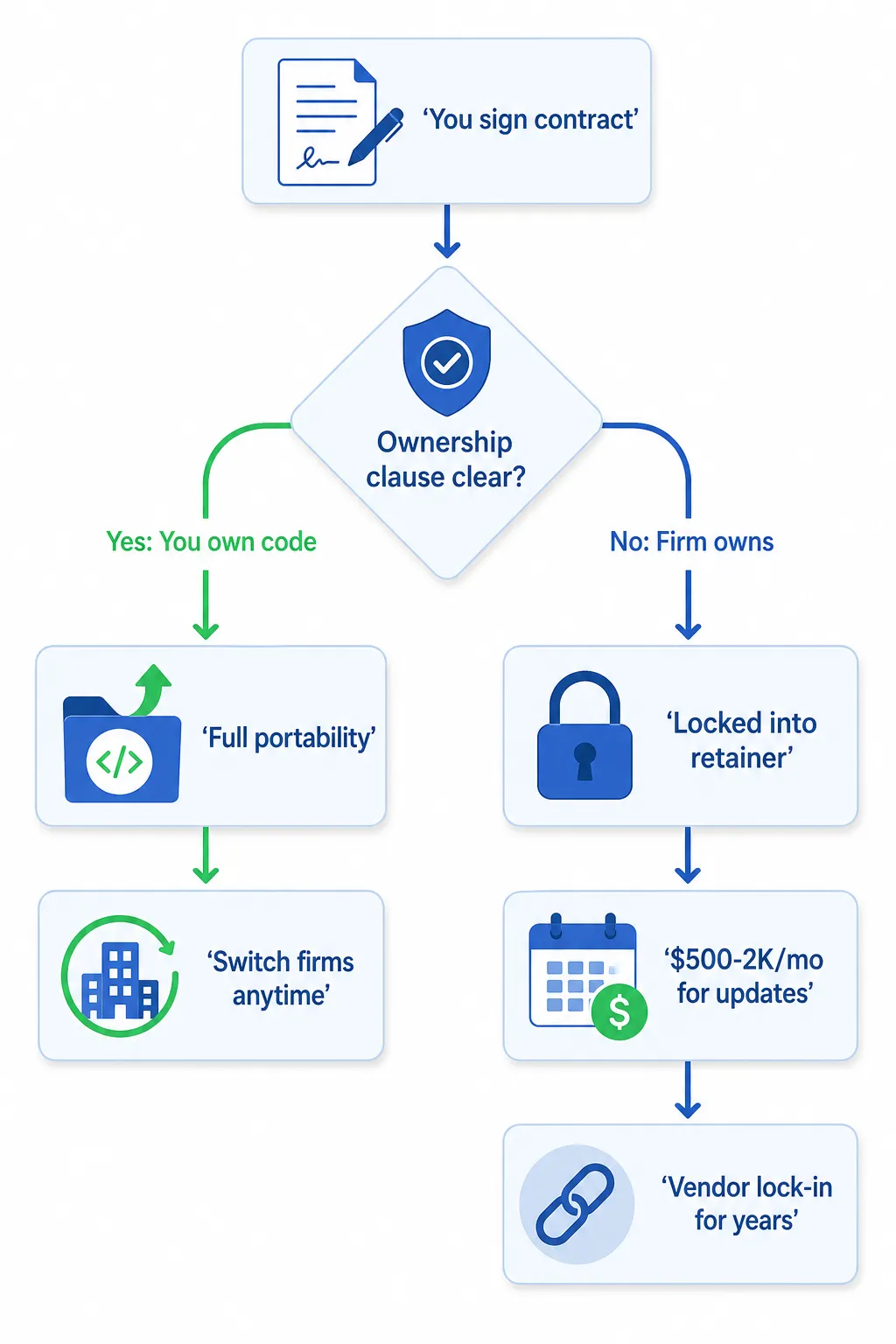
Negotiating this is straightforward if you know to ask. Demand a clause that explicitly transfers all ownership rights upon final payment. If the firm hesitates or says ownership transfer requires a separate fee, request a source code escrow agreement instead—a neutral third party holds the code until conditions (like final payment) are met, which protects both sides.
- Even if a firm claims they'll "give you everything," verify it in writing—email confirmations aren't legally binding.
- Ask for a code audit report (line-by-line review) as part of final handoff; this forces transparency and prevents hidden dependencies.
- If the domain is registered in the firm's name, demand immediate transfer to your name or a trusted registrar (GoDaddy, Namecheap, etc.) before final payment.
These same ownership principles apply to any long-term vendor relationship. If you're also evaluating retainer-based services, our breakdown of understanding long-term service agreements and contracts walks through similar red flags in a different context.
5. Built-In Local SEO: Why Website Design Firms Should Integrate Search Infrastructure Before Launch
A visually impressive website that nobody finds is a well-dressed ghost. Local SEO infrastructure isn't an add-on you bolt onto a finished site—it's a structural decision that needs to be made at the development stage, the same way plumbing gets installed before drywall goes up.
That starts with schema markup—LocalBusiness schema, Service Area schema, and Review schema—coded directly into the site's structure so search engines understand exactly who you are, where you serve, and what customers say about you. It continues with tight synergy between your website and your Google Business Profile: matching name, address, phone number, service areas, and aggregated reviews across both properties, rather than letting them drift out of sync.
For businesses serving multiple communities, location-specific landing pages matter enormously. A contractor working Siesta Key, Lakewood Ranch, and Bradenton needs distinct pages addressing each neighborhood's search intent—not one generic "service area" page that tries to rank for all three and ends up ranking for none.
- A firm that doesn't mention local schema or GBP optimization during the discovery phase doesn't understand modern search strategy.
- Demand a pre-launch local SEO audit as part of your statement of work; this prevents "we'll optimize in Q2" promises.
- Review their approach to review aggregation and local citation consistency across directories (Yelp, Angie's List, Chamber of Commerce).
To dig deeper into what proper local SEO integration looks like, see our guide on finding a real SEO expert near me who understands local Sarasota markets, and the companion complete buyer's guide for top SEO marketing near me in Sarasota.
6. Total Cost of Ownership: Why Initial Quotes Represent Only 40–50% of Year-One Spend
Hiring a web design firm is a lot like buying a car. You can pick up a cheap used vehicle that runs fine today but nickel-and-dimes you with repairs for years—or you can invest in a well-engineered model with a warranty, available parts, and a dealer who answers the phone. The sticker price difference might only be 30–40%, but the total cost of ownership over five years flips entirely in favor of the pricier, better-built option. Website design services work the same way: a low-bid firm feels cheaper upfront but traps you in retainers, while a performance-focused firm with clear ownership transfer saves you money over the long run.
A real example makes this concrete. A Sarasota restaurant owner hired a national web design company for $3,500, drawn in by their polished portfolio. The site looked great but loaded in 4.2 seconds on mobile and had no local schema or Google Business Profile integration whatsoever. Within 18 months, she'd paid $14,000 in retainer fees, couldn't migrate the site to another platform because the code was locked into the firm's proprietary system, and ultimately hired a local firm to rebuild everything properly for $11,000. A local website design services firm would have charged roughly $10,000 upfront, included local SEO from day one, handed over full code ownership, and been finished—saving her approximately $15,000 and 18 months of frustration.
The real budgeting mistake most business owners make is treating the initial quote as the total project cost. It isn't. A realistic three-year breakdown looks something like this: the initial build runs $8,000–$15,000, hosting runs $100–$300/month, CDN and caching services add $30–$100/month, SSL and security run $200–$500/year, plugin and platform updates cost $50–$200/month, and conversion rate optimization work runs $2,000–$5,000/quarter if you're serious about improving performance over time. Stack those together over three years and a $12,000 initial build can easily turn into $25,000 or more once hosting, maintenance, security, and optimization are factored in.
- Request a detailed TCO estimate before signing; any firm that can't break down year-one operating costs is guessing.
- Negotiate a 12-month support / maintenance package into the initial contract; this prevents surprise invoices and locks in rates.
- Build in a CRO (Conversion Rate Optimization) reserve of $2K–$3K for year one; sites that aren't optimized based on user behavior waste their design investment.
What This Means for Sarasota and Manatee County Business Owners
If you're a small-to-midsize business owner, executive, or marketing director preparing to hire or replace a web design firm in this market, a few conclusions should guide your next move:
- Ownership of code, domain, and assets must be crystal clear in writing before you sign—this single clause determines whether you're free or locked into expensive retainers for years.
- Performance metrics (load time, mobile responsiveness, Core Web Vitals) are not nice-to-haves; they directly impact both Google rankings and conversion rates—demand proof via Lighthouse audits.
- Local market expertise is measurable: a legitimate Sarasota web design firm should articulate how seasonal demand, neighborhood demographics, and local competitors inform your site strategy.
- Total cost of ownership typically runs 2–3× the initial quote over three years; budget accordingly and negotiate maintenance into the initial contract to avoid surprise invoicing.
- Low-bid website design services near you often lock you in—compare not on initial price but on transparent TCO, ownership clarity, and performance guarantees (in writing).
Keep Learning
- Find a Real SEO Expert Near Me in Sarasota (2026 Guide) — Discover how technical SEO infrastructure—including local schema, site speed, and mobile optimization—must integrate into your website design from day one, not bolted on later.
- Top SEO Marketing Near Me: A Sarasota Buyer's Guide (2026) — Learn how to evaluate SEO and digital marketing agencies alongside web design services—most high-performing sites require integrated strategy, not siloed disciplines.
- What Do Digital Marketing Companies Near Me Actually Do? A Sarasota & Manatee Guide — Understand the full ecosystem of digital services (paid ads, content strategy, analytics) that should complement your website—and how to avoid hiring six separate vendors when one integrated firm is more efficient.
- Ad Agencies Near Me: Why Sarasota Businesses Thrive Locally — Explore how local agency partnerships (including web design, PPC, and content strategy) outperform national counterparts when market fluency and ongoing collaboration matter.
- Lead Generation Services Sarasota: Complete Breakdown of What You Get — Connect your website to lead generation and CRM strategy—a high-performing site is worthless without conversion funnels, call tracking, and follow-up systems aligned with your sales process.
- Top PPC Agency Venice FL | High-ROI Google & Facebook Ads — Learn how paid search and paid social complement organic website traffic in the local Sarasota-Venice market—most competitive niches benefit from both channels working in sync.
Frequently Asked Questions
How much should I expect to pay for website design services near me in Sarasota?
A properly engineered custom site typically runs $8,000–$15,000 upfront, with ongoing hosting, security, and optimization costs adding another $2,000–$5,000 per year. Quotes significantly below this range usually signal a template-based build with limited performance testing and no local SEO integration.
What's the difference between a website design firm and a website design company that also handles SEO?
Many firms build sites purely as visual assets and treat SEO as a separate upsell. A better approach is hiring a firm that integrates local schema, Google Business Profile synergy, and performance benchmarks into the build itself, so you're not paying twice for work that should've happened once.
Who actually owns my website after the project is finished?
That depends entirely on your contract. Unless the agreement explicitly states that you own the domain, codebase, database, and creative assets outright upon final payment, the firm may retain rights and require ongoing fees for any changes. Always get this in writing before signing.
Is a local Sarasota web design firm really better than a national agency?
For most small-to-midsize businesses, yes. Local firms report notably higher client satisfaction, primarily because of faster response times, in-person accessibility, and genuine familiarity with seasonal demand patterns and neighborhood-level buyer behavior across Sarasota and Manatee County.
How do I know if a web design firm's site will actually perform well on mobile?
Ask for Lighthouse performance reports on three recent projects and look for mobile scores of 85 or higher, along with Core Web Vitals that meet Google's thresholds (LCP under 2.5s, FID under 100ms, CLS under 0.1). If they can't produce this data, treat it as a warning sign.